There will be a Pearl Harbor observance at the Virginia War Memorial on Belvidere Street at 11 am, tomorrow (Monday). Pearl Harbor survivors will be on hand to help remember those who died in the Japanese attack on December 7, 1941.
Yearly Archives: 2009
Thefts In The Neighborhood
There have been a few reports of petty thefts from yards and porches in the neighborhood.
One neighbor reported that someone cut a electric cord to steal a reindeer Christmas decoration from front yard, while another has had a rocking chair stolen right off front porch.
Jack Rose R.I.P.
I have some sad news.
Jack Rose, a musician who spent a lot of time in Oregon Hill, has died
of an apparent heart attack at his home in Philadelphia.
Jack hung out a lot at 238 S. Cherry back when it was the base for
Radioactive Records and Pelt.
China Street Meets Broad Street Art Walk
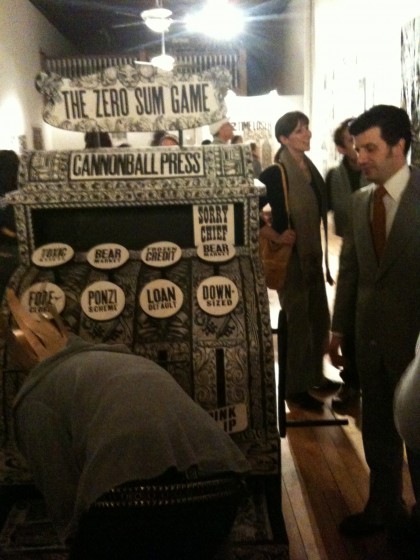
I spent part of yesterday evening enjoying the First Friday Art Walk on Broad Street. I got the chance to briefly speak with its main organizer Christina Newton, who was dutifully working the Curated Culture/First Fridays booth and table right there on Broad. I won ‘nada’ from the “zero sum game”/bailout register at the Metro Space Gallery (CannonballPress.com exhibit).

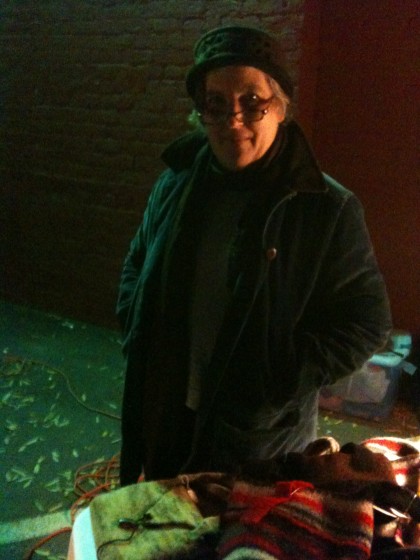
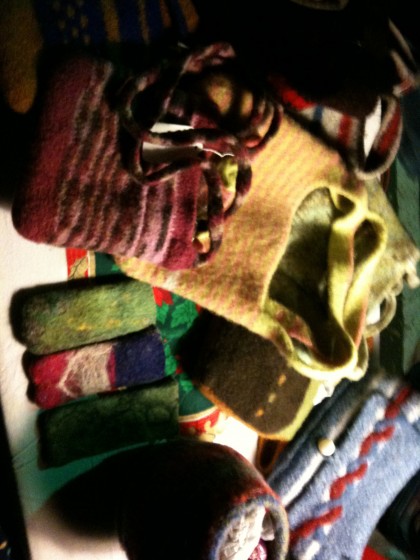
I saw many Oregon Hill neighbors- including just of a few of the neighborhood artists. Mary from China Street was there with some her hats and scarfs. She says she has also had good luck selling her wares at the South of the James Farmer’s Market.


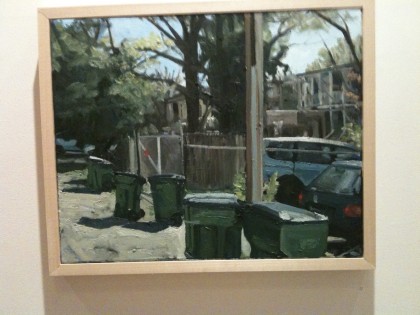
The Schindler Satellite Gallery has a strong Oregon Hill representation. David Rohrer has his oil painting, “Alley 2, Oregon Hill” there:
While Julie Elkins exhibits her porcelain wall sculpture, “Oregon Hill Blue”.

Other artists at the Schindler Satellite include Jennifer Holloway Bopst, Lisa Taranto, R. Sawan White, and Chris Milk. My neighbor British Bob, a big First Fridays fan, told me that Chris Milk used to be one of Skillet’s roommates on China Street.
Free holiday performance set for Dec. 6 at Landmark
From City press release:
For Immediate Release
Dec. 4, 2009Media Contacts:
Tesha Davis – (804) 646-3998
Christy Everson – (804) 646-5944Free holiday performance set for Dec. 6 at Landmark
The Richmond Department of Parks, Recreation and Community Facilities will present its annual holiday gift to the city, its production of “Amahl and the Night Visitors,” at 4 p.m. on Sunday, Dec. 6, at the Landmark Theater.
The musical tells the story of the mischievous shepherd boy Amahl and his mother, whose lives are changed forever after meeting three kings. It’s a heartwarming and humorous story that will charm and delight the entire family.
This is the department’s 48th year of offering this free holiday musical, which with its all-volunteer cast, has become a Richmond tradition.
The performance is free and no reservations are required.
###
Posters on Predatory Lending On Display December 4th
From announcement:
Graphic design students at Virginia Commonwealth University (VCU) have
created posters on predatory lending as part of their senior seminar
class. The posters were designed in order to stimulate a discussion on
payday, car title and other types of predatory loans. Jay Speer,
Executive Director of the Virginia Poverty Law Center (VPLC), and Dana
Wiggins, Coordinator for the Virginia Partnership to Encourage
Responsible Lending (VaPERL), provided the students with information and
the many issues that arise from these types of loans. Laura Chessin, an
Associate Professor at VCU’s Graphic Design Department, teaches the
senior seminar class and oversaw the project.The public is invited to come see these posters on Friday, December 4th
from 6-8 p.m. at Main Street Gallery on 1509 W. Main St. in Richmond.
The free viewing is an opportunity for people to not only see the work
done by these students, but to also engage in a dialogue on predatory
lending in Virginia.Please contact Urmila Oberoi at 804-782-9430 x15 or urmila@vplc.org to
find out more about the poster viewing on December 4th.
OHHIC Meeting Tomorrow Night
The Oregon Hill Home Improvement Council will be holding its monthly board meeting tomorrow, Tuesday, December 1st, at the Jacob House at 619 W. Cary St. at 7 PM. All are welcome.
This is a great time to remind that OHHIC has affordable houses for sale in Oregon Hill.
Local developer Gammino interviewed
From RichmondBizSense.com:
Gammino practiced law for more than a decade but left the legal profession to start his contracting business, which he grew a knack for after buying and fixing up homes in Oregon Hill. A native of Providence, R.I., Gammino has lived here since 1989, when he moved here to attend law school at the University of Richmond.
BizSense caught up with Gammino on the site of his first project as a developer and asked him what it’s like getting started as a developer and also about his next project he is planning in Jackson Ward.
Richmond BizSense: Tell us about your first project as a developer.
David Gammino: I’m working on the IVNA (Instructive Visiting Nurses Association) buildings at 223 S. Cherry St, which was most recently a law office for attorney David Baugh. It is 16,000 square feet over two buildings. The architect is Johannes Design Group, and my company, City & Guilds, is the contractor and developer.
RBS: What about the financing?
DG: The acquisition and construction is a total of about $2.8 million. First Market Bank is financing the project. The tax credit proceeds are secured by the bank at the front end of the deal and held by the bank until it is rented and stabilized and you meet a certain debt service ratio. The proceeds from the state and federal tax credits on this project are approximately $600,000.
RBS: Why did you decide to start doing your own development projects?
DG: I wanted to diversify the company and client base. Doing so in this environment is very difficult. There is a dearth of new development and what new business that is out there is being very aggressively bid by a multitude of players.
Growing the company within the traditional general contractor model is very difficult to do under the circumstances, so I realized one way I could continue to grow is by doing my own development. By virtue of having the existing business, I have the infrastructure in place to do so.
Editorial: Filling in the Gaps in Historic Urban Neighborhoods
Bryan Green, a Pine Street resident, wrote an editorial that recently appeared in the Times Dispatch newspaper:
One thing advocates of “smart growth” and supporters of historic preservation agree on is the importance of concentrating development where existing infrastructure is already dense — and where houses, businesses, schools, hospitals, and public transportation are already located.
Each time a new housing development is located in an outer-ring suburb or on outlying rural land, local government is burdened with the responsibility to construct and maintain new roads, utilities, and public services. For example, only 25 percent of these “exurbs” connect with existing public transportation systems — the remainder clog roads with more automobiles (and the air with more toxic exhaust). In stark contrast, 60 percent of existing urban neighborhoods are already served by public transportation and have schools, hospitals, and other community services already in place.
Concentrating new construction and rehabilitation in our existing downtowns is the most environmentally and economically sustainable development possible. Much urban building stock is historic, and one of the greatest economic engines driving the rehabilitation of these areas is historic preservation.
Building and rehabilitating in historic contexts requires sensitivity, however, and can be expensive. Recognizing this, the federal government first established a rehabilitation tax credit in 1976, acknowledging that rehabilitation, while beneficial for urban areas, was an added cost to owners.
A 20 percent tax credit was established to provide incentives for careful rehabilitation of income-producing (commercial) historic buildings, incentives that prove ever more attractive to property owners and developers.
For example, in fiscal year 2008 (the most recent year for which figures are available), the National Park Service approved 1,231 projects representing a staggering private investment of $5.64 billion — all of which cost the Federal treasury less than $1.128 billion in tax credits. This powerful financial engine has been so successful that 30 states have added complementary rehabilitation tax credit programs, and 25 have extended their programs to non-income-producing properties (i.e., private homes).
The tax credit program leverages private money to rehabilitate historic buildings, returning them — and the surrounding area — to productive use. Because state and local tax incentives can often be attached to the federal credit, the program leads to greater public awareness of the benefits of historic preservation, which, in turn, provides incentives for private investment in historic neighborhoods.
The federal Rehabilitation Tax Credit program, on average, draws five private dollars for every public dollar invested for historic preservation and adaptive reuse — an especially compelling ratio in today’s economic climate.
Rehabilitation of historic buildings alone, however, is not enough to rehabilitate entire neighborhoods. What about the “missing teeth” in our urban fabric? How do we fill those gaps?
Nationwide, there are some 14,000 historic districts, many of which are plagued by two separate problems: demolished buildings and vacant lots, and inappropriate infill.
According to the Urban Land Institute, by the year 2050 the U.S. urban population will grow by 100 million people, all requiring housing, schools, and places for business — needs that cannot always be met by the existing historic building stock. In these cases, infill construction may be necessary.Examples of poorly planned and poorly designed urban infill can be found in every city. Astute in crafting public policy to promote the re-use of historic resources, we are lousy at guiding what is built next door, and the urban fabric as a whole suffers badly.
To further stimulate our economy, state and local governments should consider expanding the existing historic preservation tax credit programs to include new, compatible infill development within existing state historic district boundaries. This could be accomplished through complementary state legislation in the form of a Historic District Infill Tax Credit (HDITC) that would further focus development within successful historic districts and encourage the completion of empty blocks.

Oregon Hill t-shirts make great stocking stuffers
I have not had time to plug it or refine it as much as I would like, but there is an ‘online store’ at Zazzle.com for buying Oregon Hill-branded clothing and items. Proceeds go to the Oregon Hill Neighborhood Association.
You can get some great deals from the store today with promo code, ‘ZAZZLEFRIDAY’.