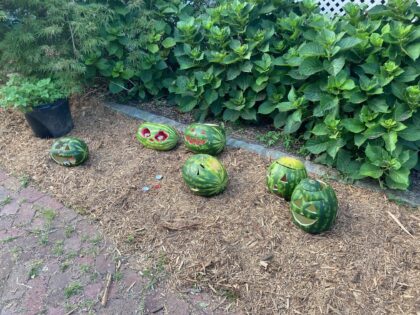
The Carytown Watermelon Festival takes place on August 10th.

The Carytown Watermelon Festival takes place on August 10th.
Rev. Florence McCarthy pastored Pine Street Baptist Church during the period of reconstruction in Richmond, VA, after the Civil War. He was controversial in his views on the equality of African Americans. The following is a brief biography that Rev. Turner shared:
Rev. Florance (Florence) McCarthy – A Ministry of
Controversy and Community Engagement
Early Life and Ministry Beginnings
1
Florance McCarthy (often spelled Florence McCarthy) was born in Richmond, Virginia on April 29, 1838 .
He was the son of Irish immigrant parents – his father, also named Florence, had settled in Richmond as a
merchant 2
. Raised in a Baptist family, the young McCarthy pursued both education and ministry from an
3
early age. In the late 1850s he moved to Tennessee to teach at Franklin Female College in Franklin, TN .
While in Franklin, McCarthy was ordained as a Baptist minister (in Franklin, on an unspecified date) and
even briefly pastored a local church there 1
. By the turn of the Civil War, he had returned to Virginia: just
1
before the war, McCarthy served as a pastor in Lexington, Virginia .
When the American Civil War erupted, McCarthy joined the Confederate Army as a chaplain. He was
attached to the Army of Northern Virginia, reportedly with the Thomas Artillery (sometimes called the
“Alleghany” Artillery) 3 1
. Letters he wrote during 1862–1865 describe his experiences in camp life
during the war 3
. While serving the Confederacy, McCarthy initially held strong secessionist views. In fact,
as one Virginia newspaper later recounted, “a few weeks [before]” the war’s end he “boldly proclaimed
4
the most extreme Southern doctrines and boasted of his services at the first battle of Manassas” .
This background made what followed even more striking.
Pastor of Pine Street Baptist Church (Richmond) in Reconstruction
At the close of the Civil War in 1865, Richmond lay in ruins and its churches were struggling to rebuild. Pine
Street Baptist Church – a congregation founded in 1855 in the working-class Oregon Hill neighborhood of
Richmond – was one such church 5
. Pine Street had been established as a mission church years earlier,
and its members endured the war’s hardships. In the summer of 1865, Rev. Florance McCarthy became the
pastor of Pine Street Baptist Church, marking the start of a tumultuous yet significant tenure. He was
appointed to this post under the auspices of the American Baptist Home Mission Society of New York (the
Northern Baptist mission board) 6
. Northern Baptists were beginning to send aid and personnel into the
post-war South, and McCarthy – despite his Confederate past – had reinvented himself as a “loyal” Unionist
minister willing to work with them. A Southern newspaper later noted with scorn that McCarthy’s “reward”
for currying favor with Northern Baptists was an appointment “at fifty dollars per month, as pastor of a
6
church on Oregon Hill”, i.e. Pine Street Baptist .
Church Life and Activities Under His Leadership
Under Rev. McCarthy’s leadership, Pine Street Baptist resumed regular worship and community ministries
amid the Reconstruction era. The church finally completed a permanent building on Pine Street (the
congregation had moved around Oregon Hill during the war) and remained at that site from 1882 onward
7
. In these early post-war years, Pine Street’s membership included many working-class Richmonders,
and possibly some African Americans who had been affiliated with the church before emancipation.
1
McCarthy’s pastorate focused on spiritual revival and also on outreach to the broader community. For
example, he cooperated with the Richmond Baptist City Mission in efforts like food relief and education
for the poor, a necessity in hungry post-war Richmond (though detailed records of specific programs at
Pine Street are scarce). We do know Pine Street hosted citywide Baptist gatherings; one such meeting in
April 1885 saw Pine Street welcoming a Baptist Sunday School Association conference 8
, indicating the
church’s active role in local Baptist life even years later.
However, McCarthy’s most notable activities were not confined to his pulpit. He became an outspoken
advocate on social issues, especially concerning the rights and welfare of African Americans in Richmond.
This was highly unusual – even shocking – for a white Southern Baptist pastor in 1865–1867. Richmond’s
black population, newly emancipated, was organizing their own churches and conventions, and McCarthy
chose to actively engage with them.
Advocacy for African American Equality and Community Involvement
Rev. McCarthy’s tenure at Pine Street coincided with the formative days of black Baptist autonomy in
Virginia. In August 1866, the Colored Baptist Convention met in Richmond (at Ebenezer Church) – one of
the first gatherings of African American Baptists in the state after emancipation. McCarthy attended as a
visitor and was invited to speak. What he said stunned the audience: he delivered an impassioned speech
in favor of racial equality and black suffrage 9 10
. He declared that a man’s color should make “no
difference in his social standing,” that he considered African Americans his “social and political equal,”
and he urged that black men must be allowed to vote 9
. McCarthy even proclaimed that as soon as
black suffrage was secured, he intended to run for public office in Virginia – effectively aligning himself
11
with the Radical Reconstruction cause .
This speech was, in effect, a bold call for racial justice. It made McCarthy an instant ally of the African
American community’s fight for equal rights. Many black delegates at the convention were reportedly
pleased by his words (though they reacted with quiet surprise rather than loud applause) 12
. In private,
after the session, a number of African Americans warmly thanked Dr. J. B. Jeter – a prominent white
minister who responded to McCarthy – indicating they respected moderate allies but were unsure how to
13
publicly support McCarthy’s radical stance .
Beyond this convention address, Rev. McCarthy demonstrated community involvement in other ways. He
maintained correspondence with Northern newspapers and Baptist organizations, keeping them informed
of conditions for freedpeople in Richmond. In fact, he developed a reputation (in the eyes of
unreconstructed Southerners) as a whistleblower on Southern racial issues. He wrote letters to the
Northern press under the self-described title “the only loyal minister south of the Potomac,” reporting
14
on the attitudes of ex-Confederates and advocating Northern intervention on behalf of freedmen .
Southern observers derisively called these “slanderous letters”, but they show McCarthy’s commitment to
14
speaking out for justice even at personal cost .
Within Pine Street Baptist Church, McCarthy likely pushed for the congregation to be welcoming toward
African Americans. It is documented that in 1867 the Pine Street membership split amidst internal
disagreement – by all indications, the split was over the church’s direction in the Reconstruction era and
McCarthy’s progressive views. One contemporary source confirms that some members strongly opposed
McCarthy’s stance toward black equality and the involvement of Northern Baptist societies, resulting
in a faction leaving in 1867 4
. Essentially, Rev. McCarthy’s advocacy created a rift: a portion of Pine Street’s
2
white members could not accept their pastor’s alignment with African Americans’ cause, while others
supported him (or at least the stability provided by Northern funding). This schism in 1867 profoundly
affected Pine Street – it tested whether a Southern church could embrace an activist, interracial ministry
during Reconstruction.
Conflict with Southern Baptist Leaders
Not surprisingly, Rev. McCarthy’s bold actions drew fierce criticism from the white Southern Baptist
establishment. His 1866 speech and writings were condemned in the Richmond press and by fellow
ministers. Dr. J. B. Jeter, a senior Virginia Baptist leader, stood up immediately after McCarthy’s convention
remarks to rebuke him for bringing politics into a religious meeting 15
. Jeter, while professing friendship
to the “colored race,” made clear that he found McCarthy’s radical politics “pernicious” in a church setting
15
. Other white Baptist clergymen, like Rev. A. E. Dickinson, likewise distanced themselves, stressing that
16
the Baptist focus should be on the religious education of freedpeople, not political agitation .
By June 1866, the Baptist General Association of Virginia (the statewide Southern Baptist body) took
action against McCarthy. At their annual meeting, they removed him from any positions on Baptist
boards and effectively ostracized him from leadership circles 17
. A Richmond paper noted that “he has
not for some time past been held in much regard by the Baptists of Virginia” and that if his equality
speech had come earlier, “he would doubtless have been denied membership in [the General
Association]” altogether 17
. In short, McCarthy was cast out by his peers – seen as a traitor to Southern
Baptist tradition. Some even questioned his sanity, calling him “crazy” for flip-flopping from a Confederate
4
chaplain to a Radical Republican preacher .
Within Pine Street Church, this external censure amplified tensions. The membership rift of 1867 led to
McCarthy’s departure from the pastorate that year. Pine Street Baptist, after losing its controversial pastor,
returned to a more traditional path. (By the 1870s the church was firmly back under native Virginia
leadership and later known for pastors like Rev. Joshua B. Hutson, who served by 1914 18
.) But for a brief
period under Rev. Florance McCarthy, Pine Street had stood at the forefront of social change –
experiencing, from within, the convulsions of Reconstruction.
Aftermath and Legacy
After leaving Pine Street in 1867, McCarthy’s life took new turns. He pursued further theological education,
enrolling at Richmond College (now the University of Richmond) through 1867 and then attending
Rochester Theological Seminary in New York, where he graduated in 1869 19
. In effect, he transitioned
fully into the Northern Baptist orbit. McCarthy went on to pastor in Middletown, New York (1869–1871)
and later in Chicago, Illinois (1871–1874) 20
. His outspoken nature, however, continued to court
controversy. In Chicago, a council of Baptist churches even withdrew his ministerial fellowship in 1874 –
an event suggesting further disputes or unorthodox views 21
. (He was eventually reinstated via a local
church re-ordination, but by the mid-1870s he shifted away from full-time ministry 22
.) Settling in Chicago,
22
McCarthy lived out his later years in business pursuits and faded from the public religious spotlight .
Despite this rather quiet ending, Rev. Florance McCarthy’s legacy in Richmond is significant. During his
brief pastorate at Pine Street Baptist Church (c.1865–1867), he emerged as a rare white Southern clergyman
who actively championed African Americans’ rights in the immediate post-Civil War period. He leveraged his
position to build bridges – speaking at black Baptist conventions, collaborating with Northern mission
3
agencies, and advocating for racial equality from the pulpit. Historian accounts note that his “platform”
was one he was “prepared to live and die by,” regardless of the personal consequences 11
. In the
historical context of Pine Street Baptist Church, this period stands out as a time when the church
became a flashpoint of Reconstruction-era change. The congregation’s struggles mirrored the South’s
struggles: old guard vs. new ideas, prejudice vs. progress.
McCarthy’s work with African American communities – though cut short – planted seeds. He helped affirm
for black Baptists that some white ministers would support their equality. And he confronted white Baptists
with the moral challenge of Reconstruction. While many of his contemporaries shunned him, later
generations can recognize Rev. Florance McCarthy as a man ahead of his time. His biography is a vivid
illustration of ministry intertwined with social justice: in Reconstruction Richmond, McCarthy used his
ministry to fight for “the least of these,” leaving an indelible if controversial mark on Pine Street Baptist
23 10
Church and the community it served .
Sources
• 5
Pine Street Baptist Church (Richmond, VA) – Church History webpage
• 3
Virginia Museum of History & Culture – McCarthy Family Papers, summary
•
Richmond Dispatch (via Savannah Daily News reprint, Aug. 27, 1866) – Report on Rev. McCarthy’s
speech and Baptist Convention incident
9 10
•
Valley Virginian (Staunton, Aug. 29, 1866) – Editorial on McCarthy (“only loyal preacher” and Southern
reaction)
4
•
Rochester Theological Seminary General Catalogue 1850–1910 – Entry for Florence McCarthy (birth,
education, pastorates)
24 25
• 2
Gale Baptist History & Heritage (2020) – Background on McCarthy family in Richmond
(contextual)
•
American Baptist Home Mission archival references – (Appointment of McCarthy and C.H. Corey to
6 26
Richmond) .

Tomorrow is a “Red Wednesday”, which means trash and recycling pickup.
Please go over what can be recycled.
NOTE: CVWMA (Central Virginia Waste Management Authority) has announced that all curbside recycling must now be INSIDE the CVWMA containers with lid closed. Items beside the container or on top of it will not be collected. In fact, incorrect setouts may not be collected at all. This is new as of July 1 for all our curbside recyclers, with the exception of townhomes/condos still using small bins. (And yes, this also applies to flattened cardboard boxes.)
Ideally, rolling recycling containers are stored and deployed in the back alleys along with trash cans. Please make sure you pick up containers after pickup tomorrow night. More CVWMA information can be found at this link:
https://cvwma.com/cvwma-locations/richmond/
In order to take your recycling to the next level, read this: 10 ways to improve your recycling.
In recycling news, the recent Packaging Recycling Summit included speakers who detailed teamwork across the supply chain that improves the management of end of life for packaging. Bringing more analytics to bear, more focus on the ability to flexible plastic pouches, improving beverage container recovery rates, more collaborative research across fields of science were some of covered topics.
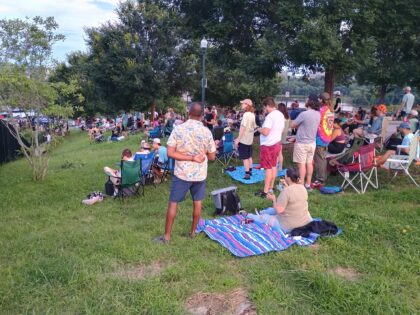
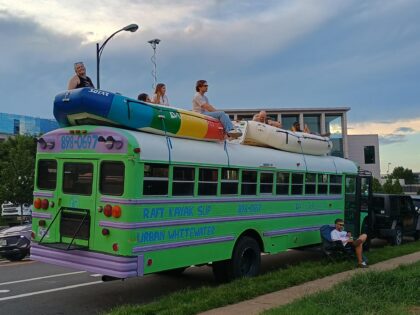
Another followup editorial…
Once the media inquiries started to come in, the City (Parks & Rec?) finally responded with a blanket statement:
For public safety and crowd control, on Amphitheatre concert days the Richmond Police Department closes Brown’s Island Way at S. 2nd Street and Tredegar Street and closes Tredegar Street between 5th and Brown’s Island Way, to vehicular traffic. This closure with the addition of closing the Tredegar Street parking lot helps ensure effective traffic and crowd management by providing organized staging zones, designated parking for staff and volunteers, and safe pedestrian access.
The City has entered into a paid, month-to-month trial lease agreement with Allianz Amphitheater/ Live Nation, granting use of the 60 parking spaces in the Belle Isle parking lot on select specific days and times to support event operations. This parking lot closure is a similar model used for RiverRock and Folk festival. The Tredegar Street Belle Isle parking lot is partially owned by the City of Richmond and Venture Richmond. Venture Richmond has also approved the use of their section of the parking lot for this endeavor.
Remaining dates that the Belle Isle parking lot will be offline for the month of July are:
Tuesday, July 15 (8:00 AM – 12:00 AM)
Wednesday, July 16 (8:00 AM – 12:00 AM)
Thursday, July 17 (8:00 AM – 12:00 AM)
Saturday, July 19 (1:00 PM – 12:00 AM)
Thursday, July 24 (1:00 PM – 12:00 AM)
Saturday, July 26 (1:00 PM – 12:00 AM)
Many of Richmond’s reporters did their usual copying and pasting of this press statement, and sadly, as expected, some added, in a very ‘Trumpian’ fashion, their own complaints about ‘complainers’ who challenged this ‘big, beautiful’ new amphitheater and the might of Venture Richmond. ‘How dare citizens speak up!’ was the chastising tone.
A couple of problems with this-
First of all, closing the Belle Isle Parking lot is contrary to the Venture Richmond lease agreement.
Secondly, they are closing the parking lot for entire days, and also from 12 noon other days, for employee parking, so this has little to do with security during events.
Brown’s Island Way is kept open most of the day. The Dominion Energy headquarters is at the end of Tredegar St. and these employees, of course, need access through Brown’s Island Way. This lot is not being closed for security, but to provide parking for amphitheater employees. (Or is there more to it? Neighbors who attended last night’s concert said that lot attendants told them that they are selling the lot as “VIP parking”, at least for last night’s show.)
Thirdly, the Allianz amphitheater is being given over $30 million in City subsidies and is a for-profit enterprise. They can well afford to rent another lot for their employees without depriving public use of the Belle Isle parking lot.
This parking lot closure is not similar to RiverRock and the Folk Festival, which are free non-profit events organized by Venture Richmond. Venture Richmond’s lease specifically allows them to close the Belle Isle parking lot for limited events, like the Folk Festival, that are organized by Venture Richmond. The Allianz amphitheater, by contrast is a private for-profit venue which is charging handsome prices for admittance and food. The Allianz events are not organized by Venture Richmond.
One point that may have been overlooked in all of this is that this lot is incredibly important for disabled access to Belle Isle. Southside access to the park is not the same.
Again, taking the only parking lot for Richmond’s most popular park for private functions is outrageous!
Lastly, if the lot is owned by the City of Richmond and Venture Richmond then is it a public parking lot or not? Upon further investigation, the land is owned by the City’s Department of Public Works. PUBLIC!
This is not the first time that the neighbors have fought to keep the Belle Isle parking lot open to the public for visiting the park.
In March 2021 a sign went up on the Belle Isle parking lot closing it to the public.
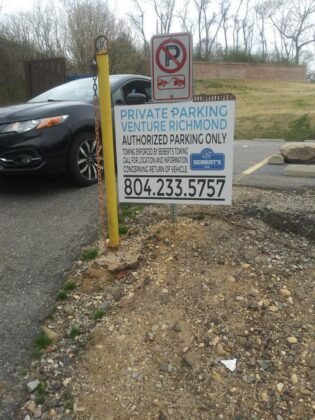
Oregon Hill residents immediately protested and pointed out that this was contrary to the Venture Richmond lease, and the lot was re-opened to the public the next day.
Now, once again, Venture Richmond is trying to close the only parking lot for Belle Isle for private functions.
It would be nice if local reporters could get off their duffs and not just reiterate whatever the local PTB (“Powers That Be”) feed them.
People complain about ‘complainers’, but there is more at stake than people think.
Still no real coverage from the local corporate media, so another pointed editorial..,
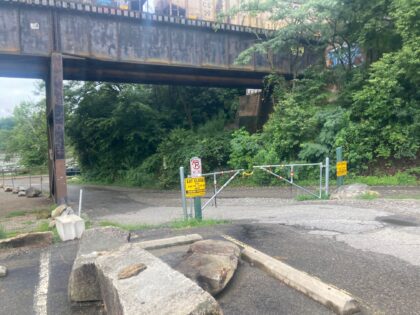
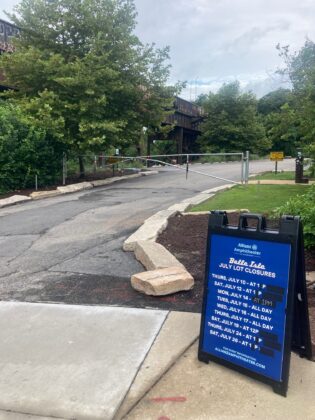
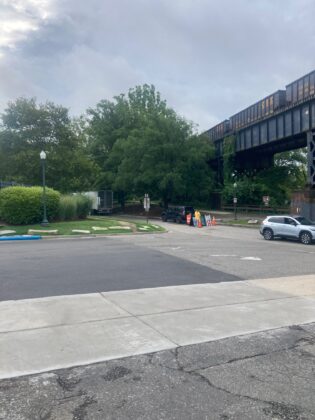
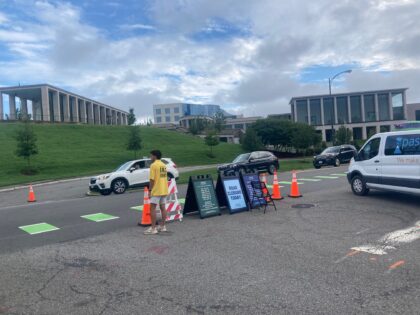
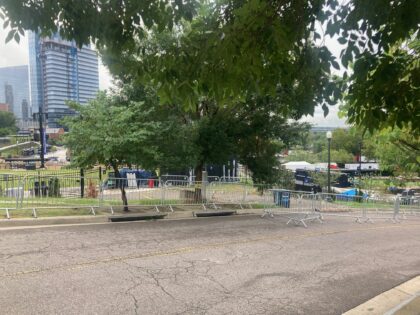
Remember when “Brown’s Island Way” or whatever it is called was built, citizens were told it was for public access to the riverfront? Well now it is being closed down with barriers for a private amphitheater concert.
This is in addition to the Belle Island parking lot, owned by Richmond’s Department of Public Works, but managed by James River Park, being closed, except for use by the Allianz Amphitheater employees or their contractors or whatever.
Interestingly enough, the only ‘official’ statement on this was made by Venture Richmond and shared yesterday in a social media post by the James River Park.
It read:
IMPORTANT INFO -PLEASE READ
The Tredegar/Belle Isle parking lot, Tredegar Street, Brown’s Island Way, and S. 5th Street will all be closed from the morning of July 15 to midnight on July 17 for load in, load out, and general security of and for the Dave Matthews concert.
This post was later taken down in haste.
Again, it is important to recognize that closing the Belle Isle parking lot for private amphitheater use is in violation of Venture Richmond’s lease agreement, which requires the parking to be open for public use. In addition, there is nothing in the $30+ million tax rebate from the City about the amphitheater having the authority to take over the Belle Isle parking lot.
Taking the only parking lot for Richmond’s most popular park for private functions is outrageous!
Supposedly this is temporary, but it calls everything into question.
And, no, it is not nearly as egregious or horrible as ICE overreach, the gutting of federal agencies, or the use of armed forces against civilians, but make no mistake about it, when government colludes with corporate powers (and vice versa) to STEAL from the public and prevent public access, it is another form of fascism.
Here in Richmond, VA, we dress this local fascism in public/private partnerships like Venture Richmond, concealed by big institutions like VCU (that are increasingly under corporate influence), make excuses about commerce and tax flows, all the while hiding behind a mostly silent and bought City Council. Sadly, citizens who have been here a while are all too familiar with it. Our increasingly strained environment bears it the best it can.
Many just look the other way and cheer when Venture Richmond makes an entertainment announcement for the next ‘public’ festival. Don’t expect it be among the polite chatter for the ultra-wealthy attending their private ‘DMB’ bro fest this evening or next. Beer prices are more likely the topic of conversation.
Hopefully we will eventually see someone else write/say something about this small parking lot matter, but don’t forget this moment. And please don’t forget it the next time that Richmond PTB (Powers That Be) decide to limit or take away real public ownership of the riverfront, our neighborhoods, information, or anything else.
We have stepped over the line from dealing with an increasingly corporate society and government to living in fascist times.
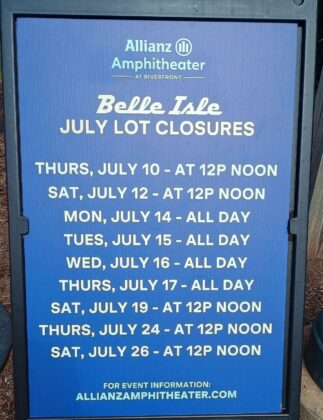
Editor’s Note: Closing the Belle Isle parking lot for private amphitheater use is in violation of Venture Richmond’s lease agreement, which requires the parking to be open for public use.
OUR PUBLIC PARKS ARE NOT LIVENATION’s PARKING LOTS!
Once again, we see the City leadership/’business community’, Powers That Be (PTB), whatever you want to call them, putting corporate priorities over public ones.
Someone needs to SLAP THEM HARD IN THE FACE, otherwise, they will keep coming back, trying to TAKE from the public. (Like they are doing with their Richmond300 rezoning).

From announcement:
Location: St. Andrew’s Episcopal Church, in the Chapel, 240 S. Laurel St., Richmond, VA US 23220
Healers from Align RVA Wellness are offering the community the opportunity to rest, heal, and recover in St. Andrew’s chapel every other Friday from 6:30 until 7:30 p.m. This beautiful and healing experience features two sound healers and multiple Reiki healers.You are encouraged to sign up on Mindbody to reserve your spot and plan to pay-what-you-can at the door. If you have questions, please contact Align RVA Wellness.
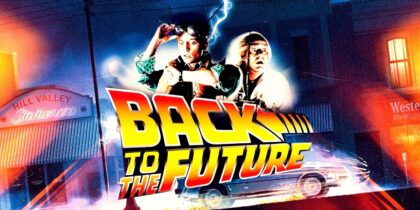
Great Scott!
We will see if the rain holds off enough for the 40th Anniversary Showing of Back to the Future in Pleasants Park behind Pine Street Baptist Church. Free Refreshments Served: Grilled Hotdogs, sides, desserts, and beverages!
Tonight, 7:30 pm