Local developer Gammino interviewed

From RichmondBizSense.com:

Gammino practiced law for more than a decade but left the legal profession to start his contracting business, which he grew a knack for after buying and fixing up homes in Oregon Hill. A native of Providence, R.I., Gammino has lived here since 1989, when he moved here to attend law school at the University of Richmond.

BizSense caught up with Gammino on the site of his first project as a developer and asked him what it’s like getting started as a developer and also about his next project he is planning in Jackson Ward.

Richmond BizSense: Tell us about your first project as a developer.

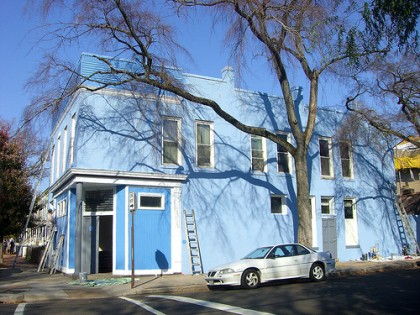
David Gammino: I’m working on the IVNA (Instructive Visiting Nurses Association) buildings at 223 S. Cherry St, which was most recently a law office for attorney David Baugh. It is 16,000 square feet over two buildings. The architect is Johannes Design Group, and my company, City & Guilds, is the contractor and developer.

RBS: What about the financing?

DG: The acquisition and construction is a total of about $2.8 million. First Market Bank is financing the project. The tax credit proceeds are secured by the bank at the front end of the deal and held by the bank until it is rented and stabilized and you meet a certain debt service ratio. The proceeds from the state and federal tax credits on this project are approximately $600,000.

RBS: Why did you decide to start doing your own development projects?

DG: I wanted to diversify the company and client base. Doing so in this environment is very difficult. There is a dearth of new development and what new business that is out there is being very aggressively bid by a multitude of players.

Growing the company within the traditional general contractor model is very difficult to do under the circumstances, so I realized one way I could continue to grow is by doing my own development. By virtue of having the existing business, I have the infrastructure in place to do so.

Article continues

Editorial: Filling in the Gaps in Historic Urban Neighborhoods

Bryan Green, a Pine Street resident, wrote an editorial that recently appeared in the Times Dispatch newspaper:

One thing advocates of “smart growth” and supporters of historic preservation agree on is the importance of concentrating development where existing infrastructure is already dense — and where houses, businesses, schools, hospitals, and public transportation are already located.

Each time a new housing development is located in an outer-ring suburb or on outlying rural land, local government is burdened with the responsibility to construct and maintain new roads, utilities, and public services. For example, only 25 percent of these “exurbs” connect with existing public transportation systems — the remainder clog roads with more automobiles (and the air with more toxic exhaust). In stark contrast, 60 percent of existing urban neighborhoods are already served by public transportation and have schools, hospitals, and other community services already in place.

Concentrating new construction and rehabilitation in our existing downtowns is the most environmentally and economically sustainable development possible. Much urban building stock is historic, and one of the greatest economic engines driving the rehabilitation of these areas is historic preservation.

Building and rehabilitating in historic contexts requires sensitivity, however, and can be expensive. Recognizing this, the federal government first established a rehabilitation tax credit in 1976, acknowledging that rehabilitation, while beneficial for urban areas, was an added cost to owners.

A 20 percent tax credit was established to provide incentives for careful rehabilitation of income-producing (commercial) historic buildings, incentives that prove ever more attractive to property owners and developers.

For example, in fiscal year 2008 (the most recent year for which figures are available), the National Park Service approved 1,231 projects representing a staggering private investment of $5.64 billion — all of which cost the Federal treasury less than $1.128 billion in tax credits. This powerful financial engine has been so successful that 30 states have added complementary rehabilitation tax credit programs, and 25 have extended their programs to non-income-producing properties (i.e., private homes).

The tax credit program leverages private money to rehabilitate historic buildings, returning them — and the surrounding area — to productive use. Because state and local tax incentives can often be attached to the federal credit, the program leads to greater public awareness of the benefits of historic preservation, which, in turn, provides incentives for private investment in historic neighborhoods.

The federal Rehabilitation Tax Credit program, on average, draws five private dollars for every public dollar invested for historic preservation and adaptive reuse — an especially compelling ratio in today’s economic climate.

Rehabilitation of historic buildings alone, however, is not enough to rehabilitate entire neighborhoods. What about the “missing teeth” in our urban fabric? How do we fill those gaps?

Nationwide, there are some 14,000 historic districts, many of which are plagued by two separate problems: demolished buildings and vacant lots, and inappropriate infill.
According to the Urban Land Institute, by the year 2050 the U.S. urban population will grow by 100 million people, all requiring housing, schools, and places for business — needs that cannot always be met by the existing historic building stock. In these cases, infill construction may be necessary.

Examples of poorly planned and poorly designed urban infill can be found in every city. Astute in crafting public policy to promote the re-use of historic resources, we are lousy at guiding what is built next door, and the urban fabric as a whole suffers badly.

To further stimulate our economy, state and local governments should consider expanding the existing historic preservation tax credit programs to include new, compatible infill development within existing state historic district boundaries. This could be accomplished through complementary state legislation in the form of a Historic District Infill Tax Credit (HDITC) that would further focus development within successful historic districts and encourage the completion of empty blocks.
Read the rest of the piece by clicking here.

OHNA Meeting Tuesday; Location Jacob House

The next Oregon Hill Neighborhood Association (OHNA) meeting is
scheduled for Tuesday, November 24, at 7 pm. Because some of the
William Byrd Community House staff are on vacation then, I am moving
the location of the meeting to the Jacob House, at the corner of S.
Pine and W. Cary.

Lt. Baltz from Richmond Police Sector 413 has indicated that she plans
to attend.

Thanks,
Scott Burger
President, Oregon Hill Neighborhood Association

Byrd House Renegade Market This Week

From announcement:

It’s that week when we feast til we burst! OK, almost burst. As we prepare to grace family and friends by sharing great food and warm company, remember the RENEGADE Market is open this week –Tuesday from 3:00 pm to 6:00 pm– to make available the freshest produce, meats and baked yummies available for your holiday convenience. Join us!
Brussels Sprouts – Cabbage (New Jersey Wakefield & Flat Dutch varieties) – Cauliflower – Broccoli – Spinach – Kale (Red Russian, Siberian and Tuscan) – Swiss Chard – Radishes – Beets – Broccoli Raab – Locally grown apples (Granny Smith, Red or Yellow Delicious, Jonagold, & Fuji varieties) – Eggs, Chevre Cheese, Chicken, Honey – Get free-range Turkey for the Holidays – Applesauce – Apples with Cherries and Raisins –
Cranberry-Apple Relish – Homemade Egg Noodles – and MORE!

Shop with a wild bunch!
BHM’s Renegade Market
Shop at the Byrd House Market’s Renegade Market, every Tuesday from 3 to 6 p.m. Corner of S. Linden St. and Idlewood Ave (same as BHM) where vendors sell autumn and winter vegetables, meat, chicken, pork, eggs, preserves, baked goods, and holiday greens.
For more information on vendors, go to www.byrdhousemarket.blogspot.com

May Day Parade Planning

From announcement :

Hey Oregon Hill! You know the Halloween Parade put on each year by All The Saints Theater Company? Well we’re starting to organize for the May Day Parade and we’re looking for folks who would like help us with that. If you’re interested check out the info below. We’re also looking for help to raise some money to assist with some of the expernses that come with organizing something like this. If you have any ideas or would like to throw a benefit event for us get in touch!

May Day 2010 Planning Committee
Sunday December 13, 2009
Meet at Plant Zero Studio #3
0 East 4th St. (right accross the 14th st bridge on southside)

If you’re interested in getting involved this year with organizing of May Day in 2010, please consider attending this initial meeting. We will be discussing what we would all like to see happen, how we can achieve these goals and how we can all help. There will be projects big and small, so please don’t be discouraged if you haven’t been involved with anything like this before. It’s a learning experience for us all, even those who have been doing this kind of thing for years.

We will be meeting at the All The Saints Theater puppet studio in the Plant Zero Art Center. It’s easy to get to and just across the 14th St. Bridge downtown.

What is May Day?

May Day! International Workers Day! Our day to recognize and appreciate the social and economic achievements of the international labor movement. The struggle began in 1884 when the Federation of Organized Trades and Labor Unions passed a resolution that would enact an eight-hour workday beginning on May 1, 1886. On May 4th, 1886 during a general strike for the eight hour day in Chicago, police fired on strikers and killed a dozen people in what has become known as the Haymarket Massacre. In 1890, Labor activists, Leftists, Socialists and Anarchists began celebrating May 1 as the International Worker’s Holiday to achieve “…the legal establishment of the 8-hour day, the class demands of the proletariat, and universal peace.”

from Kenneth Yates, causticcastle@gmail.com

Project 4063 Blackfinn Mixer Benefits WBCH

According to the blog, Project 4063, which is a VCU Mass Communications class and professor, is hosting a ‘benefit mixer’ at Blackfinn restaurant on the Canal Walk this coming Wednesday. Like a lot of Project 4063’s activities, it will benefit the William Byrd Community House.

Do you like Dancing? Drinking? Networking? Donating? FUN?……if so, this is the place for you!

locationt: Richmond’s Blackfinn 1001 Haxall Point, Suit 100.
Richmond va 23219
Date: Wednesday November 18th
Time: 5-7 p.m

Please Donate(non parishable food item or $) admission is free with a can!
This is the time of year to give back so….
Come on out and meet and greet your community!

All proceeds go to the WBCH.
Thank You!!! See you there!

BHM’s Renegade Market Today

Late notice I know, but here is part of the announcement:

Shop at the Byrd House Market’s Renegade Market, every Tuesday from 3 to 6 p.m. Corner of S. Linden St. and Idlewood Ave (same as BHM) where vendors sell autumn and winter vegetables, meat, chicken, pork, eggs, preserves, baked goods, and holiday greens.
For more information on vendors, go to www.byrdhousemarket.blogspot.com

The ‘renegade market’ is sort of whatever markets take place outside of the regular Byrd House Market calendar season.