As one of Richmond’s natural high points and one of Richmond’s urban, riverfront neighborhoods, we have a special responsibility to curtail stormwater runoff.
Stormwater Public Service Announcement
Reply
As one of Richmond’s natural high points and one of Richmond’s urban, riverfront neighborhoods, we have a special responsibility to curtail stormwater runoff.
Received this notice from neighbor:
Does Richmond Need a Citizen Tree Commission?
Information about Ordinance 2009-174Council representative, Chris Hilbert, has introduced an ordinance to establish a citizen tree commission to be called the Urban Forestry Commission, to reflect the broad vision for the group. The purpose is to improve the City’s urban forestry resources through policy development, advise, education and fundraising. Key responsibilities include:
Serve as an advisory body to Council regarding legislation and policies regarding public trees.
Facilitate the development and passage of a tree maintenance and management plan for City-owned trees.
Assist with public relations and education programs to increase public understanding of urban forestry issues.
Conduct fundraising for city tree projects.Members will be appointed by City Council and the Mayor and will include persons with expertise in areas such as tree care, urban forestry, and landscape design. Other members may include individuals with business interests and citizens interested in the beautification and well-being of our city.
Commissions in other localities in Virginia increase awareness of the critical role that trees play in our green infrastructure. They help shape policies and procedures that have long term impact on the livability of a city.
Yes, Richmond needs an Urban Forestry Commission to help maintain and improve our urban forest and to work towards a goal of increased tree canopy. We need a group with vision to help guide priorities based on the value of trees for all citizens and neighborhoods.
Please ask your Council Representative to support the establishment of a citizen Urban Forestry Commission. Come to City Council on Monday, October 26 at 6 pm — Wear GREEN to show your support! Thank you!!!
To reach the office of the City Clerk call 646-7955. Contact information for City Council members can be found by clicking here.
Prepared by the Friends of Urban Forestry. For further information, call Alli at 782-1170 or email allialligood@verizon.net
Although there have been some welcome announcements recently about local solar projects, the King of Oregon Hill asks his subjects and other local leaders to do more to utilize distributed rooftop solar energy as an alternative to the grid’s dirty coal power.
“I have lobbied heavily for more solar for a while now. All along, I have encouraged VCU to do solar, including thermal with the new rec center pool project. I have lobbied Richmond Public Schools to renovate Open High with solar as a pilot for future solar schools,” stated Burger. “Furthermore, I have tried to serve as an example, putting solar on top of my palace, and in the process, compelling Dominion Power to improve the micro-grid in the neighborhood.
Now is not the time to let up as the financial and environmental incentives keep increasing. Certainly, solar will not be our sole saving grace, but combined with energy conservation and other renewable energy, it is part of the overall solution to emerging emergencies, including Peak Oil and Climate Change.
Of course I do not expect everyone to be in a place or position to afford full PV solar arrays, but I do hope that everyone will take what steps they can- whether it be solar powering just one room or structure, or attempting solar financing as a third party.
I will also note how this intersects with previous royal edicts on food security. The conversation continues to grow.”
Sadly, the recent repaving of the parking lot at 15th Street is not the first time that Virginia Commonwealth University has disregarded important African American slave history.
Back in the 1990’s, Richmond activists warned President Trani that it was wrong to tear down the Jacob House in order to make room for the VCU Engineering School. So, to mute protests, he decided to have it moved across the street. There were still concerns that this would ruin the historical integrity of the site since it was considered a probable Underground Railroad site. One man, Alan Schintzius, actually got arrested when he laid in front of the bulldozer. Sure enough, a hidden basement room was discovered after the house was moved. Its gone now, filled in and buried by VCU.
You have to wonder what other Richmond history has been buried.
At least the moved Jacob House survives, for now, at the corner of Cary and Pine.
Would this be allowed to happen in Windsor Farms? In the Fan? On the VCU campus? In another City Councilperson’s District?
Again, this trash situation is something that myself and others have brought up time and time again.
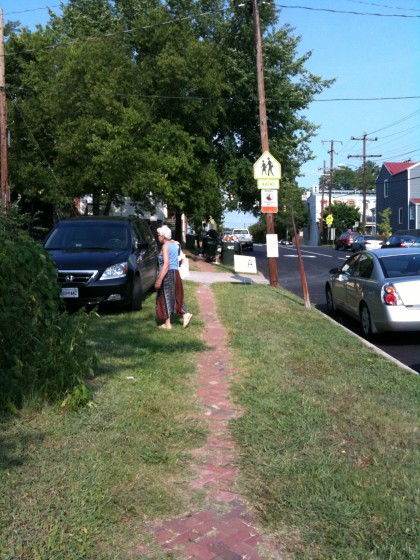
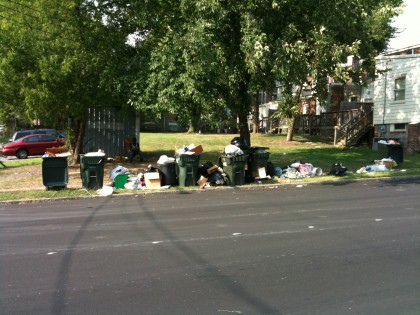
The end of July means moving for many people. Unfortunately, for far too many renters and landlords that means pile up your trash on the sidewalk and leave town, and let others deal with their trash. Although I posted before about the problem on Idlewood and Cherry, here is what will greet the Byrd Market attendees this afternoon:
Again, in the Idlewood situation, an easy solution would be to create a trash containment area along the alley which goes north behind the residences just a few yards away, and make sure residents use it. City trash trucks are supposed to be picking up from the back alleys in the neighborhood.
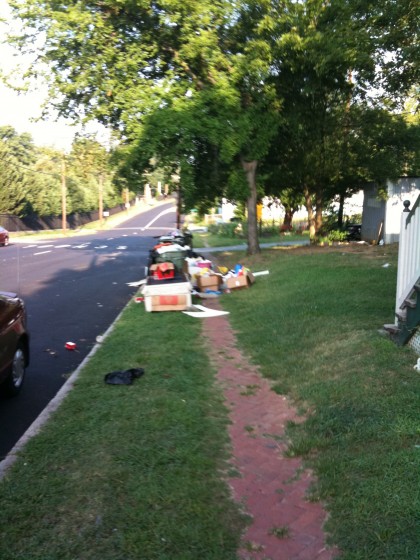
Unfortunately, this is not the only place where this happening, as the following pictures will attest. In every single case, it involves VCU student renters of absentee landlords. All of these places are repeat offenders. While not every Oregon Hill residence has a back alley access due to the way the lots are laid out, all of these places in the pictures have back alley access. There are other trash problems in the neighborhood, but I find these particularly egregious because they block front sidewalks. Personally, I suggest the City increase fines against the landlords, who are easier to identify and locate. I would be in favor of landlord licenses, not unlike what other university towns have implemented.
In the meantime, I will go out this morning since I have the day off from work and try to at least tidy the sidewalk trash on my block. Maybe this will stop the City from fining me for not mowing along my back alley while I was away on vacation.
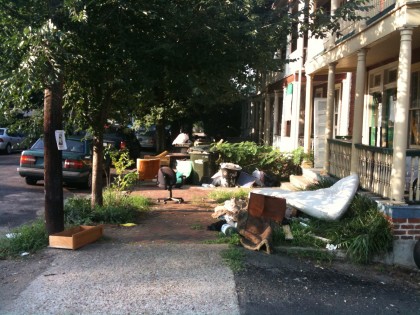
614, 616 S. Laurel St.
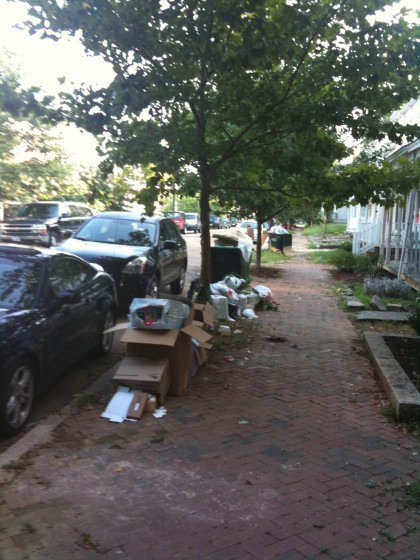
500 block of S. Laurel Street
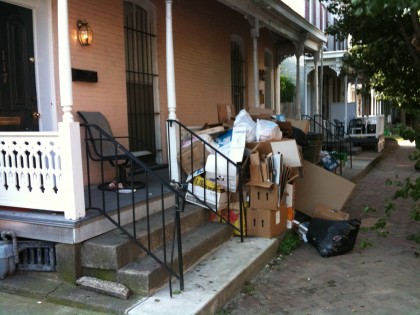
100 block of S. Cherry Street
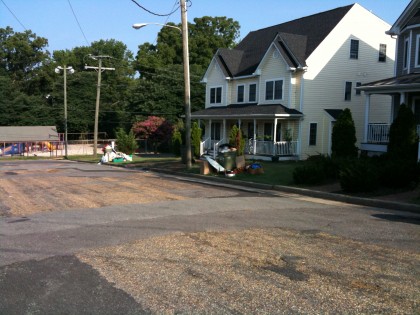
800 block of Holly Street
Previously, I have posted on new residential solar power as well as problems with Dominion Power’s service in the neighborhood. One of the benefits of putting grid-tied solar into place, (besides redundant power, besides lower power bills, besides tax credits, besides being able to sell state renewable energy credits (SRECs), not to mention cleaner energy in general), is that it does illuminate grid problems. For example, since taking inverter readings, and contacting the State Corporation Commission (SCC), Dominion Power has put new poles in, added transformers, and increased voltage to proper levels. In other words, if neighborhoods want better energy service, then get solar and create your own energy.
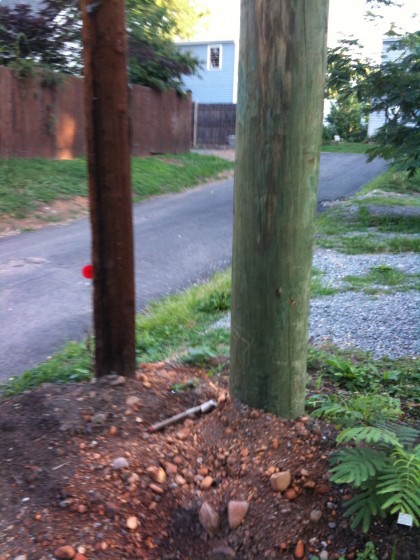
But that leaves the old utility poles in place, and brings me to my next topic- Verizon actually owns many of the old poles in the neighborhood. Dominion Power has just rented space on them in the past, while it is the City of Richmond that actually does the planning and managing of the right-of-ways. So, getting Verizon to do its part in upgrading service will encourage the City and Dominion Power to do more.
With that in mind, I call on Verizon to bring FiOS to Oregon Hill. For one thing, I have heard that FiOS is already offered north of Cumberland Street. The neighborhood has the residential density. The City has a contract with Verizon for services to its residents. I already have DSL, and Verizon sends me offers for DirecTV every week- why not save the ad money and use it instead to bring FiOS to the neighborhood? The neighborhood is right next to downtown and close to Verizon’s Virginia headquarters. While many residents already have Comcast, many of them would be willing to make the switch to FiOS. Covad and wireless beckon if Verizon cannot keep up with technological advances in the neighborhood.
The newly Council approved Downtown Master Plan recognizes Oregon Hill as a historic neighborhood that deserves Old & Historic status- to the point of offering incentives to residents for the designation. Certainly, getting rid of old utility poles and lines by bringing in buried fiber optic cable with new services would go a long way. After all, Verizon already buries line and offers these services for VCU campus.
Again, these are the sort of services that citizens expect our elected representatives to push for, especially when the service contracts come back up for vote.
The press release:
A CITY OLD & HISTORIC DISTRICT PUBLIC CONVERSATION
Wednesday, June 24th
6:30 – 8:30 pm
The Firehouse Theatre
1609 W. Broad Street [MAP]
(Free parking across the street at Lowe’s)
Richmond’s Commission of Architectural Review
and City Staff want to hear from YOU!
Why do we have Old & Historic Districts?
Why do we choose to live in them?
Why do we think they are important?
What does the public want from them?
How can the Commission of Architectural Review (CAR), the City, and residents be better custodians of Old & Historic Districts?
How can we strengthen the alliance between CAR, the City and residents?
This meeting is free and open to all residents and interested parties of Old & Historic Districts.
Please attend. Your input is crucial.
For more information, contact James Hill at james.hill@richmondgov.com
or city staff at (804) 646-6313.
Some insight:
Oregon Hill has National and State Historic Designation, but by choice not City O&H, though it may happen in the future. While I am personally favorable towards O&H for Oregon Hill, many of my neighbors have objected to government involvement and any possible economic hardship from maintaining O&H standards, and I try to respect that. I often try to broach this topic at neighborhood association meetings. If nothing else, I try to keep a sense of humor about it.
We have also watched how the City and State government has not exactly been uniform in its approach to historic preservation. Keep in mind that VCU is exempt from City code and continues to encroach and destroy our neighborhood. The debate about Union Hill’s O&H needs to be heard.
Oregon Hill has the distinction of holding the most individual historic easements in the City. There was actually a DHR meeting at the Jacob House about that not too long ago.
To get on my soapbox a bit, those individual easements are important because while Oregon Hill may lack grand mansions, we are very historic for the overall collection of working class small houses and business fronts. Its not just rich neighborhoods and government buildings that are historic and deserve to be preserved.
Thanks,
Scott
In Disciples of Vulcan, the Valentine Richmond History Center attempts to illustrate the long history of Oregon Hill in pictures and words. For residents of neighborhood, the beautiful old photographs on display are certain to leave an impression as some combination of recognition, pride, and loss washes over you. Black-and-white images tell the story of the Hill’s growth from its beginnings as a hardworking immigrant enclave to the diverse community that it is now, protecting is roots defiantly in the face of big changes.
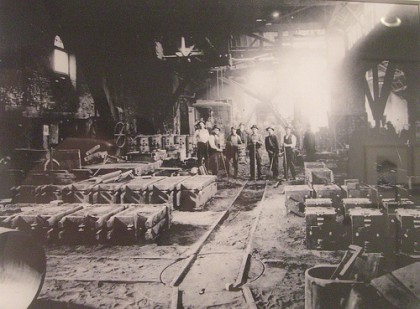
Visitors to the exhibit have a chance to see several long-gone but often-referenced places, such as the penitentiary and the older section of Oregon Hill on the other side of Belvidere. Placards trace the general history of the neighborhood from its start in the early 1800s to the present day, referencing everything from its original demographics to recent conflicts with VCU. A collection of ephemera includes advertisements for neighborhood businesses, a menu from the Chuck Wagon, and flyers for community events.
Although the exhibit is small and can be seen in about half an hour, everyone but the most seasoned neighborhood historians is sure to learn some new facts about Oregon Hill. Disciples of Vulcan could go from great to amazing if more in-depth information were to be added, such as more details about why the neighborhood remained relatively unchanged for as long as it did, race relations, boy gangs, bread riots, and personal stories about life in the area. As it is, the exhibit it a must-see for all Oregon Hill residents and enthusiasts, and will be invaluable in establishing a sense of identity as newer transplants become members of this longstanding community.
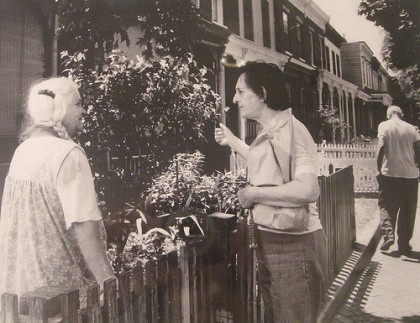
The Valentine Richmond History Center is open Tuesday – Saturday 10am – 5pm, and Sunday 12pm – 5pm. Admission is normally $8, but Sundays are Pay What You Can Day. The museum is located at 1015 E. Clay Street.
tess m. dixon
* alwaysmidnight.etsy.com
* parasolparty.wordpress.com
* midnightsocietyrva.com
Oregon Hill resident Caroline Cox has written a back page opinion piece for Style magazine, entitled “Missing the Bag“. Its about the opportunity costs of taxpayer money.
“Most of the ongoing debate about the proposed $318 million ballpark-anchored development in Shockoe Bottom has centered on the best place to put a new baseball stadium. But it’s not about the ballpark. It’s about opportunity cost. It’s about resource management, public goods and democracy.”