Death in Civil War-Era Oregon Hill

From the Daily Dispatch, Dec. 5, 1860:

On the 4th instant, at his residence, on Oregon Hill, at 2 o’clock, of pneumonia. George W. Adams, aged 25 years, 9 months and 8 days.

His friends and acquaintances are respectfully invited to attend his funeral from the Oregon Hill Baptist Chapel, this (Wednesday) evening, at 3½ o’clock without further notice.

Columbus (Ga.) papers please copy

Thanks to the University of Richmond Civil War-Era Richmond online resource, and A.R. Goodwin for leading me to it. I will try to find some more history items on there.

Blog Post on The Cowboy Junkies’ Song

Ray Bonis, who works at VCU’s library, is a treasure trove of Richmond history knowledge. He shares it in part by being one of the co-authors of the The Shockoe Examiner blog (along with neighborhood resident T. Tyler Potterfield). This week they included an addition to the VCU Special Collections, the original draft, or closest thing to it, of the music group Cowboy Junkies’ song “Oregon Hill”. To see it online, check out the blog post (by clicking here), and do yourself a favor while you are there and bookmark the blog.

Reminder: Oregon Hill Walking Tour On Sunday

This is a reminder that there will be a walking tour of Oregon Hill on Sunday, October 17 from 2pm to 4pm.

Settled by Irish and Welsh ironworkers in the 1840’s, Oregon Hill is one of the oldest intact neighborhoods in Richmond and continues to thrive as a tight-knit, working class neighborhood. Includes a visit to St. Andrew’s Church and School. Meet at Laurel and Idlewood streets.

For more information, please click here.

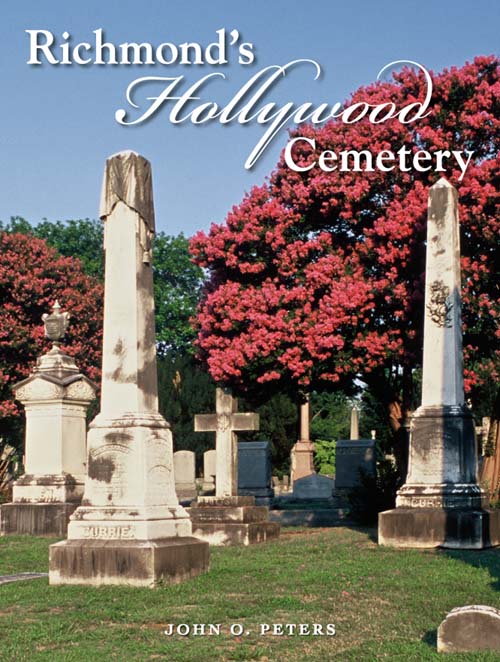
New Book: Richmond’s Hollywood Cemetery

From the Valentine Richmond History Center:

“Our new color, hardbound book about Hollywood Cemetery is finally here! Pick one up today in our Gift Shop. Or order online next week.”

Richmond’s Hollywood Cemetery A new book by Richmond resident John Peters, published by the History Center. This hardbound collection of historical and contemporary photographs and narrative about one of the country’s most famous cemeteries will be available in the History Center Gift Shop as of September 16th. Makes a great gift! Mr. Peters will deliver an Author Talk and sign books on October 5th at 6pm at St. John’s Church.

Oregon Hill Street Names A-S

Paraphrased from Thomas F. Mustian’s “Facts and Legends of Richmond Area Streets” (I think I have a second printing):

Albemarle Street was named for William Anne Keppel, second Earl of Albemarle and Governor General of the colony from 1737 to 1754.

Belvidere Street took its name from home of William Byrd III on the crest of what is now Oregon Hill. Originally, part was traversed by railway trackage.

Cary Street was originally laid out by planners to be called “C” Street according to the alphabet being third in order from the North side of the James (River). It was changed later to be called Cary Street in honor of the many Cary’s that held historic bearing in the early beginning of the City- probably Archibald Cary.

Cherry Street is one of the early streets of Oregon Hill named after the fruit tree.

China Street is named after the Chinaberry tree.

Church Street (no longer exists, was east of Belvidere) was located in the Oregon Hill area and for the short distance it covered there were located several churches.

Cumberland Street is named after the Duke of Cumberland, the third son of King George II.

Holly Street was named by developer Ben J. Harris for the trees grown there.

Idlewood Avenue was originally called Beverley Street. It was changed to be compatible with the Avenue of access to the Idlewood Amusement Park and located near the newly formed Byrd Park.

Main Street is the industrial and commercially centered early street, that in it’s beginning only ran from 18th Street to 25th Street.

Pine Street was named as was popular then for the Pine Trees.

Rowe Street (no longer exists, was east of Belvidere) was named after a Millwright who was the builder.

The following were not included in the book:

Beach Street (no longer exists, was just west of Linden Street)

Green Alley was named for was named after Ben Green who was involved in a
fairly high-profile, alleged bank embezzlement case around the mid-1800’s. More importantly, at
least as far as Oregon Hill residents should be concerned, is that Green was
the architect of the first row houses in the neighborhood.

Laurel Street was most likely named for the trees that grew there.

Linden Street was most likely named for the linden trees that grew there.

I am looking for more information on the following:

Beach Street (no longer exists, was just west of Linden Street)
Harrison Street (I am guessing was named after President William Henry Harrison, but I would appreciate it if someone could confirm)
Howard Street (no longer exists, was east of Belvidere)
Howe Street (no longer exists, was east of Belvidere)
Maiden Lane (no longer exists, was east of Belvidere)
Spring Street ( I assume there was a water spring involved.)
Conservative Rally, 1880

There was most likely quite a bit of ideological rivalry on the Hill back in day (just like now?). I wonder just how serious it became (a la Gangs of New York, perhaps?). Of course, the conservatives were likely the Democrats back then, and the Republicans were probably considered ‘the liberals’ (and certainly not ‘the radical right’ you see now with the likes of G.W. “I am the decider” Bush and Palin, (‘Goin’ rogue, you know’).

From the Daily Dispatch, August 7, 1880:

A meeting of the Conservatives of Oregon Hill is announced for to-night, at which Captain George D. Wise, Hon. A.M. Keiley, and S.B. Witt, Esq. are expected to speak.

Ed Ayers tours Hollywood Cemetery for BackStory

in memory

BackStory is a smart history radio show/podcast whose May 2010 show Grave Matters: A History of Death and Mourning includes an Ed Ayers tour of Hollywood Cemetery:

On each show, renowned U.S. historians Ed Ayers, Peter Onuf, and Brian Balogh tear a topic from the headlines and plumb its historical depths. Over the course of the hour, they are joined by fellow historians, people in the news, and callers interested in exploring the roots of what’s going on today. Together, they drill down to colonial times and earlier, revealing the connections (and disconnections) between past and present.

Missing Husband, 1902

From The Times, June 3, 1902:

Mr. Murray Browden, of Oregon Hill
Has Left His Wife, and Probably City.
Mrs. Murray Browden, residing on Oregon Hill, is very anxious about her husband, he havlng left home last Saturday and not returned.
She has notlfied the police of the disappearance of her husband.
Mr. Browden was last employed at the Richmond’ Locomotive Works. For
some time, it seems, he has been unable to obtain any work, and this it is thought
is the cause of his leaving the city without notice to his wife

Oregon Hill Park, 1888

From The Daily Times, May 22, 1888

A Desirable Improvement Completed

It is expected that there will be held a meeting this week of the City Finance Committee to consider appropriation of $3,500 for the purchase of, and beautifying, the proposed new park on Oregon Hill. This land begins at Hollywood on the Canal bank, and runs parallel with it eastwardly to Church street. It embraces a large square adjoining Hollywood, the strip along the slope of the hill overlooking the river and a large square at Church street. Terraced and beautiful with shade trees, but it will be as pretty a park as any in the city, and one that the people in this populous section want. People entering the city over the Petersburg bridge and by the Alleghany road will be struck with the beauty of the slope, which, while proving an ornamentation to the section, will enhance the value of all the property in the neighborhood.