Jewell Sentenced To Suspended Jail Term in DUI

From the Times Dispatch (this follows coverage for his arrest in October):

Richmond City Councilman E. Martin Jewell pleaded no contest yesterday to driving under the influence in October and apologized to his constituents and the community.

“I made a mistake. I should not have driven after drinking,” the 5th District council member said outside Richmond’s John Marshall Courts Building.

Substitute Judge Randy Rowlett fined Jewell $500, with $250 suspended, and imposed a 90-day jail sentence with the time suspended for three years. Jewell’s driver license also was suspended for 12 months, but he will be allowed to drive to and from work, including City Council functions. Jewell is owner of Total Home Care, a residential cleaning service.

In addition, Jewell was referred to the Virginia Alcohol Safety Action Program, an anti-drunken-driving school that will last at least 10 weeks. Attorney Craig Cooley, who represented Jewell, said the punishment was standard for a first-time offender such as Jewell.

Richmond police pulled over and arrested the councilman about 1:30 a.m. Oct. 24 near Byrd Park. Cooley said Jewell’s blood-alcohol reading was 0.11 percent. In Virginia, a motorist is presumed to be legally intoxicated with a blood-alcohol concentration of 0.08 percent or higher. Cooley noted that Jewell’s level was below the 0.15 percent that would trigger mandatory jail time.

The state’s maximum punishment for first-offense DUI, a Class 1 misdemeanor, is one year in jail and a $2,500 fine.

Editorial: Filling in the Gaps in Historic Urban Neighborhoods

Bryan Green, a Pine Street resident, wrote an editorial that recently appeared in the Times Dispatch newspaper:

One thing advocates of “smart growth” and supporters of historic preservation agree on is the importance of concentrating development where existing infrastructure is already dense — and where houses, businesses, schools, hospitals, and public transportation are already located.

Each time a new housing development is located in an outer-ring suburb or on outlying rural land, local government is burdened with the responsibility to construct and maintain new roads, utilities, and public services. For example, only 25 percent of these “exurbs” connect with existing public transportation systems — the remainder clog roads with more automobiles (and the air with more toxic exhaust). In stark contrast, 60 percent of existing urban neighborhoods are already served by public transportation and have schools, hospitals, and other community services already in place.

Concentrating new construction and rehabilitation in our existing downtowns is the most environmentally and economically sustainable development possible. Much urban building stock is historic, and one of the greatest economic engines driving the rehabilitation of these areas is historic preservation.

Building and rehabilitating in historic contexts requires sensitivity, however, and can be expensive. Recognizing this, the federal government first established a rehabilitation tax credit in 1976, acknowledging that rehabilitation, while beneficial for urban areas, was an added cost to owners.

A 20 percent tax credit was established to provide incentives for careful rehabilitation of income-producing (commercial) historic buildings, incentives that prove ever more attractive to property owners and developers.

For example, in fiscal year 2008 (the most recent year for which figures are available), the National Park Service approved 1,231 projects representing a staggering private investment of $5.64 billion — all of which cost the Federal treasury less than $1.128 billion in tax credits. This powerful financial engine has been so successful that 30 states have added complementary rehabilitation tax credit programs, and 25 have extended their programs to non-income-producing properties (i.e., private homes).

The tax credit program leverages private money to rehabilitate historic buildings, returning them — and the surrounding area — to productive use. Because state and local tax incentives can often be attached to the federal credit, the program leads to greater public awareness of the benefits of historic preservation, which, in turn, provides incentives for private investment in historic neighborhoods.

The federal Rehabilitation Tax Credit program, on average, draws five private dollars for every public dollar invested for historic preservation and adaptive reuse — an especially compelling ratio in today’s economic climate.

Rehabilitation of historic buildings alone, however, is not enough to rehabilitate entire neighborhoods. What about the “missing teeth” in our urban fabric? How do we fill those gaps?

Nationwide, there are some 14,000 historic districts, many of which are plagued by two separate problems: demolished buildings and vacant lots, and inappropriate infill.
According to the Urban Land Institute, by the year 2050 the U.S. urban population will grow by 100 million people, all requiring housing, schools, and places for business — needs that cannot always be met by the existing historic building stock. In these cases, infill construction may be necessary.

Examples of poorly planned and poorly designed urban infill can be found in every city. Astute in crafting public policy to promote the re-use of historic resources, we are lousy at guiding what is built next door, and the urban fabric as a whole suffers badly.

To further stimulate our economy, state and local governments should consider expanding the existing historic preservation tax credit programs to include new, compatible infill development within existing state historic district boundaries. This could be accomplished through complementary state legislation in the form of a Historic District Infill Tax Credit (HDITC) that would further focus development within successful historic districts and encourage the completion of empty blocks.
Read the rest of the piece by clicking here.

RETHINK AFGHANISTAN program Wed. evening at VCU

There is a free screening of the new documentary film Rethink Afghanistan on Wednesday, October 28, at 7:00 PM in the VCU Student Commons Forum Room (907 Floyd Avenue).

Rethink Afghanistan is a documentary about the U.S.’ escalating military involvement in Afghanistan directed by Robert Greenwald and distributed by Brave New Foundation.

The film will be followed by a discussion moderated by Dr. Mark Wood, of VCU’s School of World Studies.

This event is co-sponsored by the Richmond Peace Education Center, the Network of Spiritual Progressives Student Organization (nspvcu@gmail.com), and the VCU Religious Studies Program.

Urban Forestry Commission moves forward

Received this notice from neighbor:

Does Richmond Need a Citizen Tree Commission?
Information about Ordinance 2009-174

Council representative, Chris Hilbert, has introduced an ordinance to establish a citizen tree commission to be called the Urban Forestry Commission, to reflect the broad vision for the group. The purpose is to improve the City’s urban forestry resources through policy development, advise, education and fundraising. Key responsibilities include:

Serve as an advisory body to Council regarding legislation and policies regarding public trees.
Facilitate the development and passage of a tree maintenance and management plan for City-owned trees.
Assist with public relations and education programs to increase public understanding of urban forestry issues.
Conduct fundraising for city tree projects.

Members will be appointed by City Council and the Mayor and will include persons with expertise in areas such as tree care, urban forestry, and landscape design. Other members may include individuals with business interests and citizens interested in the beautification and well-being of our city.

Commissions in other localities in Virginia increase awareness of the critical role that trees play in our green infrastructure. They help shape policies and procedures that have long term impact on the livability of a city.

Yes, Richmond needs an Urban Forestry Commission to help maintain and improve our urban forest and to work towards a goal of increased tree canopy. We need a group with vision to help guide priorities based on the value of trees for all citizens and neighborhoods.

Please ask your Council Representative to support the establishment of a citizen Urban Forestry Commission. Come to City Council on Monday, October 26 at 6 pm — Wear GREEN to show your support! Thank you!!!

To reach the office of the City Clerk call 646-7955. Contact information for City Council members can be found by clicking here.

Prepared by the Friends of Urban Forestry. For further information, call Alli at 782-1170 or email allialligood@verizon.net

Congressman Scott announces Health Care Community Forum

Speaking of local politicians, Church Hill People’s News has this announcement:

August 28, 2009
Congressman Scott announces Health Care Community Forum
Congressman Bobby Scott (VA 3rd District) will be holding a Richmond Health Care Community Forum on Thursday, September 3, from 7-8:30PM at the General Assembly Building. Congressman Scott will do a brief presentation on H.R. 3200, the America’s Affordable Health Choices Act of 2009. Afterward the Congressman will take questions from the audience. This event is open to the public. Seating will be limited.

Richmond Health Care Community Forum
Thursday, September 3, 2009
7:00 p.m. – 8:30 p.m.
General Assembly Building
House Room D
910 Capitol Street
Richmond, VA 23219

Meet & Greet With Incumbent McClellan on Wednesday

IMG_0341

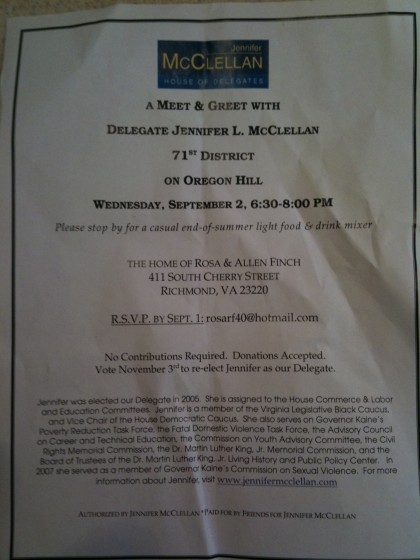
Another flyer went around the neighborhood for “A Meet & Greet” with the 71st District incumbent Delegate Jennifer L. McClellan. Its happening this Wednesday from 6:30 pm to 8pm at the Finches’ house, 411 S. Cherry Street. Its described as a casual light food and drink mixer, no campaign contributions required. R.S.V.P. by Sept 1 to rosarf40@hotmail.com.

I wonder if her competition, Silver Persinger, will make it. Unfortunately, I doubt I will be able to make it due to prior commitments. I do have some questions for the Delegate though, questions that I have asked before…

Since she serves on the House Education Committee, can she encourage VCU to take a positive step for community relations?

As a Verizon attorney, can she make sure the neighborhood gets its fair share of service, including FIOS?

Since her main contributor is Dominion, what can she do to make sure Dominion utilizes more renewable energy vs. dirty coal?

I am sure other Oregon Hill residents and 71st constituents have questions. Please feel free to leave some in the comments below.

King Asks For More Solar

Although there have been some welcome announcements recently about local solar projects, the King of Oregon Hill asks his subjects and other local leaders to do more to utilize distributed rooftop solar energy as an alternative to the grid’s dirty coal power.

“I have lobbied heavily for more solar for a while now. All along, I have encouraged VCU to do solar, including thermal with the new rec center pool project. I have lobbied Richmond Public Schools to renovate Open High with solar as a pilot for future solar schools,” stated Burger. “Furthermore, I have tried to serve as an example, putting solar on top of my palace, and in the process, compelling Dominion Power to improve the micro-grid in the neighborhood.

Now is not the time to let up as the financial and environmental incentives keep increasing. Certainly, solar will not be our sole saving grace, but combined with energy conservation and other renewable energy, it is part of the overall solution to emerging emergencies, including Peak Oil and Climate Change.

Of course I do not expect everyone to be in a place or position to afford full PV solar arrays, but I do hope that everyone will take what steps they can- whether it be solar powering just one room or structure, or attempting solar financing as a third party.

I will also note how this intersects with previous royal edicts on food security. The conversation continues to grow.”

Center Stage Siphoning Off Landmark Theater Funding?

There’s a rumor on the street that the soon-to-open downtown Center Stage project is now taking funding away from the Landmark Theater renovation.

Instead of getting it out of City of the Future funds, the way it was supposed to,
the Landmark actually got its money from the excess surplus from the Manchester Project. But CenterStage leadership is rumored to be negotiating with Council to get the money that would have gone to the Landmark. (Remember when the City of the Future was supposed to be mainly about renovating and building new schools?)

Many Oregon Hill residents have questioned the Center Stage project from the beginning. Now as it gets closer to opening day, more and more people are raising questions. And yet, even more amazing, this sad, wasteful story just keeps growing.

The Landmark renovations will most likely get finished no matter what, but if this rumor proves true then what other public priorities is Center Stage distracting money and attention from?