
Trash/Recycling (Might Be) Tomorrow

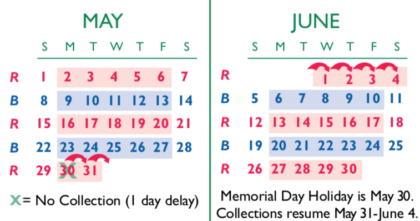
This Wednesday is a “Red Wednesday”, which hopefully means trash and recycling pickup. I say hopefully, because the Central Virginia Waste Management Authority has struggled to maintain its schedule due to a shortage of workers and has missed some pickups recently and had to reschedule. That said, as neighbors, we should do our best to help.

Recent update: Crews encourage residents to put recycling trash out on collection days

One tool that might help ameliorate the situation if pickup does not come is this online form:
https://cvwma.com/programs/residential-recycling/recycling-service-request-form/

Please go over what can be recycled. Ideally, rolling recycling containers are stored and deployed in the back alleys along with trash cans. Please make sure you pick up containers after pickup tomorrow night.

If you have not done so already, don’t forget to sign up for your Recycling Perks.
In order to take your recycling to the next level, read this: 10 ways to improve your recycling.

In recycling news, Governor Northam’s executive order is receiving some push-back from the Virginia Manufacturers Association. But, of course, the VMA does not offer any real alternatives.

Meanwhile, the Chesapeake Bay Foundation offers scientific proof that the Chesapeake Bay is a ‘sink’ for plastic pollution.

“The fact that stuff doesn’t get pushed out into the ocean — that we’re retaining plastic — is a big find,” Robinson said. “It potentially means there could be serious effects of plastic on Bay ecology.”

Former Councilperson Chuck Richardson Is Releasing An Autobiography

Former Councilperson Chuck Richardson, who once represented Oregon Hill on City Council, is releasing an autobiography this Saturday at the Black History Museum. (Registration is required – see details at this link: https://chuckrichardson.EventBrite.com). Its entitled “Cease Fire! Cease Fire!: Councilman Chuck, A Hero (In) Addiction” (click title to go the book website).

Henry W. “Chuck” Richardson tells his life story in his own words with his brother Monte Richardson. With a foreword by Dr. Raymond P. Hylton,
Chair of the Department of History at Virginia Union University, Cease fire! Cease fire! includes dozens of personal pictures and historic events in
Richmond, Virginia.

Trash/Recycling (Might Be) Tomorrow

This Wednesday is a “Red Wednesday”, which hopefully means trash and recycling pickup. I say hopefully, because the Central Virginia Waste Management Authority has struggled to maintain its schedule due to a shortage of workers and has missed some pickups recently and had to reschedule. That said, as neighbors, we should do our best to help.

One tool that might help ameliorate the situation if pickup does not come is this online form:
https://cvwma.com/programs/residential-recycling/recycling-service-request-form/

Please go over what can be recycled. Ideally, rolling recycling containers are stored and deployed in the back alleys along with trash cans. Please make sure you pick up containers after pickup tomorrow night.

If you have not done so already, don’t forget to sign up for your Recycling Perks.
In order to take your recycling to the next level, read this: 10 ways to improve your recycling.

In recycling news, more and more people are recognizing the problem of plastics.

From a recent Politico article that is part of a special report, The Recycling Myth:

Most experts agree that recycling is an important way to reduce waste and to recover valuable materials, while reducing greenhouse gas emissions and conserving significant amounts of energy and water. And yet, of the 2.3 billion tons of waste generated in the EU each year, only 37 percent gets recycled.

Some materials, such as aluminum cans, glass and paper, are relatively easy to repurpose (Nearly three-quarters of this type of waste sees a new life as a consumer product.)

But plastic poses a particular problem. Of the 29 million tons of plastic waste collected in the EU (European Union) in 2018, less than a third was recycled. About a quarter went into landfills, and about 43 percent was burned in incineration plants.

“Plastic recycling is largely a fraud,” said Jim Puckett, the executive director of the Basel Action Network, an NGO (non-governmental organization) in the U.S. that works to end illegal waste trade. “It’s been sold to us as being the answer to all the plastic waste and consumption, but in fact it really has some fundamental aspects of non-circularity that are going to plague that myth and dream forever.”

That’s not what the plastics industry wants to hear. With growing public concern about plastics — fueled by stories about garbage patches in the middle of oceans, bottle-strewn beaches and animals choking on plastic pellets — the industry is worried their product could end up as a taboo, like tobacco.

Richmond Folk Festival This Coming Weekend

With beautiful weather, the festival season is here in Richmond, VA.

Many people are looking forward to fun events after a tragic pandemic year, and the Folk Festival is a Richmond favorite. It’s taking place this coming weekend and it’s noteworthy that it is free admission (though they do ask for donations).

Although it is celebrating its 17th year, this Folk Festival will be a bit more national artist-based than past years, which is understandable given the difficulty traveling with pandemic concerns.

It does not look like they are checking vaccination records for attendees, but they are taking some COVID-19 precautions.

Editorial: Don’t Miss This Opportunity

Last month, the Eurasia Group Foundation released a report entitled “Inflection Point: Americans’ Foreign Policy Views After Afghanistan”. Here is the Executive Summary:

On August 30, 2021, the last US soldier evacuated Afghanistan, ending the longest war in American history. The withdrawal elicited disapproval from the professional foreign policy community, who expressed dismay and distress over the future of America’s global role. The public debate sparked by the withdrawal is an important and perhaps long overdue one. So the results of our fourth annual survey of Americans’ foreign policy views arrives at an opportune moment. Here are some of the key observations, which will hopefully inform this debate:
Americans want the US to be engaged diplomatically in the world
Nearly three times as many Americans – 58 percent vs. 21 percent – want to increase as decrease diplomatic engagement with the world;
A plurality of Americans fit a “Global Ambassadors” type. They support active diplomacy but oppose increasing America’s troop presence worldwide;
When asked to rank the forms of international assistance they think the United States should prioritize, the most popular types were non-military: (1) humanitarian aid and disaster relief, and (2) COVID-19 relief such as vaccine donations;
Sixty-three percent support reviving nuclear negotiations with Iran and pursuing an agreement which prevents the development of nuclear weapons;
But they also want to scale back America’s military posture and activities
Most (62 percent) think the biggest lesson from the war in Afghanistan was that the United States should not be in the business of nation-building or that it should only send troops into harm’s way if vital national interests are threatened;
A plurality wants to decrease the number of US troops stationed overseas and reduce security commitments to countries in Europe, Asia, and the Middle East;
Support for United States-led military intervention to stop human rights abuses decreased by 14 percent between 2020 and 2021; (and support for the United Nations taking the lead increased by 14 percent);
In recent years, Congress has largely ceded its war-making prerogative to the executive branch. 76 percent believe the president should seek Congressional approval before ordering military action;
Seventy percent believe “the US should negotiate directly with adversaries to try to avoid military confrontation, even if those adversaries are human rights abusers, dictators, or home to terrorist organizations;”
Americans generally make a positive appraisal of drone strikes: nearly 70 percent believe they are less costly than sending US troops into combat, or are an effective tool in depriving terrorists of safe havens in remote parts of the world;
In part because they want to redirect resources to domestic priorities
Twice as many Americans want to decrease the defense budget as increase it. The most cited rationale for decreasing the defense budget is a desire to redirect resources domestically;
Half of Americans have a “Jeffersonian” outlook: they are more eager to protect democracy at home than promote it abroad. This outlook increased by 35 percent since 2018;
Though there is little consensus around how to address other great powers
The number of respondents who think the United States should act militarily to prevent Russian troops from invading a NATO ally decreased by six percentage points between 2020 and 2021, and Americans are divided down the middle on this issue;
For the second year in a row, Americans are evenly split on whether the United States should increase or decrease its troop presence in Asia;
​​While a slight plurality of respondents believe the United States should militarily defend Taiwan, Americans appear ambivalent on the issue: 40 percent are unsure about what the United States should do in the case of a Chinese invasion;
Younger Americans (18 to 29 year-olds) are especially weary of war
Eighty percent believe that unless the United States is under attack, the president should be required to seek approval from Congress before ordering military action overseas;
Nearly two-thirds believe the United States should respond to China’s rise by decreasing the US troop presence in Asia, a seven percent increase from last year;
Of all age groups surveyed, young Americans are the most likely to believe the United States is “not an exceptional nation” (60 percent) and least likely to believe it is “exceptional because of what it has done for the world” (12 percent);
Nearly 60 percent are critical of the use of drones, more than twice as many as the older age groups;
Five times as many want to decrease as increase current levels of defense spending.

Meanwhile, what are America’s leaders doing? Last week, the House of Representatives voted to expand the mandatory age-18 Selective Service registration to include women, as part of an annual National Defense Authorization Act (NDAA), which at $778 billion this year gave President Joe Biden $24 billion more than he asked for.

Neither this report or the ‘doubling of the draft’ got that much attention by the corporate media, but Americans should be questioning why their elected leaders are ignoring public opinion.

The twenty-year-long Afghan war cost this country trillions of dollars and thousands of lives. The opportunity costs are stupefying. This is a moment when the country could significantly change direction away from war funding and waging ‘endless war’. This could be a new path. Don’t miss this opportunity.