Richmond Open Government Project

Perhaps inspired by other local online petitions, the Richmond Open Government Project launched theirs recently:

http://www.thepetitionsite.com/684/909/771/make-richmond-city-hall-an-open-government-equal-to-the-best-in-virginia/

Knowledge comes from unfettered access to information. Currently the City of Richmond lags far behind the other six most populous cities in Virginia (Alexandria, Chesapeake, Hampton, Newport News, Norfolk, Virginia Beach) in terms of the information that is made available to its citizens and their ease of acquiring said information. The City of Richmond impedes the public’s access to information and participation in many ways. A short list of what the City does not do is below. For a complete list of the comparisons between the seven cities go to: http://cityhallreview.com/opengov/index.html

City Council does not post meeting agendas on its website.
City Council does not broadcast meetings at which most deliberations occur.
City Council does not hold public hearings at convenient times
City Council does not post meeting videos on its webpage.
City Council does not provide for downloading its meeting audios.
City Council does not archive meeting audios on its webpage.
City Council does not post all reports or presentations on its webpage.
City Council does not report deliberations in its minutes.
City Council does not report public comments in its minutes.
The Planning Commission provides very limited meeting information on its webpage.
The Board of Zoning Appeals provides no meeting information on its webpage.

People who want public accountability and the opportunity for meaningful participation in the City of Richmond government can and must change the status quo. Armed with information and the opportunity to participate, the public can be a watchdog, an agent of change and a collaborative partner in the decision-making process. As the Capital of the Commonwealth and the epicenter of the development of America’s popular government, the City of Richmond should be at the top of the list for offering unfettered citizen access to public information. The people can open city hall through a united and relentless demand for change. The Richmond Open Government Project intends to start this demand for change with the following petition to City of Richmond’s government leaders:

As a citizen, stakeholder, or candidate for political office in the City of Richmond, I pledge to call for, support, and vote for the following:

That the City government, in accordance with state law, immediately begin to publish City Council minutes that include a summary of the discussion on matters considered.

That the City government broadcast live all regular public meetings on the City website; and

That the City government commit to raising its open government standards to a level that meets or exceeds those of the other six most populous cities in the Commonwealth of Virginia.

Richmond’s Big Latch On set for Saturday

From City press release:

Richmond, VA – The Richmond Healthy Start Initiative is partnering with Bon Secours Richmond Health System, HCA Healthcare and VCU Health System (VCUHS) to celebrate World Breastfeeding Week with the Big Latch On, on Saturday, August 4 at 10:30 a.m. at the Bell Tower on Capitol Square. The Richmond event is part of a worldwide gathering of thousands of breastfeeding women and their babies and/or children who will assemble in their communities to take part in synchronized breastfeeding events. Registration begins at 9:30 a.m. and nursing mothers and their babies in the metro-Richmond area are invited to participate in the Big Latch On. In the event of inclement weather, the Big Latch On will move to Virginia State Capitol House Room 3, which is accessible through the Bank Street visitor’s entrance.

Richmond Healthy Start Initiative Project Director Rose Stith Singleton noted, “Breastfeeding contributes to the normal growth and development of babies and children. Babies and children who are not breastfed are at increased risk of infant morbidity and mortality, adult obesity, diabetes, cardiovascular disease, osteoporosis, and premenopausal breast cancer and ovarian cancer in both mom and baby. The World Health Organization recommends breastfeeding exclusively for the first six months of a baby’s life to optimize the benefits, continuing to breastfeed for 2 years and as long thereafter as is mutually desired by a woman and her child.” Continue reading

Richmond’s Newest Indoor Sport …Drip…Drip…

Forget about preparations for the Summer Olympics (and speaking of conservation), right now City Council is interacting with the City of Richmond utility department over water rates. An editorial and an online petition has Richmonders taking part in the latest local internet craze- finding and comparing minimum water rate charges from across the country.

Keep in mind, according to census data there are 83,498 occupied housing units in Richmond. If each unit is paying the minimum service charge of $49.40/month, that is $4,124,801 generated monthly from the minimum water/sewer service charge, or $49,497,614 annually.

You see, this issue is generating a lot of email, and rather than dealing with actual water rate reform (which to be fair, might have to involve the Virginia General Assembly), City officials are scrambling to find a way to dispute the citizens’ complaint.

Anyway, for comparison…drip…drip..

Minimum monthly charge for residential water/sewer service:
Richmond: $49.40 [includes no water/sewer volume]
Henrico: $16.27
Chesterfield: $22.16
Norfolk: $1.00
Charlottesville: $8.00
Petersburg: $13.90
Hopewell: $25.39
Alexandria: $18.20
Roanoke: $20.75
Washington DC: $3.86 Continue reading

City Council and 2nd Street Connector

Despite letters of concern from citizens, neighborhood association, and the local Sierra Club, an ordinance was introduced for the 2nd Street Connector this past Monday. C. Wayne Taylor’s questions have not been answered and there is no word on alternatives.

Ord. No. 2012-152 (Patron: Mayor Jones) – To declare a public necessity for and to authorize the acquisition of the property identified as the “Project Area” in a certain Gift and Dedication of Real Property and Development Agreement between Gamble’s Hill, LLC, Venture Richmond, Inc., the City of Richmond, Virginia, and Dominion Resources Services, Inc., currently owned by Gamble’s Hill, LLC and to be conveyed to Venture Richmond pursuant to such Agreement, for a purchase price not to exceed $916,640.00, for public right-of-way purposes. (Planning Commission, Monday, July 16, 2012, 1:30 p.m.; COMMITTEE: Land Use, Housing and Transportation, Tuesday, July 17, 2012, 3:00 p.m.)

GRTC Task Force Meets Thursday

First, from the City’s press release:

All residents are invited and encouraged to attend

WHAT The Richmond City Council GRTC and Transit Study Task Force will hold a meeting. The purpose of the Task Force is to make recommendations to Richmond City Council with regard to enhancing mass transit in the Metro-Richmond area and the efficiency and effectiveness of the GRTC Transit System. The meeting is free and open to the public and all residents are invited and encouraged to attend.

WHEN Thursday, July 12, 2012
4:00-6:00 p.m.

WHERE Richmond Department of Economic Development
Richmond Main Street Station – 3rd Floor Conference Room
1500 East Main Street; Richmond, Virginia 23219
(PARKING: Free parking is available on the west side of the building by using the Franklin Street Entrance and using the lot below the Interstate. When facing the Train Station from the Franklin Street Entrance, make a right and park towards the Clock Tower end. When facing the building from the parking lot, the entrance door to the Richmond Department of Economic Development is located on the right of the building.)

WHO Members of the Richmond City Council GRTC and Transit Study Task Force

CONTACT For more information, please contact Councilman Bruce W. Tyler, Richmond City Council, West End 1st District, at 804.357.6007; or bruce.tyler@richmondgov.com.

Secondly, and with disclosure here as a GRTC Task Force member, I will mention a few of the suggestions that are starting to emerge from the Task Force meetings so far:

1. There seems to be consensus that the City Code needs reform in regard to how GRTC’s routes are determined.

2. There needs to be some sort of inner city circulator that is inexpensive or even free. It needs to be much more frequent and reliable than standard GRTC buses and it must be designed to serve citizens and not just tourists. How this is implemented, and perhaps more importantly, paid for, still needs to be determined.

3. Task force members have been asking for regular updates on new signage for GRTC bus stops.

4. The GRTC Task Force has asked for assistance from the Green City Commission on initiatives like bus stop recycling, green fleet usage, connections with other organizations and multimodal transportation.

Also, I will say that while task force members agree that there needs to be more regional transportation efforts, the surrounding counties have not been attending meetings with GRTC or the task force, so the task force has been focused on what the City can do to improve GRTC.

“Deal of A Lifetime”: Landmark Theater Gets ‘Center Stage’d

Don Harrison, of SaveRichmond.com fame, has a back page editorial in this week’s Style magazine that revisits Center Stage saga and it’s next victim, the Mosque, sorry, the Landmark, no, sorry, the Altria Theater (?).

Excerpt:

Now I’m no forensic accountant, but the foundation’s financial track record and recent lack of success raising private dollars suggest that there might be other motives behind the Landmark project, which City Councilman Marty Jewell recently called “the deal of a lifetime.”

If it’s so great, why shield its true cost to taxpayers? It’s been reported that only $14 million in public dollars will be invested. But the figure actually is closer to $30 million. Included in what’s called the private-fundraising side is an estimated $18 million in state and federal historic tax credits, which the foundation plans to use to finance the deal. This deal also hands over millions in Landmark corporate naming rights to the foundation, and since the theater is a city-owned facility, this is public money that is being given away (the city could independently sell these rights). Meanwhile, the mayor insists that he can’t address the city’s high meals and admission tax rates because the city is hurting for revenue.

OHNA response to latest Victory SUP

From email:

Ms. Lory Markham
Planning Department
City of Richmond
June 27, 2012

Dear Ms. Markham,

The Oregon Hill Neighborhood Association (OHNA) received the revised application for the Victory Apartments Special Use Permit (SUP) for 407 S.Cherry Street and 811 Albemarle Street. Because the applicant has failed to address the neighborhood’s concerns about the density of the project and the lack of appropriate parking, OHNA urges the City staff and Planning Commission to recommend against approval of the revised plan.

In our correspondence dated April 25, 2012, in response to the original SUP application, OHNA urged the applicant to lower the density of the number of apartment units proposed for the Victory Rug building in line with the four to six units that are acceptable under the current zoning of the property. The original application proposed 18 apartment units, but the current revised application proposes 18 apartment units along with a single family dwelling. Instead of reducing the density, the applicant has actually increased the density of the project in the revised SUP, showing a disregard for the concerns of the neighborhood.

In our earlier correspondence, OHNA also pointed out that the applicant had an inadequate number of parking spaces and that the few parking spaces that he proposed were not functional. The original application proposed 18 parking spaces, but the current revised application proposes 8 parking spaces for a project with a higher density. Instead of increasing the number of parking spaces, the applicant has actually reduced by ten the number of proposed parking spaces, again showing a disregard for our neighborhood concerns.

Indeed, none of the eight parking spaces proposed in the revised SUP appear to be functional, according to the guidelines of City Ordinance Section 114-710.3:1. Dimensions of Parking Spaces. According to the ordinance, a 25 foot aisle is required for 90 degree parking spaces, with a width of 8 feet, for full sized cars. Two alleys provide the aisle space for all of the proposed parking spaces. Five of the parking spaces spaces have an aisle of 20 feet provided by the 20 foot wide alley running in the north/south direction. Three of the parking spaces have an aisle of about 10 feet provided by the 10 foot wide alley running in the east/west direction. Without the required 25 foot aisle width, there is not enough turning radius to safely maneuver into these parking spaces. Also, backing from the parking spaces into the two alleys would be precarious because of the blind corners resulting from the building at 809 Albemarle Street, the trash enclosure, and a fence. Furthermore, the parking space beside 809 Albemarle Street, a contributing structure to the Oregon Hill Historic District, must be removed if the applicant intends to apply for state and federal historic tax credits; parking cars next to historic structures is not recommended by the National Park standards.

OHNA objects to on-street parking being used to support the parking requirements for this project. The 400 block of Cherry Street is too narrow to support parking on both sides of the street. At the location of the Victory Rug building, the street is only 25′-9″ wide. The street continues to narrow as it approaches the top of the hill, where the street is only 23′-3″ wide. This width is well below the 28′ standard width for residential streets with parking on both sides of the street. It would present a serious safety concern if cars are parked on both sides of the street, because fire trucks and other emergency vehicles would be unable to travel in that block.
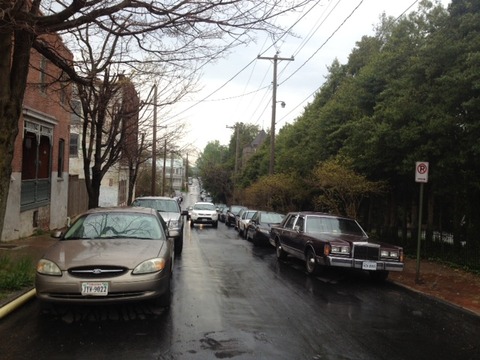
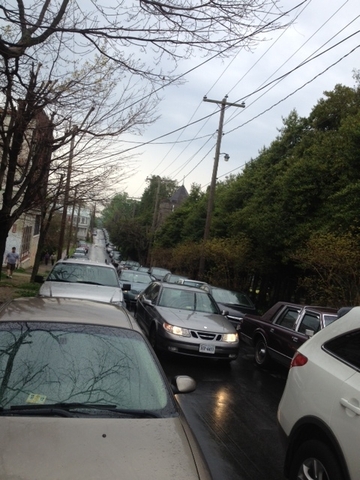
In response to the original SUP application, the city commented that it recommended that the applicant have one parking space per bedroom. The original application had inadequate parking with approximately one parking space for every two-and-a half bedrooms. With the revised SUP, the applicant has far fewer parking spaces along with additional bedrooms, equal to about one parking space for every four bedrooms. While we are pleased that the applicant has eliminated the primary use of the lot at 811 Albemarle Street in the R-7 zoning for parking and has eliminated the proposed curb cut from Albemarle Street onto this lot, this does not relieve the applicant from the burden of providing the necessary parking for the project.

OHNA is not impressed with the spec housing unit that is proposed for the lot at 811 Albemarle Street. The house appears to be designed with materials and trim details, such as vinyl siding and composition shingles, that are inferior to the average Oregon Hill dwelling.

Our association has made it clear that we do not want these apartments to be rented to VCU students. So the neighborhood was particularly dismayed to read in the application that “All sidewalks to be brick to match adjacent VCU construction …”

OHNA has made a sincere effort to work with the developer on this project. We have suggested that renting the units to the elderly would relieve approximately half of the parking requirement while alleviating the neighborhood’s concern that the units will be rented to students. We have suggested that larger units would be more easily converted to condominiums in the future and would require fewer parking spaces. Instead, the developer has chosen to disregard the community’s concerns and disregard the city’s parking and zoning requirements.

In the years preceding and including 2002, the City devoted much time and many resources toward developing an appropriate zoning designation for the Oregon Hill Historic District. The result was R7, a code that was focused primarily on single family housing and embraced wholeheartedly by a community and City Staff/Administration. OHNA considers itself open minded and flexible to reasonable new development within the neighborhood. We have collaborated with such past projects as The Overlook with Steve Middleton and continue to work to better the neighborhood with projects such as the former Synergeo building with developer Nolen Blackwood, proving our commitment to reasonable development.

All projects are judged on their individual circumstances for SUP support. Should a project merit exception, it must exhibit unique and exceptional resources to qualify for relief from certain relevant legal restrictions. For example, if a parcel has a great deal of private parking available or large area of land to accommodate extra density, then we would certainly consider that rationale in our decision. However, in the case of the Victory Apartments, the developer has not made his case for exception and, in fact, was advised by OHNA before closing on the property of the inherent limitations on developing this parcel, including what was acceptable by the community in terms of density and parking requirements.

We respectfully request that Victory LLC be limited to the existing laws and be restricted to the initial ruling of four to six units of two or three maximum bedrooms per unit for its multifamily development with the hope of future single family conversion. This is the appropriate approach and density for our neighborhood.

Again, we encourage the City staff and City Planning Commission to reject the revised SUP as submitted.

Thank you for your consideration.

Sincerely,

Jennifer Hancock

OHNA, President

195 Traffic Alert

From City’s Department of Public Works:

Lane Closure – I-195 at the 9th Street overpass

WHO: City of Richmond Department of Public Works

WHAT: Lane Closure

WHEN: Sunday, July 1 through Wednesday, August 8

WHERE: I-195 at the 9th Street overpass

BACKGROUND: One eastbound and one westbound lane of I-195 will be closed during ongoing structural rehabilitation of the 9th Street Bridge, RMA Plaza Bridge and the Kanawha Plaza Bridge.

Drip…Drip…

Correspondent of the Day in the Times Dispatch:

Water rates target smaller users

Editor, Times-Dispatch:

You ran two Op/Ed columns on Richmond’s water rates. The column by Gloria LeRose, “Water’s worth the cost and effort,” explains that the Department of Public Utilities (DPU) does a needed job protecting our water quality, and what it spends to do so is worth it.

An earlier column by Scott Burger, “City proposes outrageous water rates,” relates to the amount of service charge DPU has in its rate structure, which results in a lower volumetric charge, which in turn discourages conserving water.

While both of these are valid concerns, the main issue with a high service charge is the inequality of cost for small consumers. Someone using 3 to 5 ccfs (1 ccf = 100 cubic feet) of water per month ends up paying about 79 percent of his total bill for service charge, while someone using 100 ccfs per month pays only about 11 percent. The purpose of the service charge is to recover certain fixed costs and should be recovered proportionally based on the amount each consumer uses. Lowering the service charge requires increasing the volumetric rate to compensate for the reduced revenue. There would be no less money for the DPU. There would be no lost revenue.

I raised this issue in 2006 with the DPU after a study recommended reducing the service charge. At that time the DPU indicated it agreed the service charge was disproportionate to the small user and planned to gradually reduce it and increase the volumetric rates. The DPU needs to renew this plan.

Robert Bedell.

Richmond.