One thing that I would like to post more about is Oregon Hill’s rich musical history. Thankfully, Don Harrison is doing a remarkable job of covering Virginia’s in general.
Here are just one of Oregon Hill’s claims to fame, The Rock-A-Teens:
Woo Hoo
One thing that I would like to post more about is Oregon Hill’s rich musical history. Thankfully, Don Harrison is doing a remarkable job of covering Virginia’s in general.
Here are just one of Oregon Hill’s claims to fame, The Rock-A-Teens:
Woo Hoo
From the newspaper archives of the Times Dispatch:
Two guards were yesterday ordered to patrol that section of the City south of Spring Street and east of Belvidere Street, where citizens have been exposed to the disease.
Dr. W.T. Oppenheimer, President of the Board of Health, and Mayor McCarthy held a conference yesterday morning and decided that it was imperative to have the guards placed on the infected section of Oregon Hill to see that no one entered the houses that were quarantined.
At the risk of being alarmist, history does tend to repeat itself, and citizens should be prepared.
From the newspaper archives of the Times Dispatch:
July 22, 1905, Page 2, Image 2
GEORGE RICE DROWNED
——————-
Was Bathing In The Canal Near Hollywood – Body Recovered
——————-
George Rice, the thirteen-year-old son of Dick Rice, of Oregon Hill, was drowned in the Canal, near Hollywood Cemetery while in bathing yesterday morning.
The body was recovered by Pat Woods, who dived for it.
It sort of puts the previous post in perspective…I have been fascinated by the now-online archives of Richmond newspapers. Most of the stories I have read so far that mention Oregon Hill are about dogs, smallpox, and violence, but there are also beautiful descriptions of the neighborhood that could easily apply to today.
Do yourself a favor and search and read through them sometime. I will be sure to be including more Hill history now that these are available.
The press release:
A CITY OLD & HISTORIC DISTRICT PUBLIC CONVERSATION
Wednesday, June 24th
6:30 – 8:30 pm
The Firehouse Theatre
1609 W. Broad Street [MAP]
(Free parking across the street at Lowe’s)
Richmond’s Commission of Architectural Review
and City Staff want to hear from YOU!
Why do we have Old & Historic Districts?
Why do we choose to live in them?
Why do we think they are important?
What does the public want from them?
How can the Commission of Architectural Review (CAR), the City, and residents be better custodians of Old & Historic Districts?
How can we strengthen the alliance between CAR, the City and residents?
This meeting is free and open to all residents and interested parties of Old & Historic Districts.
Please attend. Your input is crucial.
For more information, contact James Hill at james.hill@richmondgov.com
or city staff at (804) 646-6313.
Some insight:
Oregon Hill has National and State Historic Designation, but by choice not City O&H, though it may happen in the future. While I am personally favorable towards O&H for Oregon Hill, many of my neighbors have objected to government involvement and any possible economic hardship from maintaining O&H standards, and I try to respect that. I often try to broach this topic at neighborhood association meetings. If nothing else, I try to keep a sense of humor about it.
We have also watched how the City and State government has not exactly been uniform in its approach to historic preservation. Keep in mind that VCU is exempt from City code and continues to encroach and destroy our neighborhood. The debate about Union Hill’s O&H needs to be heard.
Oregon Hill has the distinction of holding the most individual historic easements in the City. There was actually a DHR meeting at the Jacob House about that not too long ago.
To get on my soapbox a bit, those individual easements are important because while Oregon Hill may lack grand mansions, we are very historic for the overall collection of working class small houses and business fronts. Its not just rich neighborhoods and government buildings that are historic and deserve to be preserved.
Thanks,
Scott
From Richmond History Center:
June 13 (10am – 12pm)
HISTORY HOUNDS EXPLORE OREGON HILL Dogs are invited to join their owners for this of Oregon Hill, in partnership with the SPCA. Dogs must have current shots, mix well with others and remain on a leash. Owners are responsible for water and cleaning up after their dogs. The SPCA will provide bags. Reservations are required: (804) 649-0711 ext. 301. Space is limited.
Meet your guide at Cherry and Idlewood streets. $10 (Pay your guide on the day of the tour. ) Members: $5
Also:
June 14 (2-4pm)
HOLLYWOOD CEMETERY An extension of the daily “Highlights” tour, this version covers in more detail the cemetery’s unique history, landscape design, architecture, symbols and residents.
Meet your guide at the rear of the stone structure at the cemetery entrance at Cherry and Albemarle Streets. $10 (Pay your guide on the day of the tour. ) Members: $5
In Disciples of Vulcan, the Valentine Richmond History Center attempts to illustrate the long history of Oregon Hill in pictures and words. For residents of neighborhood, the beautiful old photographs on display are certain to leave an impression as some combination of recognition, pride, and loss washes over you. Black-and-white images tell the story of the Hill’s growth from its beginnings as a hardworking immigrant enclave to the diverse community that it is now, protecting is roots defiantly in the face of big changes.
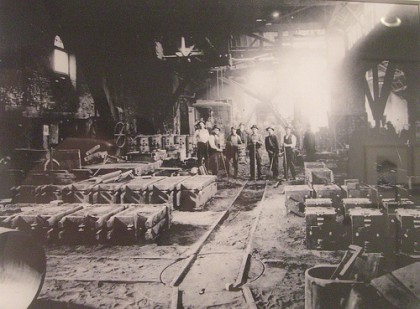
Visitors to the exhibit have a chance to see several long-gone but often-referenced places, such as the penitentiary and the older section of Oregon Hill on the other side of Belvidere. Placards trace the general history of the neighborhood from its start in the early 1800s to the present day, referencing everything from its original demographics to recent conflicts with VCU. A collection of ephemera includes advertisements for neighborhood businesses, a menu from the Chuck Wagon, and flyers for community events.
Although the exhibit is small and can be seen in about half an hour, everyone but the most seasoned neighborhood historians is sure to learn some new facts about Oregon Hill. Disciples of Vulcan could go from great to amazing if more in-depth information were to be added, such as more details about why the neighborhood remained relatively unchanged for as long as it did, race relations, boy gangs, bread riots, and personal stories about life in the area. As it is, the exhibit it a must-see for all Oregon Hill residents and enthusiasts, and will be invaluable in establishing a sense of identity as newer transplants become members of this longstanding community.
The Valentine Richmond History Center is open Tuesday – Saturday 10am – 5pm, and Sunday 12pm – 5pm. Admission is normally $8, but Sundays are Pay What You Can Day. The museum is located at 1015 E. Clay Street.
tess m. dixon
* alwaysmidnight.etsy.com
* parasolparty.wordpress.com
* midnightsocietyrva.com

I have mentioned Oregon Hill’s activist history before, but then I was tipped off about this online entry:
Ida Mae Thompson was an important figure in Virginia’s woman suffrage movement, not for her political work but for her recordkeeping. First as a member of the Equal Suffrage League, the organization that led the effort to win women the right to vote, and then as a member of the League of Women Voters, Thompson collected and preserved the movement’s history.
……
Thompson and her English-born mother moved to Richmond in 1886 to live with Thompson’s brother, Otis, a telegraph operator. The family lived in a rented frame house in the working-class neighborhood of Oregon Hill, on South Cherry Street near Hollywood Cemetery, just down the street from the first free circulating library in Richmond.
…..
(Go to top link for full entry)
Valentine History Center:
Opening May 14th : Disciples of Vulcan: Examining the Oregon Hill Community
“Bordered by Cary and Belvidere Streets to the north and east and Oregon Hill Parkway and Hollywood Cemetery to the south and west, Oregon Hill was settled in the 1840s by Irish and Welsh ironworkers and continues to thrive as a tight-knit working class neighborhood. Using images from the History Center photograph collection, the exhibition will trace the development of the neighborhood’s residents, businesses, institutions and preservation challenges.”

photograph of 614-618 China Street.
There’s been other posts about Grace Arents, but its still great to see Harry Kollatz Jr.’s recent column in Richmond Magazine.
I like the title: “The Invisible Philanthropist: Grace Arents, a shy heiress, transformed her city”.