Education Compact Meeting Scheduled/Goldman’s Proposal

On Monday, July 30 at 6pm City Council, the School Board, and the Mayor are meeting for the Education Compact quarterly joint meeting at the Main Richmond Public Library (101 East Franklin Street).

It will be very interesting to see if there are substantial changes in direction and priority. From an earlier post:

One big question is if the Mayor and other leaders who ran and were elected on ‘Education’ platforms will continue to champion the Tom Farrell coliseum plan while ignoring the Put Schools First movement. No doubt, we will hear the same tired and false arguments about how Richmond needs to increase its tax base BEFORE modernizing schools. Don’t fall for them. Take note of what is being financed before school modernization, and who proposes what. Another question is what political candidates will eventually emerge to challenge the leaders who don’t want to put schools first.

Meanwhile, from former Chairperson of the Democratic Party of Virginia and local activist Paul Goldman, on school modernization financing:

Part (1): STATE LEVEL. Assuming the $250 million annual projection is accurate, it is being both principled and pragmatic to propose using $150 million of the $250 million to support the debt service on the first-ever state K-12 school bond issue. To repeat: These are not funds from a new tax but merely from taxes currently owed yet knowingly not paid. Thus both parties can support this approach without violating any platform promises. Part (2): LOCAL LEVEL. Since this is a first-ever proposal, it makes sense to ask localities – legally responsible for local school maintenance and modernization – to match $100 million from this historic state contribution. I have studied local financial resources. This is a very fair number to use with accomations for certain distressed localities. Part (3): Brown II Mandate: The fact Virginia refused or failed, depending on your point of view, to live up to the state’s responsibility under the long overlooked maintenance and modernization part of the decision doesn’t justify continuing to avoid responsibility 63 years later! Indeed, the opposite imperative is more to the point. In that regard, the state can afford to allocate $150 million annually to fix school facilities covered by that case but never properly addressed.
THE BOND ISSUE MATH:’
Part (1) can pay debt service for roughly a $ 3 billion dollar 30 year bond issue at current rates. Part (2) can pay debt service for roughly another $ 2 billion and Part (3) can pay debt service for roughly an additional $3 billion. Added together: $8 billion potential. The plan outline assumes the state will be backing everything and that certain laws will be amended accordingly. Thus a bipartisan consensus is possible to develop an historic state/local effort to address the “crumbling” school facility crisis distressing Governor Northam. I have conceived it as a pilot program, requiring state and localities to work together here. Should the Kaine-Evans legislation pass, the dramatic reduction in local school modernization costs for many projects would allow the bond issue contemplated here to be more far reaching.
…
The key point: All three parts are independent by design . Part 1 is the base of any state initiative. It can pass stand alone. Part II is my judgment of a likely political decision to have a match type requiremeant with consideration for hard pressed areas. Part III is my own view that a Brown II initiative is both orally and historically justified/right thing to do and would be enactable you got pervious consensus for Parts 1 and 2. Like any other bold out of the box idea, it is a work in progress, designed for improvement by others. But progress requires someone doing the work to get it out there so the discussion has a concrete reference point. Improvements welcomed!
Letter From State Senator Stanley To Mayor Stoney

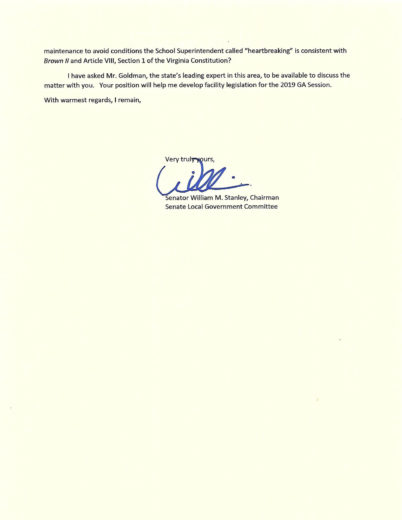
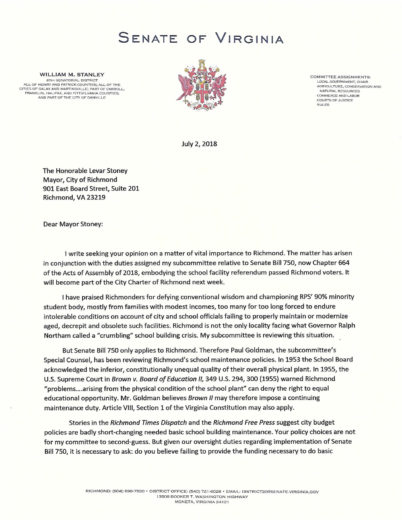
VA Senator Bill Stanley, the Chairman of the new State Senate Subcommittee on School Facilities, wrote a letter to Mayor Stoney. It was emailed to the Mayor’s office this morning. In keeping with the Subcommittee’s mandate to keep abreast of the implementation efforts required under S.B. 750 in RVA (effective yesterday as the new School Facilities mandate in the Richmond City Charter), Senator Stanley has written the letter requesting an answer to a matter of vital importance to RVA. It is hoped the answer will prove helpful in drafting new legislation for the 2019 GA Session that can benefit RPS school students.

Broken Promises: Richmond’s Leaders Don’t Want To Put Schools First

As the local media has noted, starting today, prepared meals in the City of Richmond will cost more. At the same time, City residents are receiving property tax assessments that show huge increases. So what, some liberals (many of them relatively new and affluent come’heres) say, all that money will help the schools. Unfortunately, the reality is quite different. And what facts show is a whole reel of broken promises.

Recall that the previous meals tax increase from more than a decade ago, which was passed to pay for the private, now-defunct Virginia Performing Arts Foundation, was promised to help children. The boosters for that deal, including some members of City Council, promised, infamously with ‘feet held to fire’, that the meals tax would be rescinded once the Carpenter Center was renovated. And that was not the only dishonorable lie that followed. But this has all been covered before….

Let’s fast forward, past other attempts to hijack public money, to this year, when City Council passed yet another meals tax increase (while voting down a proposed cigarette tax). Everyone promised that all of this money would go to the schools. Really?

From an article in this week’s Richmond Free Press, written by reporter Jeremy Lazarus:

But in a little noticed policy shift, City Hall and the Richmond School Board have agreed to cut back that investment ahead of Sunday, July 1, when Richmond diners will start to see the government’s take from meals rise from 11.3 percent to 12.8 percent, including the 1.5 percent earmarked for schools construction.

Instead of spending $150 million — a level of expenditure even the mayor acknowledges falls far short of the need — City Hall and the Richmond School Board plan to invest $100 million to $110 million, leaving $40 million to $50 million unused.

Instead of four schools, requests for proposals to build just three new schools — two elementary schools and a new middle school — were issued last month by City Hall, which is handling procurement.

Also consider what local activist (and former chairperson for Virginia’s Democratic Party) Paul Goldman wrote yesterday:

Redskins v RVA School Children? In 14 hours and 15 minutes, the new unprecedented Richmond City Charter provision on School Facilities will become law. The City’s elected leaders all decry the intolerable building conditions, a top official calling them “heartbreaking.” But in the new city budget likewise effective tomorrow, the Mayor/Counsel slash basic annual maintenance 80%, claiming RVA lacks the $400000 needed to finance such repairs. At the same, they voted to provide $750000 – for the next 15 years – to finance the training facility built by the city for the Redskins!

Yes, that’s right, the much celebrated, popular Put School First referendum is now law also. And hopefully it will inspire and spawn other referendums across the state.

That said, given the Richmond Free Press revelations, Richmond school modernization still faces an uphill battle. At a get-together at K-Town restaurant this past Thursday, Paul Goldman was pretty negative about real change happening, taking stock of the lack of legal momentum and a Richmond leadership that has been hostile to public demands.

One big question is if the Mayor and other leaders who ran and were elected on ‘Education’ platforms will continue to champion the Tom Farrell coliseum plan while ignoring the Put Schools First movement. No doubt, we will hear the same tired and false arguments about how Richmond needs to increase its tax base BEFORE modernizing schools. Don’t fall for them. Take note of what is being financed before school modernization, and who proposes what. Another question is what political candidates will eventually emerge to challenge the leaders who don’t want to put schools first.

Open High Students Find Grading Problem

From WTVR.com:

The Open High School student said she realized midway through her junior year that her number one ranking had dipped to fourth, but she couldn’t figure out why. So she and her parents delved deep into the details and took what they found to the school system.

“It has definitely been a long journey worth fighting for,” Ward said.

She discovered that her GPA had miscalculated, and that Richmond students weren’t getting enough points for dual enrollment classes and International Baccalaureate courses. Ward joined other students and parents who vowed to hold Richmond Public School officials accountable for correcting the situation.

School Walk Out and March Planned For Friday; Could Impact Traffic/Parking

From NBC12 news:

Another anti-gun violence school walkout is planned for Friday, and this one will include a rally at the Virginia State Capitol.

– – –

The protest will begin at 10 a.m. with a school walkout to honor the Columbine victims. Then starting at noon a march will take place from Brown’s Island to the Capitol.

Police are expecting a crowd of about 10,000 people to participate, and are asking people who are normally in that area during the day to be patient and plan ahead due to the rally.

Richmond Leading (For Once, But Hopefully Not The Last Time)

Yesterday, Sen. Bill Stanley, R-Franklin County, announced that he will create a subcommittee to address concerns about “obsolete” school buildings across the state.

In doing so, he credited Richmond’s Put Schools First campaign for “being the catalyst” in raising issues plaguing poor school districts. He specifically mentioned both Sen. Glen Sturtevant, R-Richmond (a former city school board member and Oregon Hill’s state senator), and Democratic political consultant Paul Goldman. But of course, the campaign was bigger, a grassroots effort that included the Richmond Crusade for Voters, the Sierra Club Falls of the James, and the Richmond Green Party as supporting organizations.

Paul Goldman had this to say:

Thank you Richmond! As Senator Stanley says, YOUR willingness to buck the Mayor, the City Council, School Board, and give 85% support to last year’s School Facility Modernization Referendum “opened the eyes” of state officials. What the RTD’s “know it all” editorial board – with Amens from the usual RVA chorus – called a “distraction” is now positioned to make a huge difference. Democratic Governor Northam agrees with Republican Stanley about the damaging impact to those children attending a “crumbling school building” to use the Governor’s term. The average VA child, not just in RVA, but rural, suburban, and urban school communities in the Commonwealth attends such an obsolete, aged, building! YOU did it 56000 voters, YOU stood up for the kids, I applaud everyone, YOU deserve it.

All well and good. Of course there’s a lot of work ahead. And many supporters hope that this school modernization revolution will add green building, energy conservation, and working solar that can save taxpayer money.

Speaking of which, let’s hope this is not the only revolution that takes hold. This past week, the University of Maryland’s Program for Public Consultation presented new public opinion data that shows American voters are eager for three key electoral reforms that would give voters a greater voice at the ballot box and more fair representation in government, while tempering the partisan rancor that currently dominates our politics. Those three reforms are ranked-choice voting, multi-member districts, and congressional redistricting with nonpartisan commissions.

All three proposals were seen as at least tolerable by more than two-thirds of respondents, including super-majorities of Republicans and Democrats. Not surprisingly, given the outcry over partisan gerrymandering in recent months and two cases currently under review by the U.S. Supreme Court (Gill v. Whitford and Benisek v. Lamone), redrawing congressional district lines with nonpartisan citizen commissions is supported by the largest number of voters – 66 percent – including 53 percent of Republicans, 80 percent of Democrats and 62 percent of independents.

OregonHill.net has repeatedly called for ranked choice voting, for President of the United States, and for Mayor of the City of Richmond. Of course, the local corporate media has answered these calls with mostly silence. And, undoubtedly, local corporate Democrats will continue to try to corral these reforms and any other progressive movements by barking “But Trump” as loudly as possible. As horrible as conman Trump is, voters would be wise to use their own critical thinking.

Let’s hope Richmond, learning from Put Schools First referendum, can lead on voting reforms for the rest of the state.