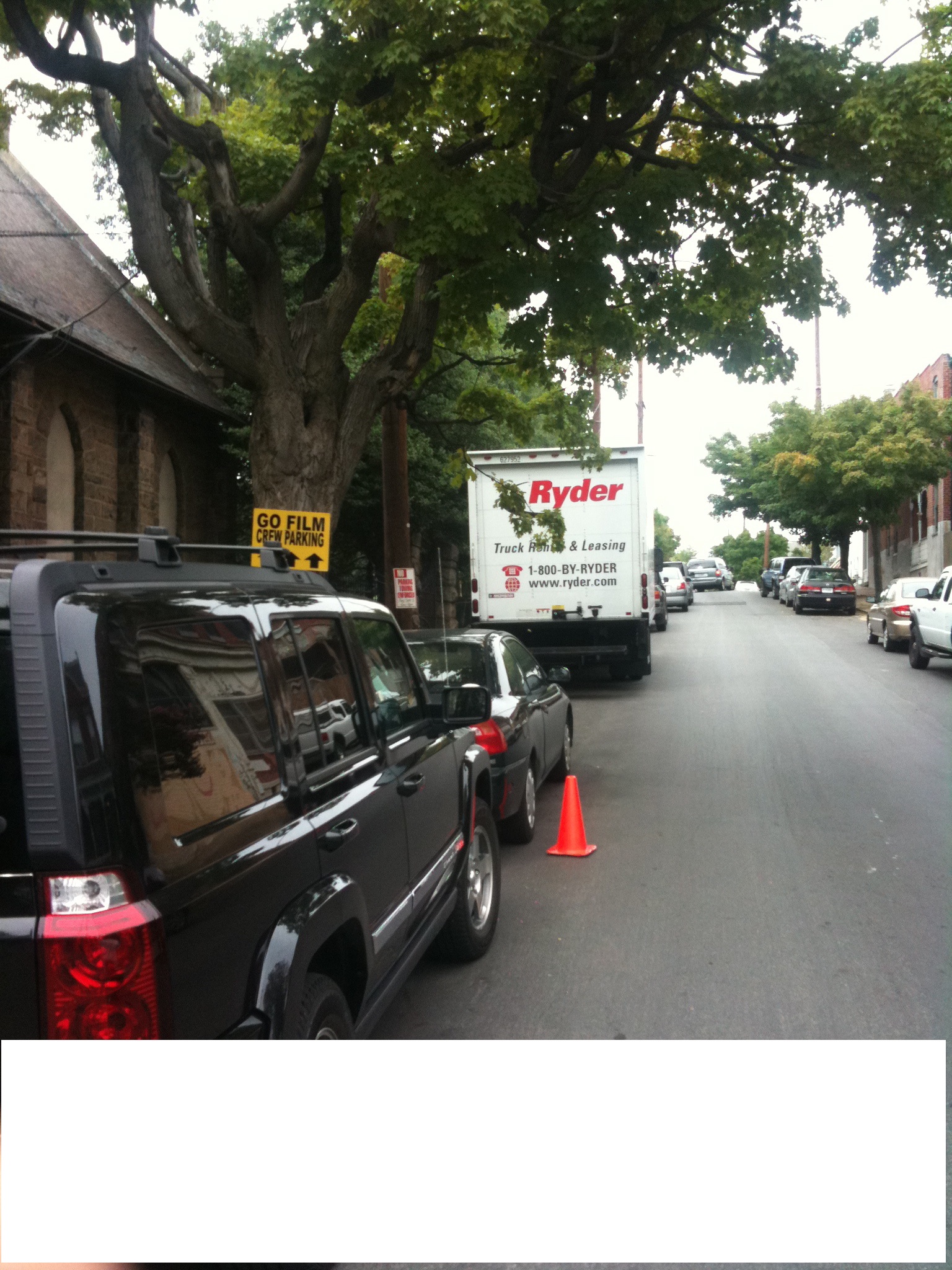
I followed the yellow “GO FILM” signs to 400 block of S. Cherry Street. A lot of catering goin’ on. Some guy told me that there was an Anthem commercial being shot at this residential location. He told me no movie stars (like I cared about that). I thought about starting a single person Single Payer protest right then and there, but decided not to, considering the afternoon heat. Besides, I was not sure what to believe since I have heard of another film production coming to the area.
City Collection Schedule Changes For Labor Day Holiday -Plus Code On Refuse and Recycling
From City press release:
Labor Day Schedule for
Refuse CollectionIn observance of the Labor Day holiday, city offices will be closed Monday, September 6. Solid Waste Management Division also will be closed. Refuse collection will be delayed by one day and will resume on Tuesday, September 7 through Saturday, September 11.
East Richmond Road Convenience Center and the Hopkins Road Transfer Station also will be closed on Monday.
For more information on city services and schedules, please visit us on line at www.RichmondGov.com.
###
Garbage for Oregon Hill is usually on Wednesdays, so I guess garbage pickup will happen on Thursday this coming week due to holiday.
Recycling usually happens for Oregon Hill every other Wednesday. This coming week’s curbside recycling will happen on Thursday, the 9th, according to CVWMA schedule.
And, since we are at it, it seems like as good of time as any to remind residents of City code concerning refuse and recycling; here is a sample:
Sec. 86-44. Times and places of collection; bulk items; brush collection; collection of loose leaves.
(a) Refuse receptacles and recycling bins must be placed out for collection by 6:00 a.m. of the scheduled collection day but not earlier than 4:00 p.m. of the day preceding, except for any special times as deemed necessary by the director of public works. The refuse receptacles and recycling bins must be removed by 7:00 a.m. on the day following collection from city property and right-of-ways to include, but not be limited to, sidewalks, alleys and median strips between sidewalks and roadways. Refuse receptacles and recycling bins shall be placed for collection at a location designated by the director of public works. The public utility account holder of any property to which a refuse receptacle has been assigned shall be responsible for removing the refuse receptacle from city property by 7:00 a.m. on the day following collection. Any account holder who allows a refuse receptacle or recycling bin to remain on city property after 7:00 a.m. on the day following collection shall receive a notice from the Department of Public Works advising of the violation and allowing the account holder an opportunity to remove the refuse receptacle or recycling bin. If the refuse receptacle or recycling bin is not timely removed from city property, the Department of Public Works shall cause the account holder to be assessed a civil penalty in the amount of $50.00 for each and every calendar day that each and every refuse receptacle or recycling bin remains on city property beginning with the date of the most recent past scheduled pick up time from the Department of Public Works. Such civil penalty shall be included on the account holder’s monthly utility statement and shall be subject to collection in the same manner as other utility charges including delinquent charges for utilities.
Article: Finding the Balance Between VCU Student Renter and Oregon Hill Resident
Last year multimedia journalism graduate student Jaclyn O’Laughlin created an article on neighborhood tensions between VCU students and longtime Oregon Hill residents. I have purposely waited to post it here until the semester started.
Here’s an excerpt:
“For many students that are here, they are away from home for the first time and they can go hog wild. It all comes down to the kids being young, which is not a problem, but they don’t have a lot of experience and some of this stuff hasn’t occurred to them,” said Jennifer Hancock, interim president of the Oregon Hill Neighborhood Association. “The point of view for some of them is that they are only going to be here for four years and they don’t care.”
The residents of Oregon Hill are not trying to pick on or “dog pile” the students, Hancock said. She believes that students have a different perspective than the long-term residents that live in Oregon Hill, because most students know they will only live in the neighborhood for a few years and eventually move away.
Read the entire article and see online video by clicking here.
Monroe Park plans revealed
NBC12 has a story on the $6 million in renovation/upgrade plans for Monroe Park, thanks to the hard work of the Monroe Park Advisory Council.
There will also be a story in Style Magazine published tomorrow.
‘CarnivOil’ Comes to Monroe Park Tomorrow
From the press release:
‘CarnivOil’ Comes to Richmond, Celebrating the Greatest Addiction on Earth
Big Oil: Keeping America dependent on oil for 150 years and celebrating
victory over
Virginia’s clean energy futureRichmond, Va. – The U.S. Senate’s failure to pass a clean energy and
climate bill this summer, coupled with the continued push to block new
clean air standards, is reason to celebrate if you profit from America’s
oil addiction. Highlighting Big Oil’s stranglehold on Washington, we
present “CarnivOil”: the Greatest Addiction on Earth – a celebration of
America’s addiction to oil with an outdoor midway-style carnival
complete with games, concessions, and some Big Oil-style celebrating.
Step right up! Don’t be afraid. See the world’s biggest polluters – by
looking behind the curtain.Games will include the Petroleum Wheel of Doom, Oil Executive Boxing and
the Big Oil version of the famous Hammer game. The event highlights Big
Oil’s success in pocketing Congress, while blocking progress toward a
clean energy future and threatening to kill American jobs and worsen
public health with the Dirty Air Act.WHAT: CarnivOil: The Greatest Addiction on Earth: complete with games to
celebrate Big Oil’s successWHEN: Tuesday, August 31, 2010
TIME: 11 am – 1 pm ET
WHERE: Monroe Park, 620 W. Main St., Richmond, Va. 23220
####
For more information, contact:
Sarah Driscoll, sdriscoll@environmentvirginia.org
Phone: (603) 236-2097
Oregon Hill Street Names A-S
Paraphrased from Thomas F. Mustian’s “Facts and Legends of Richmond Area Streets” (I think I have a second printing):
Albemarle Street was named for William Anne Keppel, second Earl of Albemarle and Governor General of the colony from 1737 to 1754.
Belvidere Street took its name from home of William Byrd III on the crest of what is now Oregon Hill. Originally, part was traversed by railway trackage.
Cary Street was originally laid out by planners to be called “C” Street according to the alphabet being third in order from the North side of the James (River). It was changed later to be called Cary Street in honor of the many Cary’s that held historic bearing in the early beginning of the City- probably Archibald Cary.
Cherry Street is one of the early streets of Oregon Hill named after the fruit tree.
China Street is named after the Chinaberry tree.
Church Street (no longer exists, was east of Belvidere) was located in the Oregon Hill area and for the short distance it covered there were located several churches.
Cumberland Street is named after the Duke of Cumberland, the third son of King George II.
Holly Street was named by developer Ben J. Harris for the trees grown there.
Idlewood Avenue was originally called Beverley Street. It was changed to be compatible with the Avenue of access to the Idlewood Amusement Park and located near the newly formed Byrd Park.
Main Street is the industrial and commercially centered early street, that in it’s beginning only ran from 18th Street to 25th Street.
Pine Street was named as was popular then for the Pine Trees.
Rowe Street (no longer exists, was east of Belvidere) was named after a Millwright who was the builder.
The following were not included in the book:
Beach Street (no longer exists, was just west of Linden Street)
Green Alley was named for was named after Ben Green who was involved in a
fairly high-profile, alleged bank embezzlement case around the mid-1800’s. More importantly, at
least as far as Oregon Hill residents should be concerned, is that Green was
the architect of the first row houses in the neighborhood.
Laurel Street was most likely named for the trees that grew there.
Linden Street was most likely named for the linden trees that grew there.
I am looking for more information on the following:
Beach Street (no longer exists, was just west of Linden Street)
Harrison Street (I am guessing was named after President William Henry Harrison, but I would appreciate it if someone could confirm)
Howard Street (no longer exists, was east of Belvidere)
Howe Street (no longer exists, was east of Belvidere)
Maiden Lane (no longer exists, was east of Belvidere)
Spring Street ( I assume there was a water spring involved.)

WBCH Offers Artery Tour This Tuesday
There is an atherosclerosis simulator that is touring our area from August 19th – 31st; it will be located at the Byrd House Market (Linden Street) on August 31, from 12 -6 pm. It shows a journey through the arteries with plaque build-up and blockages. It only takes about 5 minutes each session and can accommodate 10 people at a time. This is free. See flyer below for more information.
Finally, ZipCar
Glad to see this…(I have been asking for about three years..)
RichmondBizSense:
Finally, Zipcar is in Richmond
Zipcar is known for renting cars, usually the environmentally friendly type, by the hour in cities and college campuses across the country. Before coming to Richmond, Zipcar already had cars at the University of Virginia, Old Dominion University and The College of William & Mary.
That’s why it was hard to discern why the company continued to bypass Richmond. BizSense has an inquiry in to Zipcar’s corporate headquarters to find out why Richmond finally got its chance.
TimesDispatch:
VCU offers Zipcars, additional bus service
The cars are not limited to student use, though clean driving records are required. VCU students must be 18 years old and community members at least 21 to rent a car at a cost of $8 an hour on weekdays and $9 on weekends. That includes gas, insurance and 180 free miles.
There’s also an annual membership fee of $35 for students, faculty and staff. Drivers not affiliated with VCU pay a $50 annual fee plus a $25 application fee.
Newspaper Story on New Student Housing East of Belvidere
The Times Dispatch ran this story today:
Private housing for VCU going up east of Belvidere
Excerpts:
Gilbane Development Co. of Providence, R.I., said its 540-bed, eight-story apartment building off Canal Street should be ready for the start of the 2011 school year.
“We’ll start leasing over the next month,” said Russell Broderick, vice president and senior development manager for Gilbane. “Students will move in in August 2011.”
The $18 million building, designed by Grant Architects of Baltimore, includes 160 apartment units on six levels, and parking on two levels.
——-
Rents will be in the range of $600 to $700 per person, Broderick said. The units will be furnished.
“We’re excited to offer students a modern environment including amenities which appeal to today’s lifestyle, including flat-screen televisions, in-unit washer/dryers, and full kitchens,” Robert V. Gilbane, chairman and CEO of Gilbane Development, said in a statement.
Campus Advantage will offer students activities designed to create a thriving student community.
The green project was designed in accordance with the LEED — Leadership in Energy and Environmental Design — accreditation system, the development company said.
The project — called 8½ Canal Street — broke ground in early spring.
With 32,000 students, but only 4,882 spaces for students in university housing, VCU believes demand is sufficient to fill both its own residence halls and privately developed projects…
The Polluted James River
While there has been some progress in cleaning up the river, this newspaper report reminds us all that there are still problems to be addressed:
Of local interest, the report disclosed additional problems with the James River in Richmond.
The stretch from the Boulevard Bridge to just upriver from the Mayo Bridge — an area popular with paddlers, waders and swimmers — was listed as polluted with mercury and the long-banned pesticides DDT and chlordane.
That stretch already was known to be polluted by fecal bacteria, primarily from the waste of wildlife and upriver cattle, among other sources.
DEQ spokesman Bill Hayden said the additional pollutants don’t pose a threat to people in the river. They primarily mean that eating fish from that stretch could be unsafe.
Gerel said, “More than likely all this has been there forever, and we just haven’t caught it” until now.
Some mercury, however, could be getting in the river from air pollution from coal-burning power plants, Gerel said.