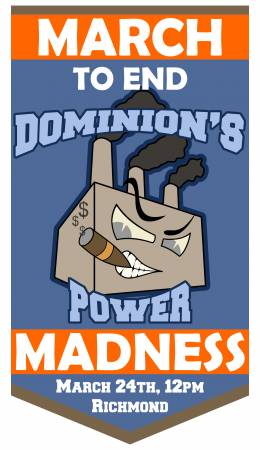
MARCH to End Dominion’s Power MADNESS This Coming Saturday

Given some earlier editorials, it makes sense to follow up with an announcement from the Chesapeake Climate Action Network:

On Saturday, March 24th, hundreds of Virginians will take a stand against fossil fuel corruption. Will you join us at the MARCH to End Dominion’s Power MADNESS?

For years, Dominion Virginia Power executives have been raking in millions while using their dirty energy money to buy political power. They’ve been making backroom deals to rig the rules for fossil fuels and for themselves. They generate ZERO electricity for us from wind or solar power but they’ve bamboozled our state-mandated electricity rates to include a whopping $76 million renewable energy reward.

We are outraged and Dominion needs to know it. If this is what business as usual looks like, then business as usual isn’t acceptable and has to stop before the planet cooks. It’s time for Virginians to stand up to Dominion’s exploitation and fight for a massive shift to wind and solar power.

Momentum is building for this action. Last week, leading climate activist Bill McKibben released a video urging Virginians to sign up for the MARCH. Will you join us?

When: Saturday, March 24th, noon
Where: Richmond, VA- Kanahwa Plaza across from Dominion’s corporate headquarters, which takes up an entire city block
What: A rally and march to take a stand against Dominion’s dirty energy money and for a massive shift to wind and solar power

Just last week, Dominion displayed its fossil fuel madness in a number of ways: Dominion lobbyists blocked a bill to expand solar power access for schools and churches, Dominion CEO Tom Farrell unveiled a proposal for another humongous carbon-polluting power plant and we learned that company executives sent a letter to the federal government opposing a transmission backbone for offshore wind power.

Please sign up to join us on the 24th. Together, we can fight back against Dominion’s corporate greed and take a stand to stop climate change!

Late Notice On Visit to Mali

Chris Maxwell reminded me that this is happening

The Vicarious Traveler’s series offers an opportunity to travel and learn about customs and cultures around the world. Though shared pictures, stories, music and discussions we can start to understand how interrelated we are and our role in this world we inhabit. This experience will hopefully make us all better stewards of our land and cultures.

Saturdays in February & March
February 4: Easter Island- Kristin Smith, lifelong traveler, will talk about her trip to Easter Island and how to save money traveling abroad.
February 25: Jordan- Virginia Vasser will talk about her trip to Jordan and offer other insights into Muslim culture.
March 3: Mali and Senegal- Dr. Robin Poulton and Virginia Vasser discuss their visits to two former French colonies. Dr. Poulton’s recent book oabout Mali will be available for purchase at the hostel after the program.
March 31: Tanzania- Alice Baird presents slides of Tanzania’s gorgeous scenery and amazing wildlife.
3:30-5 p.m.
Richmond Main Library

Refreshments provided by the Richmond Hostel Committee. Programs are free and the public is invited.

The series is part of Hostelling International’s Opening Doors, Opening Minds initiative, which brings into sharp focus a vision that hostellers can become caring world citizens who are catalysts in creating a more peaceful world.

Programs will be followed by an optional tour of the future Richmond Hostel under
development near the Main Library.

A couple of quick editorial notes/comments-

Segou, Mali is one of Richmond’s Sister Cities.

While the Times Disgrace continues to trumpet the corporate development plans, it’s things like the Sister Cities program and the future Richmond Hostel that really speak for sustainable, intelligent tourism in Richmond.

Sierra Club Speaks Against Proposed 2nd Street Connector

The letter:

February 1, 2012
Honorable Dwight C. Jones Office of the Mayor
900 East Broad Street, Suite 201 Richmond, Virginia 23219
Re: Opposition to Proposed 2nd Street Connector

The Sierra Club Falls of the James group would like to express our many concerns regarding the recent proposed riverfront development just west of downtown. In particular, we see several issues with the proposed “2nd Street connector road.”

Lack of Amenities for Bicyclists and Pedestrians
First, we share the concerns expressed by neighborhood and bicycle groups about the lack of bicycle lanes and pedestrian features in plans for this development. It is absolutely hypocritical for the City to declare itself “bicycle-friendly” while creating a new roadway in its downtown riverfront without these measures. This sends all the wrong signals as the 2015 World Road Cycling Championship approaches.

Disrespect for Historic Context
Secondly, we are very interested in protecting the historic features of the Kanawah Canal that this proposed roadway will bisect. The canal, listed on the National Register of Historic Places, is of great historical significance to the City of Richmond. It was first development of the city. Samuel Pleasants Parsons, a noted abolitionist, whose home (built in 1819) survives at 601 Spring Street, was the Superintendent of the Canal in 1840 when the Canal was expanded westward to Lynchburg. From about 1850 to 1875, John Messler ran a canal boat building enterprise in the Penitentiary Basin. Messler had a short walk from his home the Jacob House (which survives at 619 W. Cary Street) to the canal basin. Based on these facts alone, we believe that any construction in the area should be preceded by careful archeological investigation. All of the historic images of Richmond’s Kanawha Canal emphasize how important this area is to the City’s identity, and it deserves better than the typical corporate campus driveway treatment.

Environmental Degradation and Canal Boat Impasse
Thirdly, in addition to the history of the canal, its natural aspects also bring up important environmental concerns. Putting a paved road over the canal and so close to the river will have a significant effect on stormwater runoff in the area. With the James River Park so close by, any development of this area will have an adverse effect on the environment. We understand that the land above the canal area is ready for development, but the canal area itself is not. While much of the land for this proposed road may be on private property now, for the City to accept its donation under these circumstances is not proper environmental stewardship.
Moreover, we are listening to Jack Pearsall, who has served with the Historic Richmond Foundation and City planning committees and who has championed the canal as a transportation alternative. He has raised red flags with regard to how this proposed road will meet the historic canal. He has estimated that the culvert would be about 12 feet high with only about 6 feet of clearance if water flow were restored. That means typical canal boats would not be able to pass.
In a recent Richmond Times Dispatch article, Mr. Pearsall was quoted as saying, “The purpose of the canal is to float boats. If we’re going to float boats on this canal, they’ve got to be able to pass this constriction.”

Disregard for Possible Alternative Future Uses
We also note public support for this restored canal concept. There was support for it twenty years ago, and support for it was again expressed at the recent public riverfront planning meetings. Planning for the canal might be a question of whether the chicken or the egg comes first. At first the canal might be seem to be mostly for tourist boats up to Maymont and an extension of the history tour on the canal downstream; but some day the larger culture may see the benefit of and begin to use “water taxi” for transporting commuters downtown or to the slip, and eventually it may be functionally necessary again for commercial forms of traffic moving up the river. Navigable water is wisely being mapped with an eye on the future value to the state and municipalities as real estate. The movement to open and protect blue-ways is focused especially on keeping a cap on the scale of expansion or commercialization. Re-opening the canal must also be designed within the context of supporting conservation easements to prevent sale of any segments of James River Park.
We might say to ourselves that that little canal would have to be expanded to carry significant traffic once again, yet we must also look at the canal as it is: an existing option that we protect with foresight now while we have the chance, in preparation for the time it might need to be pressed into service because of a lack of resources for the kinds of massive infrastructure projects that we in our time are temporarily fortunate enough to consider ordinary.

Exacerbated Traffic Problems
Finally, we share concerns expressed by neighborhood groups with regard to traffic and further riverfront development. We recall our opposition, along with that of over a dozen other neighborhood and environmental groups, to Dominion Power’s Special Use Permit for its headquarters building on the riverfront. At the time, traffic was brought up as a chief concern, and Dominion assured City Council that existing roadways could serve the additional traffic created by its development. Now ten years later, Dominion is insisting on this new road while at the same time saying it has no plans for new development “at this time.” Oregon Hill neighborhood residents have made it clear there already are problems with additional traffic coming from the 195 expressway onto Idlewood Avenue that would be exacerbated by the 2nd Street connector. The City Department of Planning has not delineated the necessity of this road for emergency access.
In summary, the Sierra Club Falls of the James Group does not see the purpose of this road, and more pointedly, we are opposed to its current planning for the reasons set out above. We are not totally opposed to development in the area, but what has been suggested so far in regard to the Kanawha Canal and the 2nd Street Connector is not acceptable. We welcome the opportunity to discuss this matter with you.

Sincerely,
Adele MacLean, Co-Chair

Cc: City Council, Planning Commission
Dominion Power and HB 657

Having written about Dominion Power and renewable energy on this site before, there is simply no reason to let up.

Here’s the latest, including a solution for the General Assembly in the form of HB 657:

Virginia’s “voluntary” renewable portfolio standard is voluntary for utilities, but it’s mandatory for ratepayers. Utilities charge citizens for the energy they buy to meet the goals, and then they get to charge citizens again for their bonus under the law. The idea behind the law was to incentivize utilities to buy renewable energy, but utilities have treated it as an entitlement program for their shareholders and are doing the minimum possible to earn their profit.

Everyone thought the 2007 law setting up the renewable energy incentives would result in Virginia-made wind and solar energy. That hasn’t happened, and yet utilities are collecting their full bonus amounts just as if they had made a real effort.

Dominion Power ran advertisements in 2010 claiming they were building wind farms “to power Virginia’s energy future.” Those ads misled everyone into assuming they were doing just that. But they have built no wind farms in Virginia.

Dominion talks a good game about renewable energy, but the reality came out in its rate case this fall, when it had to reveal the energy sources it was using to meet Virginia’s renewable energy goals. Almost all of it consists of old conventional hydroelectric plants from dams. None of it comes from projects built after 2000, and none of it is wind or solar.

Legislators should support HB 657 (Rust), the RPS reform bill, in its current form, including the provisions for Virginia-made wind and solar energy. If the final bill does not incentivize wind and solar in Virginia, the RPS law should be repealed rather than charging ratepayers millions of dollars extra.

The Virginia-made requirement makes sure that the ratepayers who are paying for the renewable energy are getting the benefits of it. Building wind and solar energy in Virginia is important to create new jobs here for Virginia’s young people, to increase energy supply without adding air pollution, and to give Virginia a stake in these fast-growing industries.

Coal In Their Stocking- Dominion’s Permit Has Expired

Speaking of Special Use Permits, local citizen watchdog C.Wayne Taylor has been just as concerned about the latest flurry of riverfront planning as Oregon Hill neighbors.

He has started asking some very pertinent questions and has come to the conclusion that, despite what local officials may or may not say, Dominion Resources’ riverfront SUP has legally expired:

In 2001, City Council approved a special use permit for the Dominion Resources headquarters on Tredegar Street. The permit increased the maximum allowed building heights within a sloping “envelope” that extended from 60 feet above ground level to 160 feet above ground level.
Under the terms of the permit, it would automatically expire if certain conditions were not met. The city maintains that the conditions were met and that the permit is “still valid.”
The facts indicate that the permit expired. The property owner failed to meet the deadline for using the special use permit. The development that occurred on the property complied with the zoning regulations and did not require the special use permit.

Look for Dominion to try to quietly go behind the scenes and change things to their advantage. After all, this is what they do. And continue to do.

And don’t look for the local corporate media to cover it, after all, this is what they they won’t do. Why is it up to this little neighborhood community news site to mention the local connection to the MF Global story, where a former United States Congressperson and Governor “doesn’t know” where over a billion dollars went?

Citizens, remain vigilant!

Bridge Improvements Too?

As we look forward to Holly Street playground improvements, hope for green alleys and Idlewood roundabout, and stubbornly await OUR canal bridge, we might consider this discussion on Church Hill People’s News about proposed modifications of the Martin Luther King Bridge. (Click here for link)

How about Oregon Hill’s 195 overpass/bridges? Would we want to similar improvements? Or should we hold out for a bigger project to cover the 195 expressway completely, making the “highway” a tunnel and reclaim the space above?

The Future of Our Alleys?

One reoccurring question on this community news site concerns the future of our alleys. Oregon Hill, one of Richmond’s oldest neighborhoods, sadly had many of its alley stripped of their historic cobblestones by the City and developers years ago (Where did they go?). Over time, their surfaces have been made either loose gravel or smooth pavement. The results have been less than desirable.

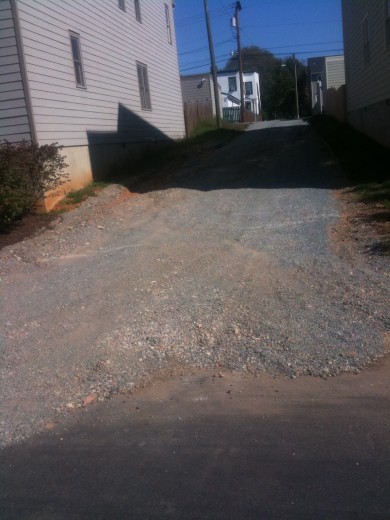
In the alleys that have been paved, residents have experienced more cars speeding and more rain runoff. In the alleys still with gravel, giant potholes, huge ruts, and spillover into streets (as in the picture below on the 500 block of S. Cherry) develop.

Things have recently come a head in the 100 blocks above the expressway (wryly known as the Oregon Heights) and have been discussed a bit on the City’s SeeClickFix system.

Continue reading

2nd Street Connector Draws More Citizen Scrutiny- What Does It Mean For ‘Riverfront Planning’?

While OHNA urges support of the City’s interest in protecting the historic resources in the canal basin, citizens continue to question plans for the proposed 2nd Street connector street.

C. Wayne Taylor provides a great graphic with details on his City Hall Review site.

One Oregon Hill resident sent this to me on September 30:

I have many comments and questions about traffic.

Bike Lanes
I’d be more likely to bike on this new road vs drive. If it must be built then bike lanes are a must.

Roundabout
We’ve been waiting for a long time for the Idlewood roundabout. I’d like to see that finished before we build a 2nd Street connector. After the last OHNA meeting I noticed there was a traffic accident at the 3 road merge exactly where the roundabout would be located (Grayland + Idlewood + RMA ramp). We need sidewalk improvements here and we should add bike lanes as well. The Byrdhouse Market would benefit from these improvements as well.

Pedestrian Bridge
We’ve been waiting for a long time for the Pedestrian Bridge. I’d like to see that finished before we build a new 2nd Street Connector.

Area Traffic
Will we see more traffic coming from the Idlewood RMA ramp? Will people shortcut through the neighborhood down Idlewood and or S Laurel? I commute down Spring St out of Oregon Hill and turn left onto 2nd Street to get downtown for work. Will the morning southbound traffic on 2nd hinder that left turn during rush hour? Will there be any traffic lights added? Will there be a traffic study?

I should say that Oregon Hill residents do understand that many people would like more public routes to the riverfront and understand the pubic desire in the proposed 2nd Street connection road, however there are real concerns about HOW this project is done. At the moment it seems to be proposed in a manner that benefits the corporate interests of New Market and Dominion more so than any public interests. That New Market seems determined to rush it does not give folks any confidence that their concerns will be considered.

Perhaps we will hear more about this at the next Riverfront Planning meeting on October 18th. Hopefully citizen involvement will be meaningful.

Speaking Truth To Power: Solar for Disaster Recovery

While many Richmond residents are still without power after Hurricane Irene this past weekend, a few residents have access to their own produced energy (without noisy generators) due to their previous investments in solar arrays. This should come as no surprise, for after Hurricane Katrina, pre-existing solar arrays were the only power sources for a period of time in New Orleans after the fossil fuel supplies ran out.

I understand that President Obama may come to the area and meet with Governor McDonnell today, in part to survey the damages left by the storm. If I could meet with those two leaders in person, I would strongly suggest to them that distributed, scalable solar (in addition to conservation, of course), is the best way to make the country and Commonwealth stronger- economically, environmentally, and in case of disaster.
Not only that, but despite what people like Duke Energy CEO Rogers say, solar is proving safer and more cost-efficient.

Look for a press release from the Virginia Solar Energy Association on this very subject later today.

(and come back when I have more time to supply some even better informational links for this post).

(Issue #1) Still No Positive Step From VCU

In regard to Issue #1, at a meeting last week between the Virginia Commonwealth University administration and Monroe Park campus community and neighborhood leaders, VCU President Michael Rao dismissed calls for lasting compacts for the university’s physical expansion and instead suggested that input be given in the next VCU Master Plan process.

The problems with that are numerous:

Oregon Hill residents in particular have no reason to trust VCU’s Master Plan process, simply because VCU now has a history of abruptly changing it’s Master Plan at any point to serve its own purposes. Add VCU’s assumed powers and history of encroachment on top of that, and there is even more reason for nearby neighborhoods to feel threatened. There’s no “community partnership” in that!

Another reason to look askance at the VCU Master Plan process is that Richmond in general has always discounted any citizen input into planning, including it’s own Downtown Master Plan. This city has a bad history of patrician rule that is not above playing racial politics with whole neighborhoods. It’s again worth noting that the initial draft of the City’s Downtown Master Plan asks for more protection of Richmond’s historic neighborhoods.

One thing that I conveyed to President Rao was how the administration’s willingness to disregard community concerns about VCU encroachment in turn fosters a disrespectful attitude from some VCU students and boosters. And it’s not just Oregon Hill that bears the brunt of this arrogance, especially in discussions over possible football stadium locations.

In the end, the VCU Public Relations Department can keep acquiring awards, but until the VCU administration takes the positive step of making a lasting, reliable border agreement with its neighbors who have been asking for one for years, then there can be no true “community partnership”. The thirty+ year siege of Oregon Hill continues.