Editor’s note: Michael James is a native Richmonder who has been giving history tours and writing about Richmond for twenty years. Recently he established a new blog which contains both his music and his stories. He asked to share this post with OregonHill.net readers, which I am happy to do. It’s a good reminder of just how special and lucky we are to live in Oregon Hill. Happy Flag Day!
Hollywood Cemetery – Three Presidents and a Pyramid
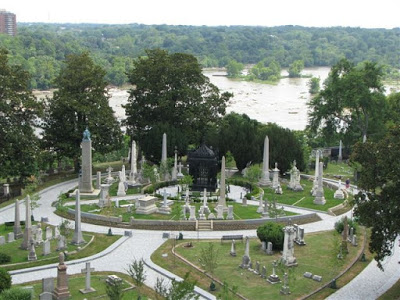
Hollywood Cemetery is a 130 acre cemetery on or next to “Oregon Hill“, overlooking the James River. Crowded with tombstones, memorials, mausoleums and obelisks, it can be easily identified looking west from the Lee bridge (Rte 1) on the north side of the river.
Originally a part of the Belvidere estate of William Byrd III, son of Richmond’s founder William Byrd II. Bushrod Washington who purchased it in 1795 and sold it prior to his appointment to the U.S. Supreme Court in 1798, would have been located in today’s Oregon Hill, an old blue collar working class neighborhood, now mostly student housing. The estate was sold to Jacquelin Harvie prior to the 1819 financial panic, who had earlier unsuccessfully sought to create the town of Sydney, now part of today’s Fan District. Thirty years later, the cemetery was laid out on the western edge of Belvidere, called Harvie’s Woods. The cemetery was originally established in 1849 by William H. Haxall and Joshua Fry, who were inspired by the “rural garden style” of the Mount Auburn Cemetery they had visited in Boston and laid out by architect John Notman, who had designed Philadelphia’s “Laurel Hill” cemetery.
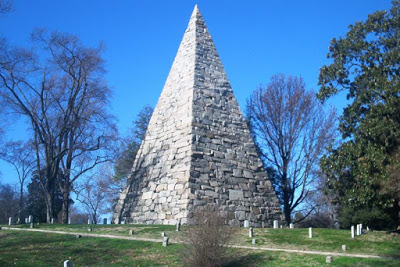
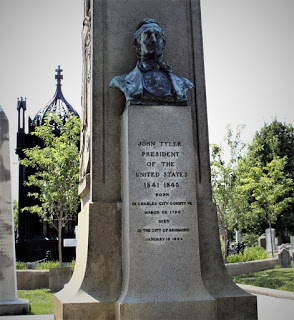
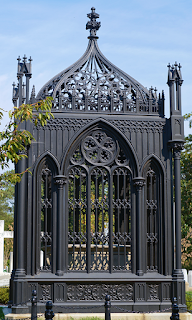
Two U.S. Presidents, James Monroe and John Tyler are buried in President’s Circle, pictured above, along with scores of other prominent Virginians and approximately 1,800 Confederate soldiers. Jefferson Davis is buried in another section of the cemetery along with some other Confederate luminaries.
After the battle of Gettysburg in July of 1863, the remains of Union soldiers were carefully exhumed from the battlefield and ceremoniously re-interred at the new Gettysburg National Cemetery where Lincoln gave his now famous address calling the nation to finish the work their sacrifice made possible.
“that from these honored dead we take increased devotion to that cause for which they gave the last full measure of devotion—that we resolve that these dead shall not have died in vain — that this nation, under God, shall have a new birth of freedom — and that government of the people, by the people, for the people, shall not perish from the earth”.
The Confederate dead, buried unceremoniously in shallow graves and trenches, were left on the battlefield farmlands. Likewise, Union dead were treated similarly in the South. After the war, the man who was hired to oversee the grisly disinterment, Samuel Weaver, a local teamster merchant, was accompanied by his young son Rufus, who would one day leave his mark in the field of medicine with his significant research on the human nervous system. Samuel Weaver died in 1871, just as discussions to exhume the Confederate dead began in the south.
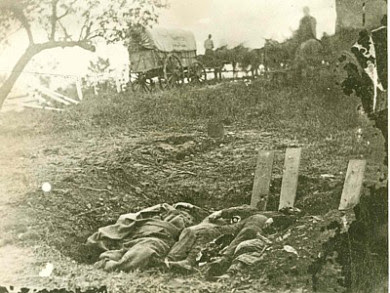
The Gettysburg farmers were more than happy to allow Rufus, who was now in medical school and the obvious choice for the “undertaking” of the task, which required knowledge of human anatomy and a familiarity with the terrain, to proceed.
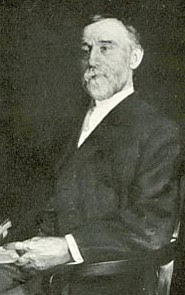
Rufus, now in medical school, was the obvious choice for the task, which required knowledge of human anatomy and a familiarity with the terrain. The Gettysburg farmers were more than happy to allow him to proceed. Funds were raised in Richmond by a committee of ladies who formed the Hollywood Memorial Association to front him enough money to get started.
Never thrilled about being elected, Rufus managed to disinter nearly 3,000 bodies and ship them to Richmond, but when it came time to collect, he was unable to find anyone to pay his bill. The ladies apparently spent the rest of their funds on the parade and pageantry on the way to the cemetery. He ended up getting “stiffed” to the tune of about $1,000.
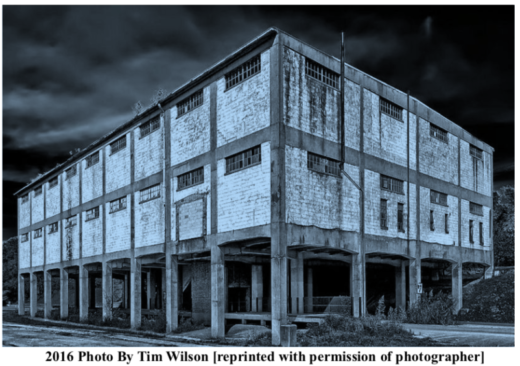
The Hollywood Women’s Association put up the Monument to the Confederate Dead near the Gettysburg graves. It was designed by engineer Charles Dimmock, whose brother, Marion J. Dimmock, was the architect the soldier’s chapel behind Virginia Museum of Fine Arts and the old farmer’s market in Oregon Hill, now part of VCU’s Cary Street Gym.