Oregon Hill historian Tom Elliott sent this moving account of the Civil War prisoner camp on
Belle Isle:
From the National Tribune, 11/10/1892
BELLE ISLE REVISITED.
A Loudoun Ranger Taken in the Spot where He Starved and Suffered.
A long cherished dream to revisit Belle Isle, the place of my imprisonment during the late war, was realized during the 26th National Encampment in Washington. We took steamers down the Potomac and Chesapeake Bay to Norfolk (next line unreadable) known in war times as the Southside Railroad. From Richmond we crossed over one arm of the James to Belle Isle on a new bridge connecting the Tredegar Iron Works with the Old Dominion Nail Works, located on the Island.
The Tredegar Iron Works is where was rolled the heavy iron plating used for the armament of the Merrimac, as well as all the heavy ordnance for the Confederacy. This important industry was then, as now, the largest in the South. The solid shot and shell used by that defunct Government was made here. Those who were so unfortunate as to be prisoners of war on he Island will probably never forget how the Confederates would test their cannon and shell made at the Tredegar Works, by firing them over the prison stockade on the Island. Quite often the shell would burst, and the fragments would create consternation among the prisoners and graybacks. I suppose everything is fair in war.
As we stepped from the bridge to the Island a panorama of 28 years ago passed rapidly before us. We looked for the stockade, but it was gone; almost all traces have disappeared. A portion of the dead-line is quite visible at the northwest corner; the paraphet that was once about 13 inches high.
A map the writer made of the prison-pen some 10 years ago, exclusively from memory, was produced, and was as accurate as if made by a civil engineer, on the ground. We have always insisted the prison, after it was enlarged in the Fall of 1863, contained about two acres of ground. Now I know I was accurate in that statement. Where the prison-pen was located is now an immense rolling-mill owned and operated by the Old Dominion Nail and Iron Co. Where the writer lay in the sand with P. A. Davis and Rube Stypes, and where both died during that memorable Winter of 1863-’64, is now located a large Fairbanks scale for weighing ore.
Where the prisoners caught Serg’t Haight’s dog, and ate him in about 15 minutes, is now a large set of rolls, rolling out red-hot bar-iron. Where the hospital tent was located, beside which the dead were piled up to the number of 200 waiting burial, is now an immense bank of dead cinders from the rolling mills.
I walked down to the dead-line, where poor Jeff McCutchen was shot for getting too near that line. I picked a sprig of the National flower, the golden-rod, from as near the exact spot as I could locate it. I stepped upon the parapet, now not over 18 inches high, where the two little boys who belonged to the 13th Regulars would get with fife and drum and sound the grub call. What sweet music it was to the starving prisoners!
I walked to where the gate was located that led to the river for water and the sinks where we traded our last gutta-percha ring for a half dozen biscuits. At the same place I also traded the copy of the New Testament that was sent to me by the Christian Commission, in return getting one dozen biscuits. The physical man was perishing then, and not the spiritual. I walked up to the hill where was located the cannon that pointed its ugly nose down on the prisoners. The guards took especial delight in telling us they captured this gun at Bull Run. As I walked back towards the once stockade I met a green snake coming towards me. I did not argue the point, but began pounding Mr. Snake with my walking stick.
I was eager to conquer this enemy on the island, and as upon my first visit the serpent had me, but now the table was turned, and I thought of the many thousands of our fellow prisoners who had suffered here, and then I pounded Mr. Snake again. While Mr. Snake was probably not to blame for my mistreatment on the first visit, yet I readily seized upon the pretext of holding him responsible, and beat him until he was dead, dead, dead.
I walked down to the gate where 100 men were taken out every morning for Andersonville. I had always tried to get out before my turn, but was always detected; when Serg’t Haight would bring down his long club on my head, and send me back to starve awhile longer.
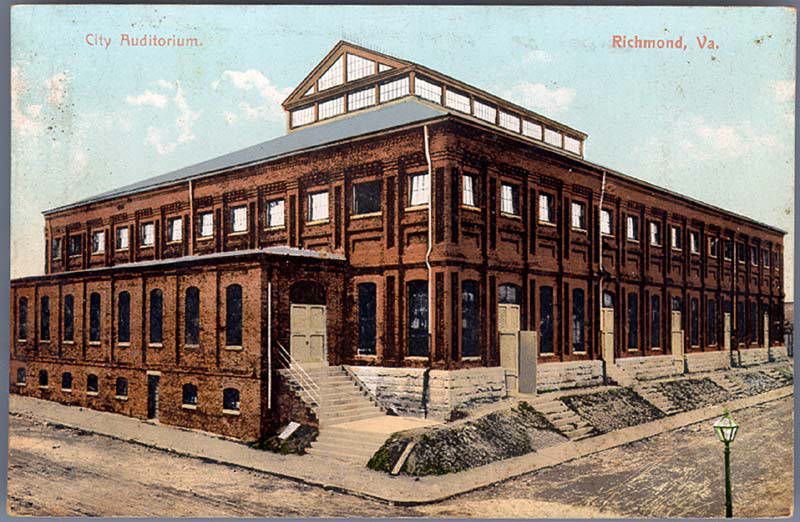
Mr. Baird, who was born on the Island, now the Superintendent of the Old Dominion Nail Works, was exceedingly kind and pleasant to me. He showed the large kettle that was used to boil the morning bean soup for the prisoners. It is now used to mix cement in to lay firebrick. This relic the National Prison Association should possess. I believe the Old Dominion Works would present it to that association gratis. Mr. Baird also showed us about 10 or 12 tons of the iron plate that formed the armament of the Merrimac. He had bought it for old iron. Several pieces showed dents in them three or four inches deep made by the solid shot from Ericsson’s Monitor. He has had several kegs of nails made from the same material, and took great pleasure in presenting our party with two each. We were also shown one wing of the nail works that was built by the prisoners, as good as the day it was put up, a splendid job of masonry. All prisoners (bricklayers) that worked on the building got double rations of corn-dodger, and glad to get the job.
Most of the prisoners who died on the Island (starved to death) are now buried in the National Cemetery about three miles east of the city; over 5,000 are unknown. This was the result of carelessness on the part of the Confederates. When a prisoner would die we would always give his name, company, and regiment to the Confederates, who would write it out on a piece of paper and pin or stick it in a buttonhole, or lay it on the body, but when as many as 200 at a time would lay out in the rain and snow for two weeks, before burial, nearly all the names would be blown away or lost. Hence so many unknown. Those that sleep there now the flag for which they died waves proudly over them.
“Rest on, embalmed and sainted dead,
Dear as the blood ye gave;
No impious footsteps here shall tread
The herbage of your grave,
Nor shall your glory be forgot,
While fame her record keeps,
Or honor points the hallowed spot
Where valor proudly sleeps.”
Our party each cut a sycamore cane from the sprouts that have grown up in the stockade, and walked off the Island with none to molest or make us afraid. – BRISCOE GOODHEART, Loudoun (Va.) Rangers, Knoxville, Tenn.
Was in Squad No. 34 on the Island.