Dueling Maps of the Towpath

Venture Richmond Director Jack Berry gave a presentation on the proposed amphitheater at the July meeting of the Oregon Hill Neighborhood Association. One the main assertions Berry made was that the tow path on the south bank of the canal was only 12 feet wide until it was enlarged in the 1880s to make way for the railroad. He wants to remove over half of the tow path on the south bank of the canal, from 25 to 12 feet to improve the sight lines of the the proposed amphitheater.

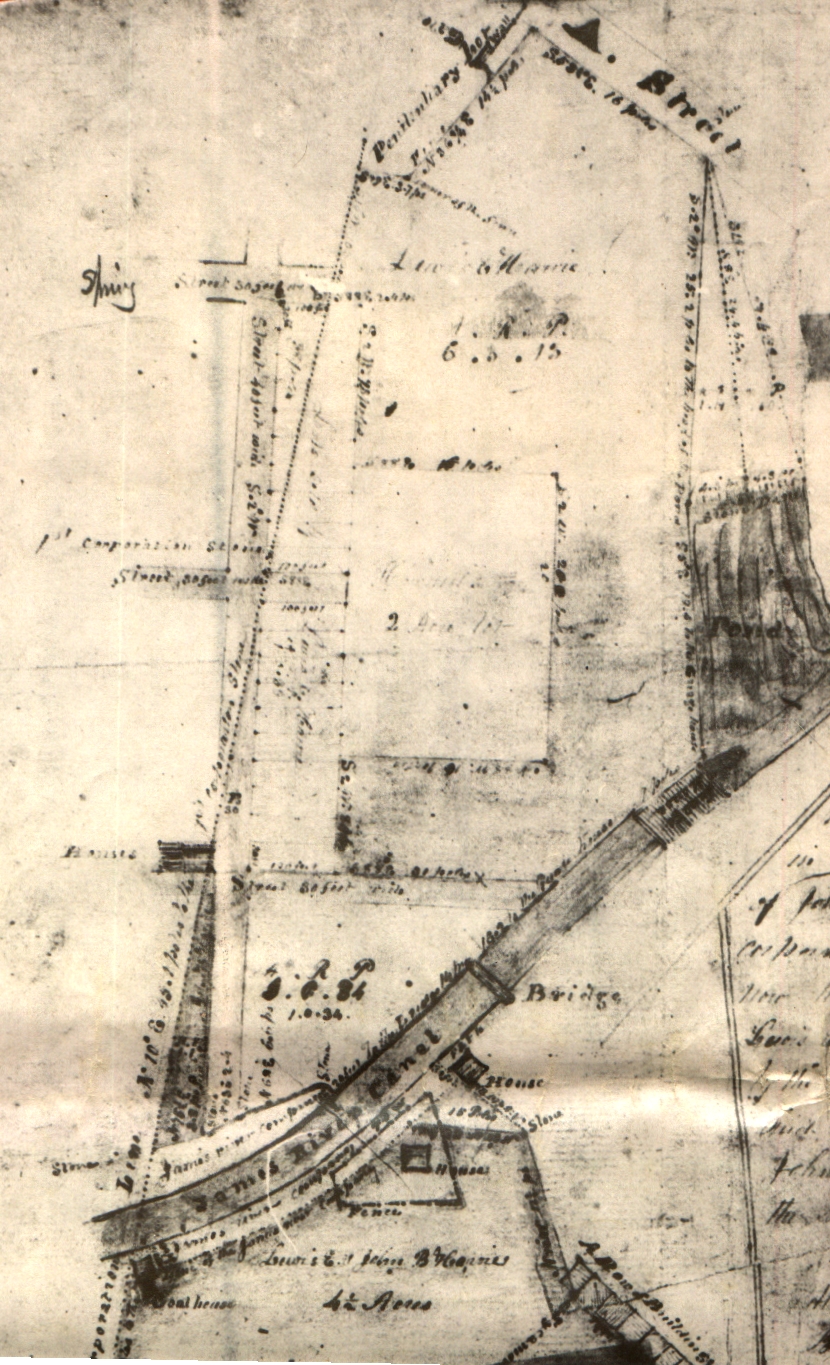
Disproving Berry’s assertion is the 1848 plat of Lewis Harvie’s property on file at the Henrico Courthouse (Plat 3-417), which is far more detailed than the Morgan map cited by Berry. This plat is of such detail that it actually gives the dimension of the tow path as being 30 ft. wide at the location of what is now Venture Richmond’s proposed amphitheater. (See measurement on the attached Henrico Plat below the word “Path” to the left of the “House.”) The east-west street above the canal is the same width as the tow path and is also labeled “30 feet wide.”

Henrico Plat 3-417, 1848

This 1848 Henrico plat establishes that the towpath was at least as wide as it is today during the canal’s primary period of significance, and long before the railroad purchased the right-of-way on the canal bank. This canal was carefully engineered with an impermeable “puddled” clay layer that would be irreparably damaged if half of the south canal bank is removed.

Tredegar To Merge?

Chris Dovi has an interesting blog post in Richmond Magazine about a possible merger discussion.

Three Richmond museums that focus on history may soon become more intertwined. The Museum of the Confederacy, the American Civil War Center at Historic Tredegar and the Virginia Historical Society have entered into discussions that may lead to a merger of the organizations.
The three museums have “a long history of cooperation,” says Jennifer Guild, a spokeswoman for the Virginia Historical Society, who confirms that the cooperation could evolve into a greater unity of the three entities. “All three of the museums are working together to determine what collaborations exist so we can make Richmond a premier Civil War tourist destination.”

The Women of Hollywood Specialty Walking Tour This Saturday

From the Valentine Richmond History Center:

May 25
Hollywood Cemetery: The Women of Hollywood Specialty Walking Tour* (2-4pm)
Explore the significant role that women’s groups played in Hollywood Cemetery’s history from the Civil War to the present. Stops include gravesites of female residents who led independent lives as educators, authors, preservationists, suffragists, humanitarians or as the power behind the scenes of famous men. Meet at the cemetery entrance at Cherry and Albemarle streets.

Hollywood Cemetery Specialty Walking Tour This Sunday

From the Valentine Richmond History Center:

May 12
Hollywood Cemetery Specialty Walking Tour* (2-4pm)
An extension of the daily “Highlights” tour, this version covers in more detail the cemetery’s unique history, landscape design, architecture, symbols and residents. Meet at the cemetery entrance at Cherry and Albemarle streets.

Neighbors Working On Pleasants Park

Several neighbors took time yesterday to do some badly needed volunteer yard work on Pleasants Park.

Why is it called Pleasants Park?

From the Richmond Friends website (click here for link):

Robert Pleasants, who was born at Curles in Henrico County, Virginia in 1723 and died in 1801, was one Virginia’s most noted Quaker abolitionists. As one of the founders of the Virginia Abolition Society in 1790, he served as president. In 1782 he successfully lobbied for the Manumission Act, which, within one decade, was responsible for freeing over ten thousand slaves in Virginia. In 1792 Mr. Pleasants submitted a petition to the U.S. Congress from the Virginia Abolition Society calling for the end of the slave trade. Mr. Pleasants went to court repeatedly to free hundreds of slaves. He wrote to Virginia leaders such as George Washington and Patrick Henry, asking that slavery be abolished.
Several of these documents are contained on this website.

In 1784, two years after manumitting his slaves, Mr. Pleasants founded the Gravelly Hill School, the first school for free blacks in Virginia, and set aside 350 acres of land to maintain the schools. Henrico Parks and Recreation will dedicate a historic maker on the Gravelly Hill Site in 2003.

The Oregon Hill Neighborhood Association successfully petitioned the Richmond City Council in 2003 to name Pleasants Park at 401 South Laurel Street for Robert Pleasants.

This is history that is not part of the new Liberty Trail.

Letter to City Council On Historic Canal

Neighbor Charles Pool sent this email to members of City Council yesterday.

(Ed. note: He received permission to send them an attachment of the “Tiller” magazine article, but I have not received permission to post that here. If I do receive it or a public website link to it, I will be sure to post it here.)

Dear Richmond City Council members,

Please take time to read the article entitled, “New Richmond Amphitheater Endangers Canal Plans” by Elizabeth Davis in the attached Winter/Spring 2013 edition of the “Tiller,” the wonderful publication of the Virginia Canals and Navigations Society (VCNS).

This article highlights the threat to the historic canal by Venture Richmond’s proposed amphitheater. If the canal bank is lowered as proposed, it would destroy the long-range plan of a canal boat trip to Maymont. Concern for our canal has arrived from as far away as Yangzhou, China, where the World Canal Conference “urged the people of Richmond, Virginia to prevent further destruction to the canal and to preserve, restore, interpret and wisely use this irreplaceable amenity for Virginia and her visitors.”

Other cities would be envious of our canal, running through the heart of downtown Richmond, that was promoted by George Washington at Mount Vernon, the canal company’s honorary President!

As noted in the “Tiller” editorial by Holt Messerly, “I want all people to enjoy this precious national resource for the betterment of Richmond, and for the preservation of our history and for the enjoyment of all — not just for someone to be able to cut the grass easier and see a straighter line to an amphitheater. We must look at the big picture and consider all of the areas as one big entity; a green way with a blue way …”

Continue reading

Williams Profiles WBCH

Richmond Times Dispatch columnist Michael Paul Williams has a profile of the William Byrd Community House in advance of its Byrd House Bash fundraiser on Saturday.

More than a century after nurses and social workers introduced the resettlement concept to Richmond, William Byrd provides essential resources to Richmond’s most vulnerable families. That’s an achievement worth celebrating and perpetuating.

Local History Includes Streetcar Bombing

This past week has seen a lot of local anxiety due to the bombing of the Boston Marathon on Monday, especially since the Monument 10K in Richmond was held just before it.

WTVR’s reporter Mark Holmberg recently did a piece on the history of local bombings.

One that he did not include was the 1903 bombing of a Laurel Street streetcar. Click here for the old Times Dispatch newspaper story about that. In that case, the incident was suspected to be related to the labor strife of competing trolley lines.

It’s not always easy to sort out the motivations for such acts. As we wait to learn more about the Boston Marathon suspects, its hard not to wonder what would drive people to do such things.

“The last public bath in the city”

From a neighbor:

There is an interesting photo in the Times Dispatch today of the Grace Arents public baths on the 500 block of Belvidere.

Click here for photo.

Caption: In May 1952, the Richmond City Council ended a longtime city service: the Grace Arents public baths, in the 500 block of South Belvidere Street. As a Times-Dispatch story noted: “The last public bath in the city … finally bowed to old age and the home bathtub and shower.” Arents, who lived from 1848 to 1926, was a local philanthropist and niece of Lewis Ginter.