Dear Delegate Carr and Councilperson Lynch,

Dear Delegate Carr and Councilperson Lynch,

As you both are well aware, the City of Richmond will hopefully be electing a new Mayor in a few short weeks. You both probably also know that, ultimately, candidates vying to be Richmond’s Mayor need to win a plurality of the vote in at least five of the city’s nine city council districts. Should no candidate have achieved that feat on November 3rd – something considered a distinct possibility considering the numerous serious candidates left in the race – a second round vote between the top two city-wide vote earners is to take place (with the same requirement of winning a majority of the city’s districts). In addition to discord, a run-off election could prove very costly financially to the City.

On April 10, 2020, Governor Northam signed HB 1103. This Act amended the Code of Virginia by adding a section numbered 24.2-673.1, relating to using ranked choice voting (RCV) in local elections. The Act stipulates that elections of members of a county board of supervisors or a city council may be conducted by ranked choice voting pursuant to this section. The decision to conduct an election by ranked choice voting shall be made, in consultation with the local electoral board and general registrar. The law shall be enacted within the county or city by a majority vote of the board of supervisors or city council that the office being elected serves (or, this being Richmond, is it the General Assembly?). The Act will go into effect on July 1, 2021.

Unfortunately, the Act also stipulates that any costs incurred by the Department of Elections related to changes in technology that are necessary for the implementation of this Act, including changes to technology for receiving the results of elections conducted pursuant to this Act, shall be charged to the localities exercising the option to proceed with ranked choice voting. On behalf of FairVote Virginia, I respectfully request that you both ask the City of Richmond Registrar to provide Richmond City Council and the Virginia General Assembly with an estimate of the costs associated with the implementation of this Act.

After receiving this estimate, City Council, (or, this being Richmond, is it the General Assembly?) will be in a better position to make a decision regarding the implementation of ranked choice voting in future Richmond local elections.

A couple of things that are also on my mind in regard to this matter:

I am closely watching for the findings of a study required by the General Assembly Budget Amendment HB29, which explores replacing VERIS (Virginia Election and Registration Information System.) If VERIS is replaced, the new system chosen must be compatible with RCV ballots. I am hearing the study completion is on target for October reporting, and since RCV has already passed the legislature and has become an option for all localities in 2021…it will be part of the initial requirements!

“It is the intent of the General Assembly that the Department of Elections release a Request for Information in fiscal year 2020 related to the replacement of the Virginia Election and Registration Information System (VERIS). The Department shall provide an update to the Chairs of House Appropriations Committee and the Senate Finance and Appropriations Committee on the options and potential costs for replacing VERIS on or before September 1, 2020.”

https://budget.lis.virginia.gov/amendment/2020/1/HB29/Introduced/FA/83/1h/

During the pandemic, ranked choice voting has become a necessary alternative to lengthy assembled run off conventions, RCV was used in both Democratic and Republican Party Conventions this year in Virginia. Most notable, in August, to elect the Republican Party of Virginia’s State Chair. In the second round of tabulation Rich Anderson received 62% of the vote.

In VA10 and VA11 districts, the Republican Party conventions selected candidate for House of Representatives by ranked choice voting. Commentary in an article on thebullelephant.com noted that in the 10th District convention, “was a very well run unassembled convention with everything working as it should have. For most of the day, there were no lines at all, with some short wait times in the early morning when Loudoun county was voting. There were 1600 delegates registered and 1240 showed up to vote, an excellent turnout.”

Arlington County Democratic Party used ranked choice voting to endorse candidates for County Supervisor and School Board.

Also, in Arlington County, there is an initiative underway to implement RCV in local elections.

Regardless, I appreciate any information or attention you can give to my humble request for RIchmond.

Sincerely,
Scott Burger
FairVote Virginia board member and 5th District resident

(FairVote Virginia is a non-partisan, non-profit champion of ranked choice voting. Our members cover the entire political spectrum and come together from across the Commonwealth, united by a shared mission to revive real, representative democracy by enacting and implementing ranked choice voting legislation.)

UPDATE:

Thank you very much for your prompt response.

Sincerely,
Scott

On Oct 26, 2020, at 1:15 PM, Betsy Carr – House of Delegates wrote:

Dear Scott,
Thank you for your email. I will forward your request to the Richmond Registrar’s Office. Please keep in mind that since the election is a week away, they may not respond until after their work relating to the election is complete.

HB1103 stipulates that the local governing body (i.e. the City of Richmond’s Council, not the General Assembly) in consultation with the local electoral board and local registrar can decide to implement RCV in their locality.

Additionally, I spoke to House Appropriations staff about the HB29 budget language regarding the report on the replacement of VERIS. Due to COVID-19, budget language was passed that allows for state agencies to defer their reporting in order to prioritize their response to the pandemic. The Department of Elections is one of those agencies that has had to seriously shift their focus in order to ensure that all Virginian voters are able to safely vote. A report is expected around the end of the year.

Please let me know if you have any additional questions or concerns.

Sincerely,
Betsy

Mayor Wants To Take Away Park Land For ‘Affordable Housing’

Mayor Stoney’s Biennial Real Estate Strategies Plan wants to use city land to promote affordable housing development and affordable homeownership.
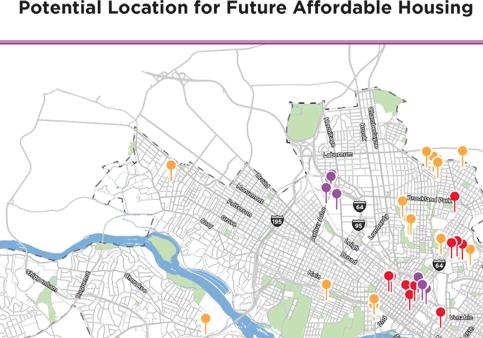
To that end, it proposes taking City-owned parcels to the Maggie Walker Community Land Trust (MWCLT) for the development of affordable homes.

It is including at least two parcels in Oregon Hill’s Samuel Parsons Park in this proposal.

(and least people think this just about Oregon Hill, the Biennial Estate Strategies Plan also identifies other city park lands such as 1800 Maplewood in the Randolph neighborhood and 1901-1905 Conrad Street in the East End as building sites.)

Neighbors, understandably, are very upset. But so far, either the Mayor’s office, other City officials, the media, and the Mayor’s challengers in the election are ignorant of the proposal or don’t care.

Of course, many neighbors believe in and support affordable housing, and have done so historically in Oregon Hill and elsewhere.

But this proposal is bringing up bad memories from when other parts of the park were built on due to City government’s (and in particular, the Planning Department’s) ineptitude and callousness.

It’s part of the utter disregard for established neighborhood plans and the neighborhood’s dream for a Belvidere greenway.

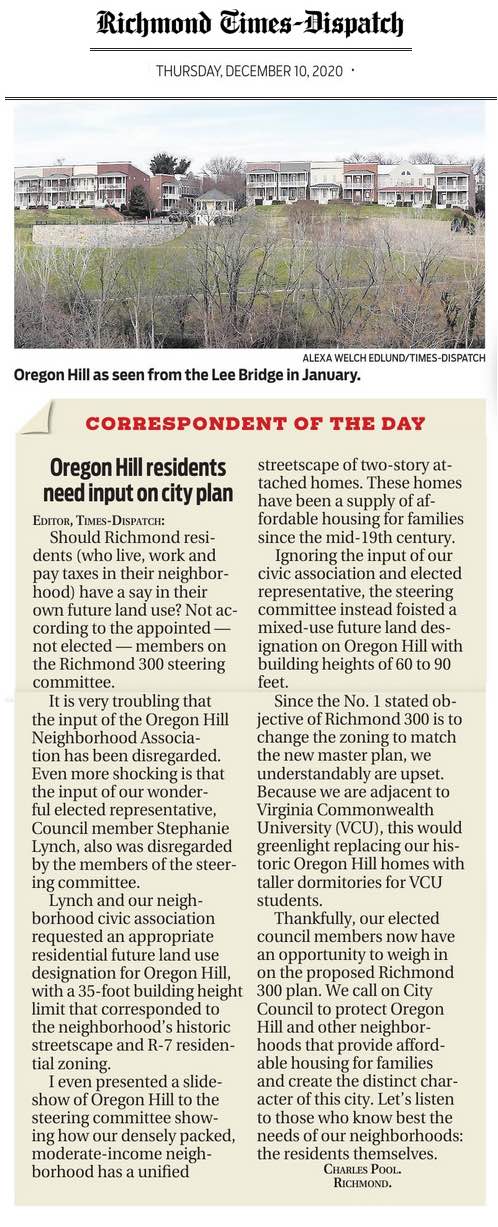
Neighbors can’t help but see this as part of a coordinated attack on the Oregon Hill neighborhood in conjunction with the disastrous Richmond300 plan. If they were not aware of the target lines being drawn on the community before, they are becoming aware now.

Olinger’s Storefront Canard

This past Wednesday evening, City of Richmond Planning Director Mark Olinger and planner Maritiza Pechin did a Zoom presentation for Oregon Hill residents. It was primarily a discussion of Oregon Hill’s proposed future land use in accordance with the Richmond300 planning.

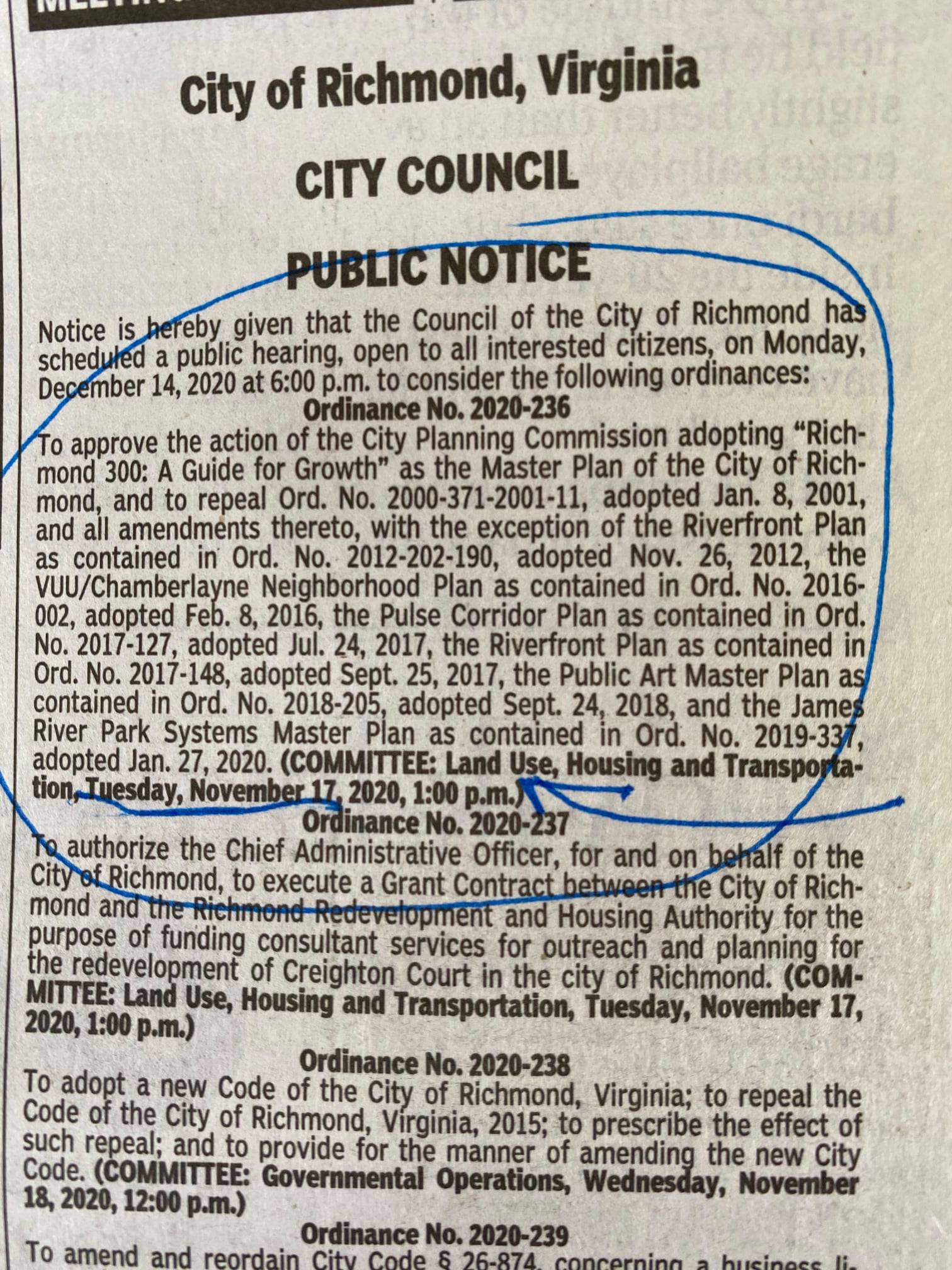
What needs to be understood by everyone is that land designation is used to justify future zoning. Objective #1 of the Richmond 300 plan is change zoning to match the future land use designations. Any SUP will be recommended for approval by planning if it matches the future land use designation. Oregon Hill neighbors worked hard for our appropriate R-7 zoning and we need a future land use that matches it!

What Olinger kept coming back to during the Zoom meeting is that he and other planners would like to see ‘old storefronts’ brought back to commercial use and that is why they are insisting on giving Oregon Hill “neighborhood mixed use” land designation despite repeated demands by the Oregon Hill Neighborhood Association and many residents that would like for Oregon Hill’s land designation to remain ‘residential’.

This is not to say that OHNA and neighbors are against ‘old storefronts’ returning to commercial use. The overall record (voting included) makes it very clear that Oregon Hill has encouraged more small commercial return to the ‘old storefronts’. The reality is the storefronts that are currently not operating as businesses are homes and people are living in them. If they wanted to run a business, they simply have to ask for a special use permit, and they would most likely get it. The proposed change in land use designation is solving a problem that doesn’t exist.

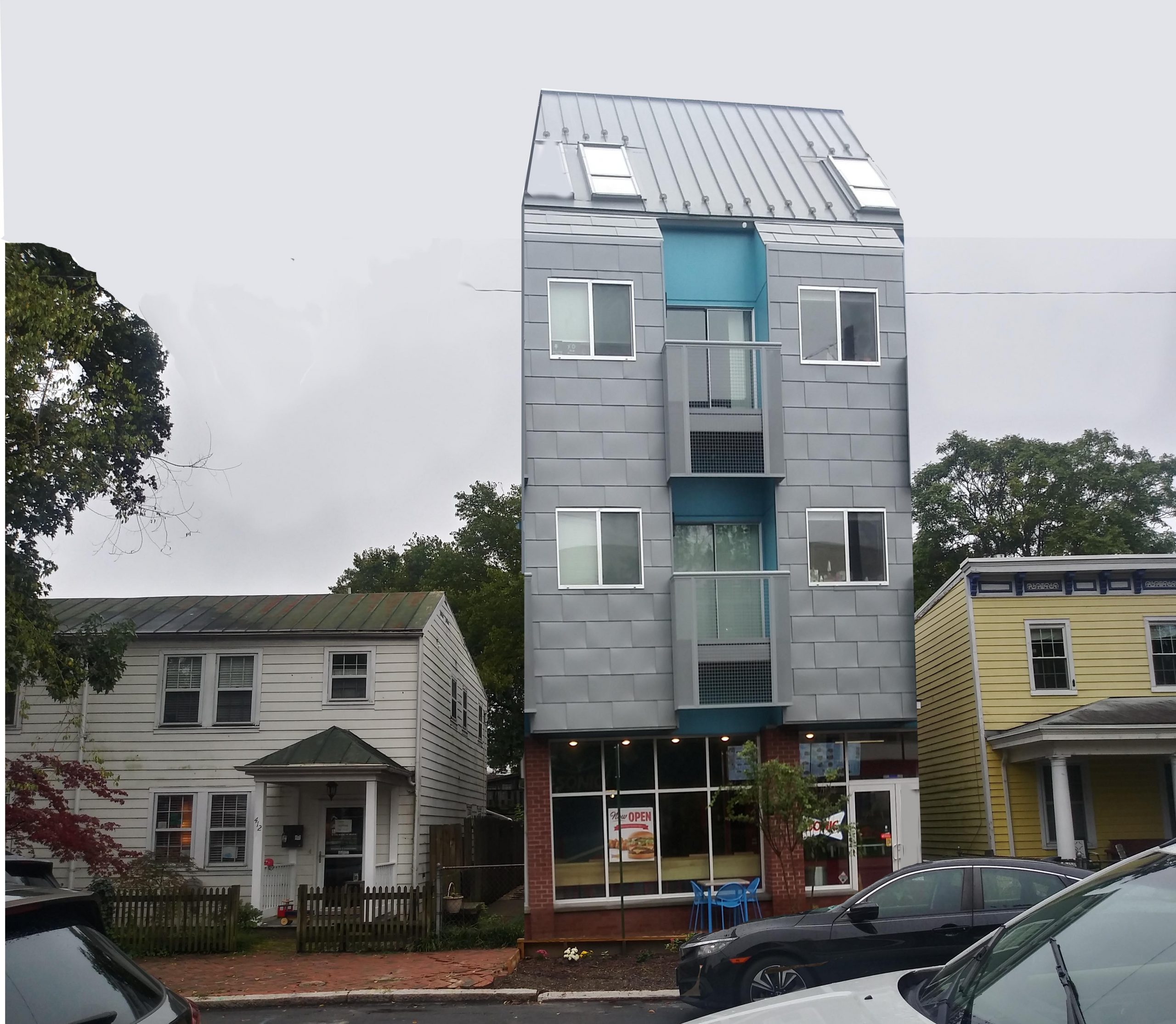
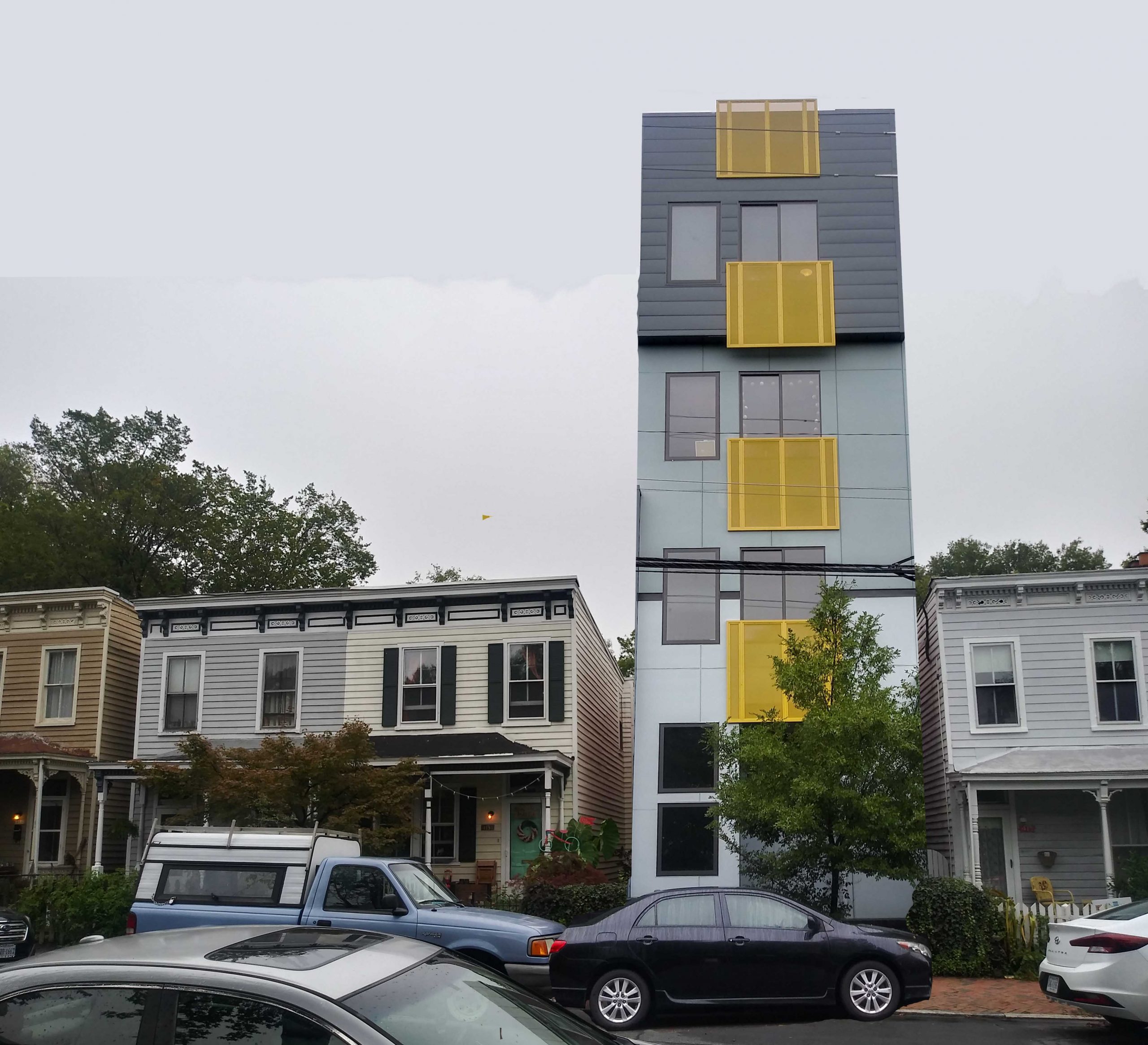
It’s not just nomenclature though. The proposed change in land designation also opens the door to knocking down houses and building apartments and commercial spaces for taller buildings. Olinger suggests that the Planning Department, government, and neighbors would still have some say and control over replacement structures. But Oregon Hill neighbors know from the recent ‘805 W. Cary’ development that that simply is NOT TRUE! If anything, the decks were stacked strongly against any neighborhood say or control.

The city zoning code defines a story as 15 feet in height. The appropriate, current R-7 zoning has a height limit of 35 feet, which matches our historic two-story streetscape. Four stories mixed use would allow a height limit of 60 feet, almost double the current zoning!

Oregon Hill neighbors know that we cannot have our R-7 zoning undermined by this mixed-use future land use designation that allows multi-family projects 4-6 stories. This will be a green light for developers to buy up Oregon Hill to build ad hoc dormitories (and may explain recent 70% increases in land values on property assessments). If this happens, its pretty clear that the historic Oregon Hill neighborhood that residents and visitors love and cherish will be lost within a decade or two.

OHNA and individual neighbors have repeatedly asked Richmond300 planners for Oregon Hill to keep its hard-won ‘residential’ land use designation. Thankfully, Councilperson Lynch has indicated that she supports this. She was successful in establishing the residential future land use designation for most of the Randolph neighborhood in the Richmond300 plan.

Also, Oregon Hill is not the only neighborhood to question who the Planning department is really working for. Many residents in the Fan are now concerned about a recent proposal to raise the height limit on Broad Street to twenty stories after previously having an agreement for a twelve story limit. For this to happen during a pandemic with limited public interaction is outrageous.

It’s understandable that Olinger was originally hired as the City’s planning director in order to bring more density to the City of Richmond, especially along the Pulse corridor of Broad Street. But at this point, many Richmond citizens are questioning if he is the right person for the job.

Who Will Be Richmond’s Next Mayor?

With a lot of voting already underway, many Richmonders are confronting the reality that they still don’t know who to vote for Mayor.

Sadly, as with the last Mayoral election, the corporate media is trying to paint the election as being between two headline candidates, incumbent Mayor Stoney vs. challenger City Councilperson Gray, and a litmus test on Stoney’s tenure.

But for many Richmond citizens, its not nearly so cut and dried. Many find the frontrunners in both the Mayoral and Presidential elections to be extremely unpalatable, and it has not been unexpected in that regard (and I can’t help but wonder how different these elections would be with needed reforms like ranked choice/instant runoff voting). For Oregon Hill residents, questions still zero in on what ALL the candidates can and will do for THIS neighborhood.

For example, both Stoney and Gray have failed to act on the Monroe Park debacle, which is a fiscal and environmental disaster under the private ‘Conservancy’. The Sierra Club Falls of the James recently endorsed Alexsis Rodgers, based on some sort of green promise. But it is not very well defined and says nothing about Monroe Park, Richmond’s most historic PUBLIC park.

Oregon Hill residents know how important it is to exact promises now, especially given the existing threats and still-existing threats.

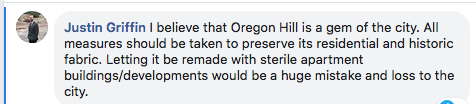
Only mayoral candidate Justin Griffin has said he will act to terminate the Conservancy’s lease on Monroe Park. Furthermore, Griffin has also stated:

This is not an out-right endorsement, for we still need to know more about Griffin’s overall stances, but his tagline does ring true, “Because we deserve better”.

We know Richmond overall deserves better, and we would love to hear specifics on what candidates plan to do about many other issues, including everything from the water to the sun.

Former Governor and Mayor Wilder has also made this observation. Hopefully his upcoming debate will bring the fire.

As has been made clear from past elections, Oregon Hill residents vote and their votes matter- if Mayoral candidates want to win, they need the Central 5th District, and thus they need Oregon Hill.

Councilperson Stephanie Lynch Stands up for Oregon Hill and Randolph against Richmond 300

Dear Richmond 300 Advisory Council,

Thank you all for your time and consideration over the last several months. We wanted to send some formal comments. As you all are aware, we have remaining concerns with the current draft of the Richmond 300 Master Plan process. I would like to highlight two areas of concerns that both Oregon Hill & Randolph neighbors have brought to our attention.

The Oregon Hill neighborhood is currently listed as mixed use. Only 1% of the neighborhood’s 650 building south of I-195 are businesses, the other 99% are residential. The fabric of the neighborhood is rapidly changing as we see more families moving into the neighborhood and starting families. I echo the neighbor’s concerns under Mix Use regarding height and density. Oregon Hill fought hard in the early 2000s to get R-7 zoning with the 35 foot cap. We would like to strongly state our opposition to the mixed use designation and recommend moving this to Medium Density Residential.

We would also like to call your attention to the Randolph Neighborhood boundaries. They are not properly represented in this current draft. This has been discussed with Mark Olinger and we recommend updating to reflect the true boundaries of the neighborhood. The northern part of the neighborhood is also listed as Mix Use. This entire swath of neighborhood is currently residential and we feel strongly that it should remain so.

In addition, we would strongly recommend moving the VCU node north of Oregon Hill. We also support completing a ‘green way’ map that highlights Monroe Park as the city’s oldest municipal park, among other important denotations for our parks & recreational spaces.

Thank you all for all of your time, work and efforts in crafting this Draft Master Plan. We appreciate you reviewing these concerns and please let us know if you have any questions.

Sincerely,
Stephanie

Stephanie A Lynch
5th District Councilmember
Richmond City Council

Monroe Park Conservancy In The Red

While citizens have been warning about mismanagement for years, the accounting on Monroe Park is becoming more stark.

Yesterday the Richmond Free Press published an article on the situation, “IRS filing shows Monroe Park Conservancy running deficit”.

The report for the 12-month period ending June 30, 2019, shows the conservancy received $238,264 in revenue primarily from grants, but expenses ran $503,000, leaving the group swimming in red ink.

The group, established in 2014 to be self-supporting and awarded a 30-year lease to manage the city’s oldest park, also reported a significant drop in its total assets, leaving it with virtually no cash or monetary backup to support its work, according to the report.

Readers are left to wonder about the latest 12-month period. The article does not mention that the Sierra Club, the Oregon Hill Neighborhood Association, and many citizens have already called for the ouster of Alice McGuire Massie, the president and executive director of the Monroe Park Conservancy and the termination of the private Conservancy’s lease on the public park. The article also fails to mention that 2nd District Councilperson and mayoral candidate Kim Gray sits on the Conservancy’s board.

Mayoral candidate Justin Griffin has said that “An audit of the Monroe Park situation is one of the first things I will do. This project is a prime example of the mismanagement and waste we have here in Richmond.”

DISHONORABLE AND DISGUSTING ‘Business Leaders’ Pressuring City Councilperson’s Employer

The Richmond Free Press newspaper yesterday published an article on the doomed ‘Navy Hill’ project, in which it also confirmed what 5th district residents have already been hearing- ‘business leaders’ who live in the surrounding counties are putting pressure on our City Councilperson though her employer. That’s not just inappropriate, it’s deliberately attempting to subvert democracy. It’s VILE, DISHONORABLE, AND DISGUSTING.

It’s great to see the community-oriented Richmond Free Press buck the system and make this particular story known, but more has to be done to dig this scum out. Earlier this week, we saw more corporate media, notably the Times Disgrace newspaper, run articles that not so subtly conveyed ridiculous threats- that if ‘Navy Hill’ does not happen, sick children would suffer and jobs would be lost and it would all be City Council and ‘activists” fault. Never mind that Richmond schools would again lose or that VCU Medical as a massive nonprofit hospital is not exactly penniless, or that Richmond citizens are under NO obligation to provide sweetheart deals to any corporation and we don’t have to give up more real estate to VCU’s empire.

Now, sadly, this is nothing new for Richmond. Citizens have heard many other tales of infamous arm twisting of decision makers by ‘business leaders’ who want to coerce government. And this sort of thing is happening at every level, from City Council and City department, to Urban Design Committee to even neighborhood association.

It’s part of Richmond’s dirty secret- that while there are good opportunities here with amazing natural and historic resources and Southern charm, the civic scene is one of oppression. Yes, the United States has become a country increasingly under the undue influence of corporations in commerce, society, and government, but Richmond’s top-down, almost aristocratic, corporate rule is overwhelming.

It has been for a long time a deep corruption where public concerns and priorities are thrown aside for corporate ones. Decade after decade, Richmond citizens have seen this again and again in everything from arts, to parks, from riverfront planning to even down to our water utility payments.

It should be made immediately clear that what happened to Councilperson Lynch reflects poorly on ALL of Navy Hill’s backers- Venture Richmond (previously known as Richmond Renaissance), RVA Chamber of Commerce, Retail Merchants, VCU administration, and, of course, the monopoly that controls our State Capital, Dominion. The public should hold them all in contempt until there are sincere apologies.

What should citizens do?

Of course, they should shame these people and groups’ DISHONORABLE AND DISGUSTING arm twisting tactics for this, and previous transgressions.

Last week, the Oregon Hill Neighborhood Association, having heard these allegations, immediately voted at its January meeting to oppose the Navy Hill Dominion-VCU coliseum scheme in its current form. Other civic guards should do the same- reject the Navy Hill scheme WITH PREJUDICE and STAND BY AND SUPPORT our PUBLIC officials, at least the ones are honest and have not given in to the corporate slime.

Furthermore, citizens should look to reform measures- not only ones that promote transparency, but ones that beat back corporate influence altogether. On the local level, consider that the City of Charlottesville joined localities all across the nation and passed a resolution in support of the Move To Amend movement, which would overturn the Supreme Court’s terrible Citizens’ United decision and establish that corporations are not people and money is not speech. Why not the City of Richmond? Why not for both the federal AND state constitutions?

Speaking of state, support HB111 in the General Assembly. Let’s take this City and state back from Dominion control!

In the wake of the public exposure of the corporate hegemony, now’s not the time to go on with business as usual, but to revolt and demand better. If RVA is truly going to live up to its potential, we need to throw the corporate welfare mavens out for good!