Utility Rates Meeting Tomorrow Night

In addition to the OHNA meeting, The City of Richmond Department of Public Utilities is hosting a community meeting on the Cost of Service study for the water, wastewater, natural gas and stormwater utilities.

Tuesday, Dec. 18, 2012 at 6-7 p.m.
DPU Operations Center Atrium
400 Jefferson Davis Highway (at Maury Street intersection)

All interested parties are invited.

Of course, the citizen’s petitioners who have protested the high minimum monthly service charge are watching this carefully. Here’s the an update from their perspective:

(One potential problem is if) The City trots out some sort of new lower tier or charity level for residents who are unable to pay the high minimum monthly service charge. While this may help the poorest of the poor, it sidesteps the rate reform that we have asked for. It would add additional complication and bureaucracy to OUR utility’s billing.

Another potential problem is if questions about water contracts with the counties are ignored. There is already a lot of concern about why the City is selling water to the surrounding counties so cheaply. There are also doubts about the City’s ability to collect payment for the existing contracts that were supposedly examined by the outgoing Councilperson Jewell.

While it’s good to attend meetings like this one tomorrow night, the utility officials may not reveal important information until they submit the budget. The public should be given all the information that has been given to the consultants. It is also important that a time line be established for the budget process. Otherwise, it’s possible that neither the Council or the public will get to comment until the time the Council get the Mayor’s budget, which I believe is in March sometime- Only then will Council and public meetings be held to discuss the entire budget and the rate structure will get short shift because the time left for the Council to approve it is limited. What are the various budget process dates? It would be good to bring this up at this meeting.

We must keep these matters in mind at the same time we stay on our message–the high minimum monthly service charge is ridiculous and unacceptable. We are asking for a revenue neutral approach that raises volume charges while lowering the service charges in a way that encourages conservation. Based on some of the data that we have received, our suspicion is that the high minimum residential rate is still being used to offset lower commercial rates, in effect subsidizing big businesses while gouging residents.


Continue reading

Richmond Water Rates Protest On Monday

There is a water rate protest planned for this coming Monday outside City Hall before the formal City Council meeting. The All the Saints Theater troop, the same group that organizes the Halloween Parade in Oregon Hill, is planning to attend with puppets and posters.

From the Facebook Event page:

This is an important demonstration to be held at Richmond City Hall at 5:00 p.m on Monday Sept. 24th to protest the city of Richmond’s outrageous minimum water/sewer service charge of $49.40, which is the highest in the nation. This is a real burden for every social security grandma and other low income residents to have to pay $592 annually just to be connected to the water supply. The city utility raises over $30 million annually from this residential water/sewer service charge, and almost half of this, $12 million is, paid directly into the city’s general fund. This is the most regressive means possible to raise general funds for the city– putting an outrageous service charge on the most basic necessity — water. Furthermore, Richmond’s water rate does not promote conservation because the city utility gets more than half of its revenue from the minimum service charge instead of the volume charge.

This protest is part of campaign that has seen over 1300 people sign an online petition that demands the City adopt the rate schedule used by Henrico County, which buys water from Richmond’s water utility.

From the petition:

Henrico’s water/sewer rates are equitable and promote conservation. Henrico’s minimum monthly water/sewer service charge is about a third of Richmond’s. To encourage conservation, Henrico offers a volume use discount for customers who use 6 ccf or less of water, while customers using over 6 ccf pay a premium water/sewer volume rate. Richmond can receive the same total revenue from its water works by slashing the minimum monthly service charge, eliminating the high volume discount, and charging a premium for customers using over 6 ccf of water/sewer.

The City of Richmond has a long-term financial incentive to adopt Henrico’s rate schedule. By giving customers genuine incentives to conserve water, Richmond will reduce the need for future treatment facilities and reduce pollutants downstream.

Neighbor Charles Pool is scheduled to speak on the water rate issue during the Citizen Comment period at the City Council meeting. The campaign to reform the CIty’s water rates goes back at least five years.

Kanawha Canal

Looking west near entrance of North Bank Trail (notice flowing water):

Looking west from new pedestrian canal bridge:

You may have heard of greenways, the Kanawha Canal is one of Richmond’s original ‘blueways’.

From a current Canal Walk display:

Washington’s vision was to connect the Atlantic Ocean to the Mississippi River with navigable rivers, canals, and a land portage through what is now West Virginia. After the Revolution, the James River Company was created, primarily as a result of his sponsorship and lobbying efforts. Before Washington’s death in 1799, a large portion of his dream had been realized.
Two canals bypassed the falls of the James River at Richmond, and 220 miles of river improvements extended westward. In the early 19th century, other farsighted Virginians took over Washington’s leadership role. The final elements of his plan were completed in the 1820s, when the Kanawha Turnpike joined the headwaters of the James River to the Kanawha River. In 1835, the James River and Kanawha Company was formed, and within 15 years a canal system stretched to Buchanan, Virginia, a distance of 197 miles.

Richmond’s Newest Indoor Sport …Drip…Drip…

Forget about preparations for the Summer Olympics (and speaking of conservation), right now City Council is interacting with the City of Richmond utility department over water rates. An editorial and an online petition has Richmonders taking part in the latest local internet craze- finding and comparing minimum water rate charges from across the country.

Keep in mind, according to census data there are 83,498 occupied housing units in Richmond. If each unit is paying the minimum service charge of $49.40/month, that is $4,124,801 generated monthly from the minimum water/sewer service charge, or $49,497,614 annually.

You see, this issue is generating a lot of email, and rather than dealing with actual water rate reform (which to be fair, might have to involve the Virginia General Assembly), City officials are scrambling to find a way to dispute the citizens’ complaint.

Anyway, for comparison…drip…drip..

Minimum monthly charge for residential water/sewer service:
Richmond: $49.40 [includes no water/sewer volume]
Henrico: $16.27
Chesterfield: $22.16
Norfolk: $1.00
Charlottesville: $8.00
Petersburg: $13.90
Hopewell: $25.39
Alexandria: $18.20
Roanoke: $20.75
Washington DC: $3.86 Continue reading

Underwater Choir Recording Scheduled for August

As the new group RVA League of Leisure and Public Pool Appreciation takes shape, some events are starting to be scheduled. This one is for August 11 at 1 pm in the bottom of the Randolph Public Pool. Practice, practice, practice.

From the Facebook event page:

This event’s platform is continuing to re-envision our public space while providing a recognizable pastime in performance. The direction of this recording situates the group in a circle formation dialoging to one another. Submerging together the group screamingly sing which will be received through the condenser microphones in the center of the ring.

Advancing towards this event I realized that this pastime of underwater vocal projection is enjoyed through basic achievement in absurdity. The enlarged statement making of the group dilutes any talent, content, or exacted consciousness. This fundamental encourages participation whether cloaked or not and now being said i hope to see you, my friends, at Randolph Public Pool 1pm sharp for a musical collapsing of classical reservations. hahaha ♥

Don’t Swim In The James River Right Now

From the Times Dispatch article:

About 2.6 million gallons of partially treated sewage flowed into the James River on Saturday when Lynchburg’s sewage-treatment plant lost power from Friday’s thunderstorms, officials said.

The sewage was disinfected with chlorine, but it did not get full treatment, which includes using microbes to break down waste, said Fred DiLella, a water compliance manager for the state Department of Environmental Quality.

The risk to swimmers and paddlers from Lynchburg to Richmond is unclear, but a state Department of Health official said it was probably low.

“I don’t think there is a significant risk, but we want people to be aware that there certainly is a risk from swimming in any water body that is not treated,” said Rebecca LePrell, the department’s director of environmental epidemiology.

People generally should avoid swimming in streams for three days or so after a sewage release or after a heavy rain, which can wash pollutants into waterways, LePrell said. Today is the third day after the Lynchburg release.

People who do get in the James or other rivers should try to avoid swallowing water and avoid swimming with open wounds, LePrell said.

Human and animal waste contain bacteria that can sicken people who ingest river water. Open wounds can become infected.

Health officials did not make an announcement after the sewage release but responded to questions from paddlers and others, LePrell said.

Drip…Drip…

Correspondent of the Day in the Times Dispatch:

Water rates target smaller users

Editor, Times-Dispatch:

You ran two Op/Ed columns on Richmond’s water rates. The column by Gloria LeRose, “Water’s worth the cost and effort,” explains that the Department of Public Utilities (DPU) does a needed job protecting our water quality, and what it spends to do so is worth it.

An earlier column by Scott Burger, “City proposes outrageous water rates,” relates to the amount of service charge DPU has in its rate structure, which results in a lower volumetric charge, which in turn discourages conserving water.

While both of these are valid concerns, the main issue with a high service charge is the inequality of cost for small consumers. Someone using 3 to 5 ccfs (1 ccf = 100 cubic feet) of water per month ends up paying about 79 percent of his total bill for service charge, while someone using 100 ccfs per month pays only about 11 percent. The purpose of the service charge is to recover certain fixed costs and should be recovered proportionally based on the amount each consumer uses. Lowering the service charge requires increasing the volumetric rate to compensate for the reduced revenue. There would be no less money for the DPU. There would be no lost revenue.

I raised this issue in 2006 with the DPU after a study recommended reducing the service charge. At that time the DPU indicated it agreed the service charge was disproportionate to the small user and planned to gradually reduce it and increase the volumetric rates. The DPU needs to renew this plan.

Robert Bedell.

Richmond.

Virginia Water Environment Association Response on…Water?

This morning the Times Dispatch ran an editorial by Grace LeRose, the President of the Virginia Water Environment Association. I should note that I know Ms. LeRose, having met her personally during some of the hearings on the James River TDML. In particular, pet waste is one of our shared concerns in terms of water quality. Her editorial this morning continued on the water quality theme. But it seemed as if it was in response to a column that I had submitted earlier on City water rates. Her column begins-

Recently this paper published an opinion piece declaring the City of Richmond’s water fees to be “outrageous.” As president of the Virginia Water Environment Association (www.vwea.org), a nonprofit educational association of wastewater professionals dedicated to preserving Virginia’s water resources, I offer the following observations:

The water (and wastewater) industry has been called the single most important public health development in the past century, bringing clean water to our citizens while removing and treating wastewater in an efficient (oftentimes unseen) manner. The incidence of water-borne disease has almost been eradicated in our country. Funding for investment in water infrastructure came from many sources — rate payers, local governments (by selling bonds), state governments (matching grants or loans to communities that could not afford these improvements on their own) and finally, the federal government. Like the interstate highway system that helped the US grow after World War II, spending on water and wastewater systems brought health benefits and access to an expanding economic prosperity for all Americans.

The importance of water in our daily lives can hardly be overstated. Water industry professionals work tirelessly to protect public health, more than 3 million miles of rivers and streams, 40 million acres of lakes, 87,000 square miles of estuaries (including the Chesapeake Bay) and 95,000 miles of coastal waters. The infrastructure that supports this massive effort — 800,000 miles of water pipe and 600,000 miles of sewer pipe — lies below our feet every day. These systems have worked silently for years, in some cases more than a century, to deliver and remove water and wastewater. The water and wastewater utilities have done such a remarkable job of producing and delivering clean water out of the sight of the public that the public can be forgiven if they think water should be always available and always cheap. We are now learning that water may not always be available and will probably not be cheap.

Of course, none of this is wrong- however, LeRose begins this piece as if she is offering a rebuttal to my column, yet ignores the rate structure issue. LeRose is not addressing my column in which I criticized Richmond’s plan to hike the minimum water/sewer service charge to $49.40 per month. Deriving the lion’s share of the revenue for the city’s water works from the minimum service charge does not promote conservation. If I conserve this resource and got my water use to below 1 ccf, this month and yet my water/sewer bill is still $47.03 for 0 ccf of service (soon to be raised to $49.40). Richmond’s minimum service charge may be the highest of any city in the United States, and that allows the city to keep the volume rate artificially low. As a result, there is no financial incentive to conserve water in the Richmond.

In Hanover, the minimum service charge for the water/sewer bill is only $14.03 per month. This is less than a third of Richmond’s minimum monthly service charge. Hanover promotes conservation by giving a volume rate discount to those who use little water. Hanover offers a heavy discount for the first 4000 gallons of water volume, while the volume charge increases almost three fold for the next 11,000 gallons of water and increases again for over water volume in excess of 15,000 gallons. Richmond has this backward and offers a discount, not to those who use the least water, but to those who use the most volume: over 74,800 gallons of water.

Can we get the Virginia Water Environment Association and other groups to address this? The local Sierra Club is on board, but where is the N.A.A.C.P., James River Association, or the Richmond Crusade for Voters? What does it take for citizen concerns to gain attention and triumph over corporate control these days?

Charlies’ Letters

Neighbor Charles Pool’s letter got printed in the Times Dispatch today:

Proposed water and sewer hikes are outrageous

Editor, Times-Dispatch:

While commuters are protesting the proposed $1 monthly service charge for the E-ZPass, there is little notice as the city of Richmond quietly hikes the minimum monthly service charge for water and sewer to $49.40 per month.

How many cars would use the toll roads if those monthly service charges were raised to $49.40 a month? Unlike the toll roads, water service is a necessity and the city knows that no one will be digging a well in his backyard to avoid the rate hike.

We don’t have the option of turning off the water, but we can vote. Every candidate for city office in this election cycle should be challenged to explain why Richmond’s outrageous, minimum water and sewer bill is the highest in the country.

Charles Pool.

Richmond.

At least one other Charlie and City Council candidate is speaking up:

Let’s Reward Conservation of Our Resources
An opinion piece appeared in the Times Dispatch on May 24, 2012 addressing what we are charged for water and sewer in Richmond. After reading Scott Burger’s piece over many times, I tried to write a blog post in reference to the minimum fee method of charging us for the water we do or do not use. As I tried over and over, I realized that the only fair thing to do was to share the opinion piece with you, my supporters and potential supporters, in its original form.
It is simply unfair for a person who uses 1 CCF of water per month to pay an amount equal to or slightly less than the person who uses 10 CCF per month. People should be rewarded for their conservation, not punished for it.

Editor’s note: This does not constitute an endorsement of Diradour (…But what are other candidates saying?)

Re-Connecting Cherry Street to Riverside Park?

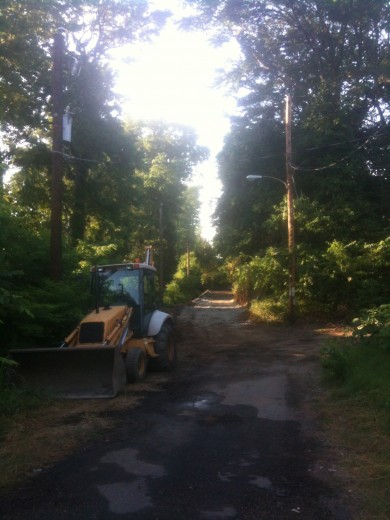
What is the City doing?

I suspect they are just creating a service alley before they figure out what they will do with 816 Riverside Park, but could this be part of a larger plan to reconnect Cherry Street with Riverside Parkway? Who has the skinny? Anybody, Historic Richmond?

Update: According to nearby neighbors, this relates to the larger plumbing work that is being done throughout the neighborhood.