
Virginia Water Environment Association Response on…Water?

This morning the Times Dispatch ran an editorial by Grace LeRose, the President of the Virginia Water Environment Association. I should note that I know Ms. LeRose, having met her personally during some of the hearings on the James River TDML. In particular, pet waste is one of our shared concerns in terms of water quality. Her editorial this morning continued on the water quality theme. But it seemed as if it was in response to a column that I had submitted earlier on City water rates. Her column begins-

Recently this paper published an opinion piece declaring the City of Richmond’s water fees to be “outrageous.” As president of the Virginia Water Environment Association (www.vwea.org), a nonprofit educational association of wastewater professionals dedicated to preserving Virginia’s water resources, I offer the following observations:

The water (and wastewater) industry has been called the single most important public health development in the past century, bringing clean water to our citizens while removing and treating wastewater in an efficient (oftentimes unseen) manner. The incidence of water-borne disease has almost been eradicated in our country. Funding for investment in water infrastructure came from many sources — rate payers, local governments (by selling bonds), state governments (matching grants or loans to communities that could not afford these improvements on their own) and finally, the federal government. Like the interstate highway system that helped the US grow after World War II, spending on water and wastewater systems brought health benefits and access to an expanding economic prosperity for all Americans.

The importance of water in our daily lives can hardly be overstated. Water industry professionals work tirelessly to protect public health, more than 3 million miles of rivers and streams, 40 million acres of lakes, 87,000 square miles of estuaries (including the Chesapeake Bay) and 95,000 miles of coastal waters. The infrastructure that supports this massive effort — 800,000 miles of water pipe and 600,000 miles of sewer pipe — lies below our feet every day. These systems have worked silently for years, in some cases more than a century, to deliver and remove water and wastewater. The water and wastewater utilities have done such a remarkable job of producing and delivering clean water out of the sight of the public that the public can be forgiven if they think water should be always available and always cheap. We are now learning that water may not always be available and will probably not be cheap.

Of course, none of this is wrong- however, LeRose begins this piece as if she is offering a rebuttal to my column, yet ignores the rate structure issue. LeRose is not addressing my column in which I criticized Richmond’s plan to hike the minimum water/sewer service charge to $49.40 per month. Deriving the lion’s share of the revenue for the city’s water works from the minimum service charge does not promote conservation. If I conserve this resource and got my water use to below 1 ccf, this month and yet my water/sewer bill is still $47.03 for 0 ccf of service (soon to be raised to $49.40). Richmond’s minimum service charge may be the highest of any city in the United States, and that allows the city to keep the volume rate artificially low. As a result, there is no financial incentive to conserve water in the Richmond.

In Hanover, the minimum service charge for the water/sewer bill is only $14.03 per month. This is less than a third of Richmond’s minimum monthly service charge. Hanover promotes conservation by giving a volume rate discount to those who use little water. Hanover offers a heavy discount for the first 4000 gallons of water volume, while the volume charge increases almost three fold for the next 11,000 gallons of water and increases again for over water volume in excess of 15,000 gallons. Richmond has this backward and offers a discount, not to those who use the least water, but to those who use the most volume: over 74,800 gallons of water.

Can we get the Virginia Water Environment Association and other groups to address this? The local Sierra Club is on board, but where is the N.A.A.C.P., James River Association, or the Richmond Crusade for Voters? What does it take for citizen concerns to gain attention and triumph over corporate control these days?
Charlies’ Letters

Neighbor Charles Pool’s letter got printed in the Times Dispatch today:

Proposed water and sewer hikes are outrageous

Editor, Times-Dispatch:

While commuters are protesting the proposed $1 monthly service charge for the E-ZPass, there is little notice as the city of Richmond quietly hikes the minimum monthly service charge for water and sewer to $49.40 per month.

How many cars would use the toll roads if those monthly service charges were raised to $49.40 a month? Unlike the toll roads, water service is a necessity and the city knows that no one will be digging a well in his backyard to avoid the rate hike.

We don’t have the option of turning off the water, but we can vote. Every candidate for city office in this election cycle should be challenged to explain why Richmond’s outrageous, minimum water and sewer bill is the highest in the country.

Charles Pool.

Richmond.

At least one other Charlie and City Council candidate is speaking up:

Let’s Reward Conservation of Our Resources
An opinion piece appeared in the Times Dispatch on May 24, 2012 addressing what we are charged for water and sewer in Richmond. After reading Scott Burger’s piece over many times, I tried to write a blog post in reference to the minimum fee method of charging us for the water we do or do not use. As I tried over and over, I realized that the only fair thing to do was to share the opinion piece with you, my supporters and potential supporters, in its original form.
It is simply unfair for a person who uses 1 CCF of water per month to pay an amount equal to or slightly less than the person who uses 10 CCF per month. People should be rewarded for their conservation, not punished for it.

Editor’s note: This does not constitute an endorsement of Diradour (…But what are other candidates saying?)

Re-Connecting Cherry Street to Riverside Park?

What is the City doing?

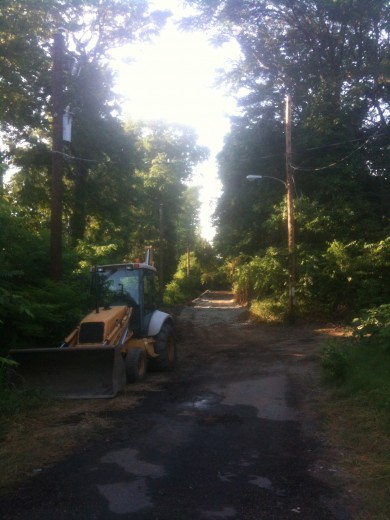
I suspect they are just creating a service alley before they figure out what they will do with 816 Riverside Park, but could this be part of a larger plan to reconnect Cherry Street with Riverside Parkway? Who has the skinny? Anybody, Historic Richmond?

Update: According to nearby neighbors, this relates to the larger plumbing work that is being done throughout the neighborhood.

Drip, drip, drip…here we go again.

I thought the message had already been sent, but I guess not. Hello Anti-Poverty Commission.

Excerpt from today’s Times Dispatch:

On an annual basis, Richmond’s minimum charge for water really puts a dent in the budget of a low-income resident. While in Norfolk the minimum annual cost per consumer for water/sewer service is only $12, in Henrico annually it is $195.24, and in Richmond annually it is a whopping $564.36!

This is a conservation issue: There is little incentive to conserve water in Richmond because the city finances the lion’s share of its water works through the minimum service charge. The cost per CCF of water is kept artificially low so you don’t feel much of a pinch when you use more water. It would encourage conservation if Richmond slashed the minimum service charge while raising the cost for each CCF of the resource.

This is a social justice issue: Richmond’s outrageous minimum water/sewer service charge shifts the burden of financing the city’s water supply disproportionally onto those who use the least water, and often unto those who can least afford it. For a senior citizen on fixed income, the water bill will often be the largest bill of the month, even if minimal water is used. It is unjust to require low-income residents of Richmond to pay a whopping $564.36 in minimum service fees annually just to be connected to the water supply. Water is a necessity that no one can do without.

Here is a revenue-neutral proposal. Let’s revamp Richmond’s water rates by lowering the minimum monthly charge for water and sewer service to $15 per month, while raising the cost per CCF of water in line with the neighboring counties. As sure as the spring showers, the summer droughts will follow. Richmond should have a price structure in place that encourages conservation of this important resource while giving those on fixed income a fair deal.

(Sorry if you are tired of editorials on this site this week. I did not have any control on when the TD piece would come out.)

Lots of Meetings Early This Week

I already mentioned the water pollution meeting on Wednesday, but there are a few other important meetings this week. Tonight the City’s anti-poverty commission seeks public feedback. While the meeting is in Gilpin Court, it would be interesting to include an Oregon Hill perspective. Tuesday, there is the monthly Oregon Hill Neighborhood Association meeting, but earlier the GRTC Task Force’s Macro Subcommittee will meet-

From City press release:

Richmond City Council GRTC and Transit Study Task Force has established and will hold two subcommittee meetings

All residents are invited and encouraged to attend

WHAT The Richmond City Council GRTC and Transit Study Task Force has established and will hold two subcommittee meetings. The subcommittees include: the Macro Subcommittee, which will focus on long range transit planning issues, and the Services Subcommittee, which will focus on bus users’ service issues.

The purpose of the Richmond City Council GRTC and Transit Study Task Force is to make recommendations to Richmond City Council with regard to enhancing mass transit in the Metro-Richmond area and the efficiency and effectiveness of the GRTC Transit System. The meeting is free and open to the public and all residents are invited and encouraged to attend.

The two Richmond City Council GRTC and Transit Study Task Force Subcommittee meetings will be held as follows:

Continue reading →

Important, Nearby, Water Pollution Public Meeting This Wednesday

From Virginia Conservation Network announcement:

You may be aware that over 10,000 miles of Virginia’s rivers and streams are considered unhealthy. Virginia is required to ensure its streams and rivers are clean, and develop a clean-up plan for waters that don’t meet those standards. Recently Virginia has developed one of these plans and will host a meeting to get your input on Wednesday, May 23rd from 2 to 4 pm in Richmond

(ed. at VCU!)

Continue reading →

By Request, Stormwater Education on Cigarette Butts

A faithful reader pointed me to the Rivanna Regional Stormwater Education Partnership website and specifically asked me to post information about cigarette butts.

From the site:

Many smokers discard their cigarette butts by the roadside or on the ground when they are driving or walking around out doors. Perhaps the prevailing view is that cigarette litter is too small to have a significant effect on water quality. Nothing could be farther from the truth.

Cigarette litter is often carried into storm drains when it rains, where it is deposited in local streams and rivers. Nationwide, smokers litter about 4.5 trillion cigarette butts annually. About 95% of cigarette filters are composed of cellulose acetate, a plastic that persists in the environment for years and even decades. Cigarette filters concentrate a number of very toxic substances, which are released into our waterways when they are washed off roads and sidewalks into storm drains.

Happy World Water Day….and local water issues

I hope everyone has had a nice World Water Day.

While there are a lot of international water issues, its as good as time as any to bring up water as a local issue.

So, a couple of things:

Despite all the earlier attempts to bring attention to the City of Richmond’s water rates, as far as I can tell this city still has the highest minimum residential water rate in the country.

Richmond continues its regressive water rates, offering a discount to those using vast amounts of water while maintaining the highest minimum water/sewer service charge in the country. Meanwhile, Henrico County’s minimum service charge is a third of Richmond’s while promoting conservation by offering a one-third discount in water/sewer volume charge for those using 6 ccf (hundred cubic feet) or less.

Continue reading →